Quick answer: Hire a fractional marketing executive the moment you need elite strategic leadership to build a scalable revenue engine, but you do not yet have the revenue to justify a $250,000 full-time CMO. Three inflection points signal this: stalled founder-led growth around the $5 million to $10 million mark, a major pivot or product launch, and a funding event where investors demand a rock-solid go-to-market plan without burning runway on a full-time salary. AI tools can execute tactics at scale, but they cannot replace the human judgment a fractional CMO brings to strategy and positioning.
You are looking at the monthly P&L, and one line item makes your stomach turn: the marketing budget. Your company needs to grow, so like most mid-market leaders, your first instinct was to hire someone to “do marketing.” You brought on a junior social media manager, signed a retainer with an external SEO agency, or started throwing cash at digital ads.
Six months later, you are frustrated. The data shows no predictable pipeline and no measurable revenue.
Most scaling companies misdiagnose this exact pain point. They assume they hired the wrong agency or the wrong employee. The real problem is usually simpler and more expensive: you are executing marketing tactics without a foundational strategy behind them.
So you are trying to figure out exactly when to hire a fractional marketing executive to fix the chaos. Most companies get this timing wrong. They either wait too long and burn hundreds of thousands of dollars on disconnected tactics, or they jump the gun and hire a bloated, full-time C-suite executive far too early.
This article covers:
- Why junior hires and the “tactical trap” quietly burn cash
- The three specific inflection points that signal you need a fractional CMO
- Why the “AI illusion” is a dangerous shortcut, not a real strategy
- Why a full-time CMO is often an expensive mistake for mid-market companies
1. Escaping the Tactical Trap: Why Junior Hires Burn Your Cash
The first clear sign you need a fractional marketing executive is when your company is stuck in what can be called the tactical trap.
This happens when the CEO or founder is still acting as the de facto head of marketing. Despite running a multi-million dollar business, you are the one approving ad copy, deciding which industry events to attend, and managing a chaotic roster of freelance writers and content creators.
Because you are busy running the company, marketing happens in erratic fits and starts. Your go-to-market motion becomes reactive instead of intentional.
To relieve the pressure, founders often make a classic mid-market mistake: hiring a junior marketing coordinator. They bring in an enthusiastic professional at a $60,000-a-year salary and hand them the keys to the entire revenue engine. A few months later, the founder is frustrated because this junior hire is not driving business strategy.
Be realistic here: a $60,000-a-year tactical coordinator cannot build a comprehensive, multi-million dollar go-to-market engine. They simply do not have the years of pattern recognition required, even with heavy use of AI tools.
This is where a fractional executive steps in and takes the burden off the CEO’s shoulders. A fractional CMO is a senior, experienced leader who works on a permanently part-time basis and is embedded directly in your leadership team. They take ownership of high-level strategy, which frees the CEO to focus on running the business. Bringing in this level of leadership also means your junior tactical team finally gets the mentorship and direction they need to execute effectively.

2. The Three Critical Inflection Points for Fractional Leadership
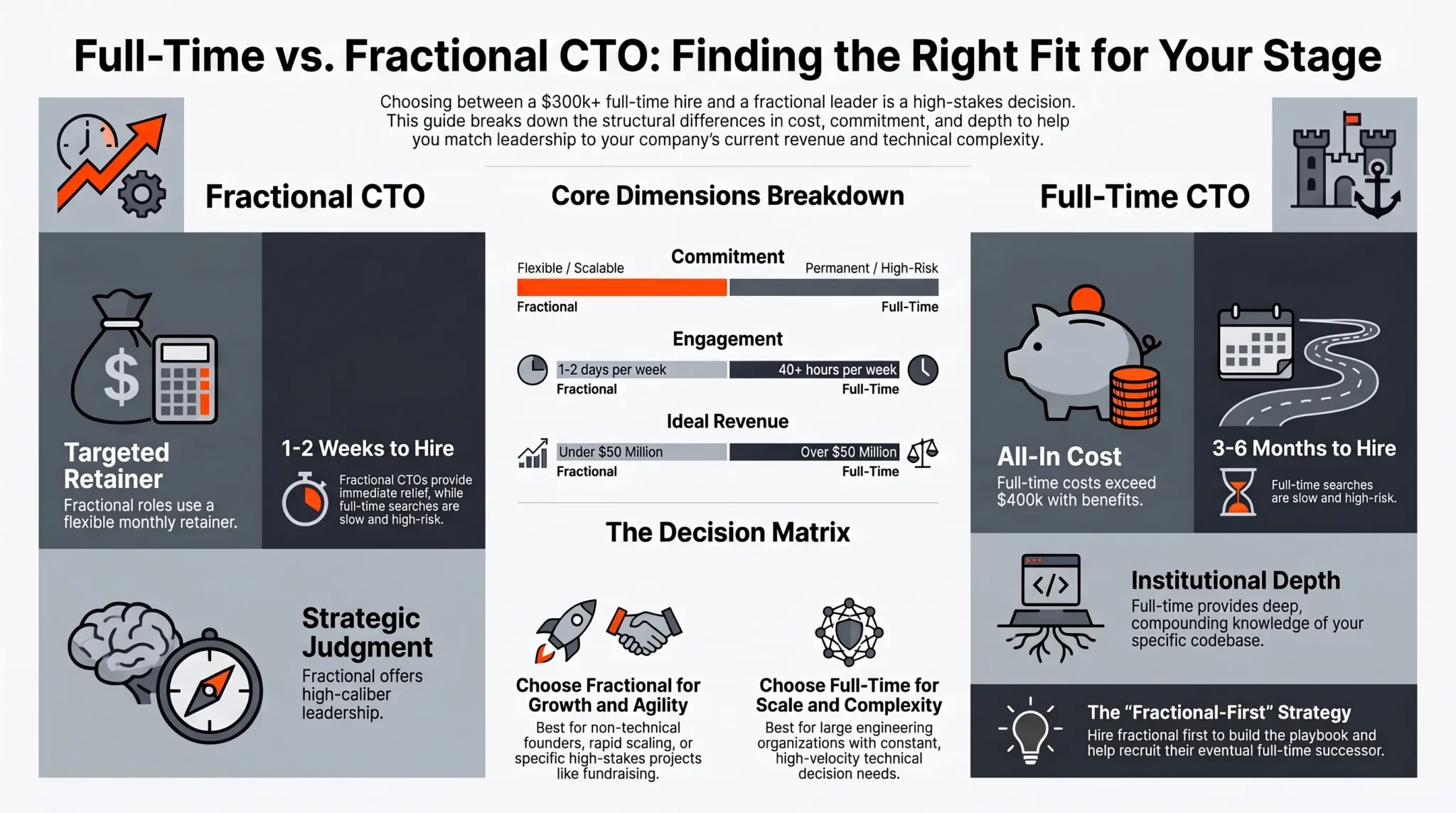
The simplest answer to “when to hire a fractional marketing executive” is this: you hire one the moment you need elite strategic leadership to build the revenue engine, but you do not yet have the revenue to support a $250,000 full-time CMO.
A fractional marketing executive assesses the landscape, builds a rigorous strategy, and manages the internal team to execute it. Operationally, there are three specific inflection points in a B2B company’s lifecycle when hiring a fractional CMO is the smartest, highest-ROI move a CEO can make.
Inflection Point 1: The Stalled-Growth Phase
You pushed your company to the $5 million or $10 million revenue mark through founder-led sales hustle and organic word of mouth. That scrappy early engine is now tapped out. You have exhausted your personal network, and growth has stalled. To break through to the next revenue tier, you need a predictable, scalable marketing system, an architect to build a machine that works while you sleep.
Inflection Point 2: The Pivot or Launch Phase
Your business is entering a competitive new market, launching a major product line, or repositioning its brand narrative. In these high-stakes moments, you need high-level strategic guidance so the launch does not fall flat. A fractional CMO provides the expertise required for a flawless launch, but you do not need to absorb that level of strategic overhead forever. Once the strategy is built and the launch succeeds, the fractional leader can scale back their hours.
Inflection Point 3: The Funding Phase
Your company is entering the world of institutional capital. You are preparing to raise venture capital or private equity and need a rock-solid, investor-grade go-to-market strategy for the board. Or you just closed a funding round, and investors are demanding immediate, disciplined execution. You need a heavy-hitting executive to deploy that capital efficiently, but you do not want to burn your new runway on a full-time executive salary.
If your organization is in any of these three phases, a fractional marketing executive is the right strategic hire.

3. The Danger of the “AI Illusion”
Before hiring senior marketing leadership, address a common misconception. An alarming number of CEOs believe they no longer need a marketing leader because they have access to ChatGPT and other generative AI tools.
This is the “AI illusion.” Founders assume that because AI can write blog copy, build email campaigns, and generate basic leads, the need for a senior marketing mind has disappeared.
Here is the reality: AI cannot build a nuanced strategy that deeply understands your specific business the way a human executive can. You can ask an AI to build a strategy, but it will produce something generic and watered down, making your company sound like every competitor.
AI is an excellent execution tool, but it needs a human executive to guide it intelligently. A strong go-to-market engine requires a leader who understands the nuances of your industry vertical, the psychology of your premium B2B buyers, and how to architect differentiated positioning in a crowded market.
A fractional executive does not try to replace AI. They harness it, using AI tools to execute tactical work at scale, which frees them to focus on the high-level, human strategy that actually drives predictable revenue. Relying entirely on an AI chatbot for strategic thinking is a race to the bottom. Winning requires a human leader at the helm.
4. The 40-Hour Executive Fallacy: Why Full-Time Is an Expensive Mistake
If you recognize you are in a stalled growth phase, and you recognize AI cannot save your strategy, your next instinct might be to hire a traditional, full-time Chief Marketing Officer.
Hiring a full-time CMO too early is often an expensive, destructive mistake, the same mistake companies make when they hire a full-time CFO before they truly need one, instead of using a fractional CFO.
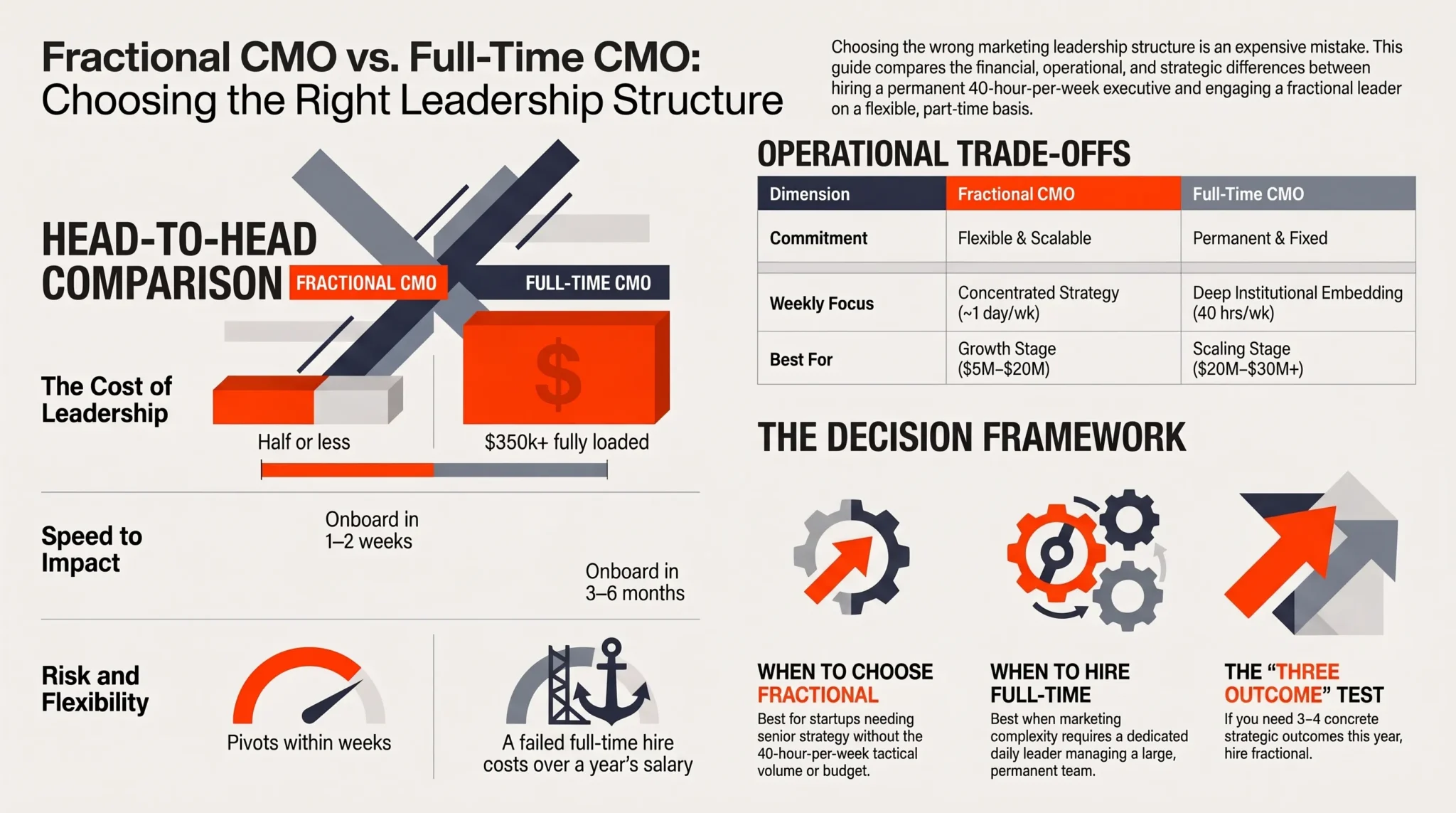
Look at the operational math. A company in the $5 million to $20 million revenue range hiring a full-time CMO pays a premium for top-tier strategic thinking: a $250,000 base salary, performance bonuses, and equity. But a company of that size does not need 40 hours a week of pure strategy. It lacks the organizational complexity to keep a visionary executive fully occupied.
What a $15 million company actually needs is closer to 10 hours of world-class strategy and 30 hours of tactical execution.
So what happens when you hire that full-time executive anyway? The expensive CMO finishes their strategic mandate quickly, looks at an empty calendar, and fills 30 hours with $50-an-hour tactical work just to justify the salary. You end up with a quarter-million-dollar executive formatting spreadsheets, writing basic email copy, and tinkering with CRM settings. Eventually they get bored with the low-level work and leave.
A fractional marketing executive solves this by operating on a permanently part-time basis. You secure the elite talent you need to break through growth ceilings, at a fraction of the full-time cost, then use the savings to hire junior tactical staff or fund marketing campaigns directly.
Comparison at a glance:
| Full-Time CMO | Fractional CMO | |
| Typical annual cost | Around $250,000 plus bonus and equity | A fraction of full-time cost |
| Weekly strategic hours needed at $5M-$20M revenue | Roughly 10 of 40 hours | Scoped to actual need, often 10-15 hours |
| Risk of idle time filled with low-value tasks | High | Low, since engagement is scoped |
| Flexibility to scale up or down | Low, fixed headcount | High, hours adjust with the business phase |
| Typical fit | Complex, high-headcount marketing orgs | Mid-market companies at $5M-$20M revenue |
Whether you need a fractional CMO, a fractional CEO for a turnaround, or a fractional COO to streamline operations, the model is built on efficiency and, more importantly, on guaranteed outcomes.
Key Takeaways
- The tactical trap happens when a founder is still running marketing personally or has handed it to a junior hire who cannot build strategy.
- Three inflection points signal it is time for a fractional CMO: stalled founder-led growth, a major pivot or launch, and a funding event.
- AI can execute tactics at scale but cannot replace human strategic judgment. Relying on AI alone for strategy leads to generic, undifferentiated positioning.
- Full-time CMOs are often overkill for companies in the $5 million to $20 million range, since most only need about 10 hours a week of true strategic work.
- A fractional CMO gives you elite strategic leadership at a fraction of full-time cost, with the flexibility to scale hours up or down as the business phase changes.
Frequently Asked Questions
Question: When is the right time to hire a fractional marketing executive?
Answer: The right time is when you need elite strategic leadership to build a scalable revenue engine, but you do not yet have the revenue to justify a full-time $250,000 CMO. This typically shows up at three points: stalled founder-led growth around $5 million to $10 million in revenue, a major pivot or product launch, and a funding event that demands a strong go-to-market plan without burning runway on a full salary.
Question: What is the “tactical trap” in marketing?
Answer: The tactical trap is when a company runs disconnected marketing tactics, like ads, social media, and content, without an underlying strategy connecting them. It usually happens because the founder is still acting as the de facto marketing lead, or because a junior hire has been given responsibility for strategy they are not equipped to build.
Question: Can AI tools replace the need for a fractional CMO?
Answer: No. AI tools are strong at executing tactical work at scale, such as drafting copy or building campaigns, but they cannot build a nuanced strategy tailored to a specific business, industry, and buyer psychology. Companies that rely on AI alone for strategy tend to produce generic positioning that looks like their competitors.
Question: Why is hiring a full-time CMO often a mistake for mid-market companies?
Answer: Companies in the $5 million to $20 million revenue range usually do not have enough complexity to keep a full-time CMO occupied with strategic work for 40 hours a week. A common pattern is that the executive finishes strategic work in about 10 hours, then fills the rest of the week with lower-value tactical tasks, which is an inefficient use of a six-figure salary and often leads to turnover.
Question: How much does a fractional CMO cost compared to a full-time CMO?
Answer: A full-time CMO is often benchmarked around $250,000 a year, plus bonuses and equity. A fractional CMO typically costs a fraction of that, since the engagement is scoped to the actual hours of strategic work needed, often closer to 10 to 15 hours a week rather than a full 40-hour role.