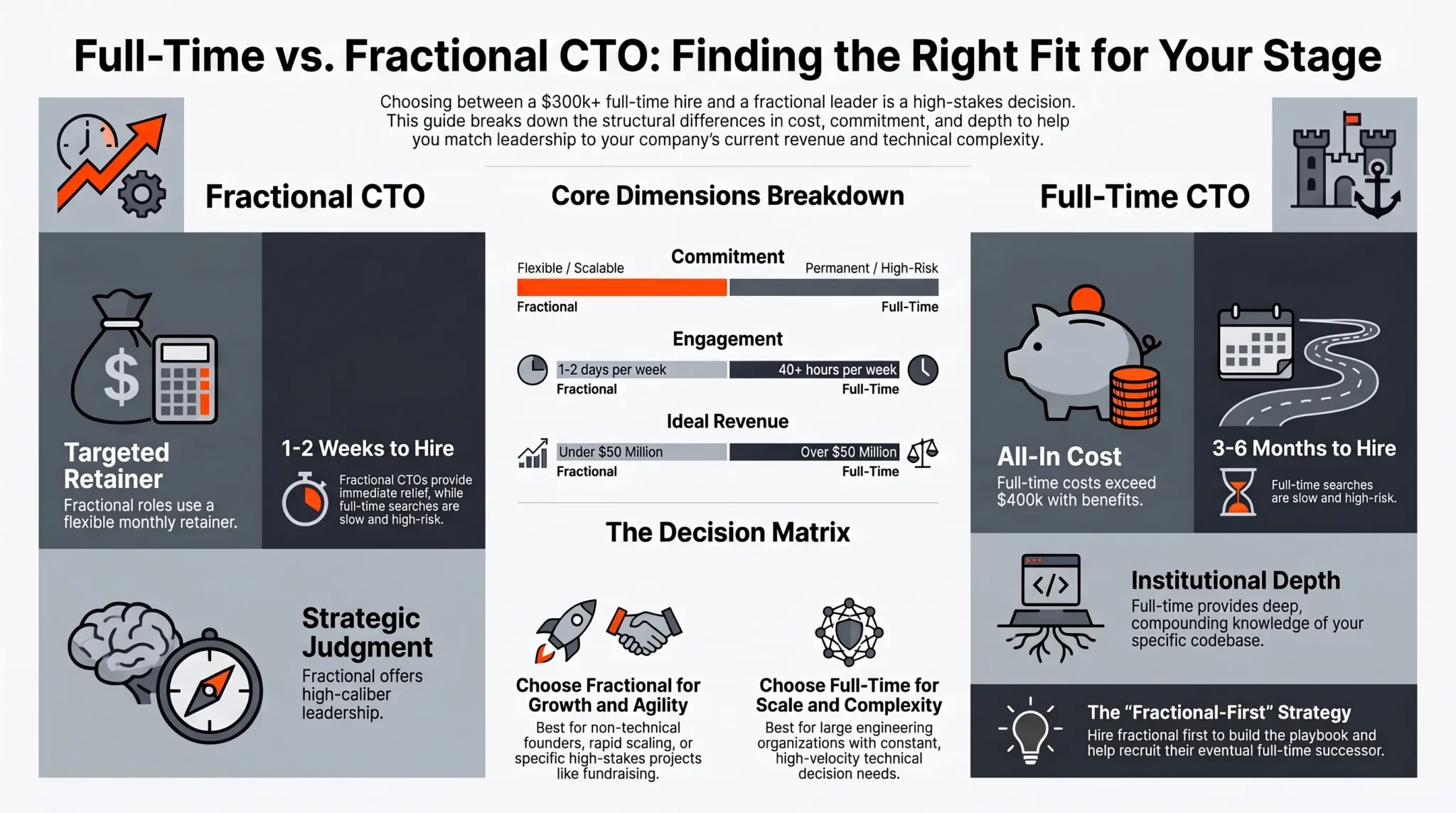
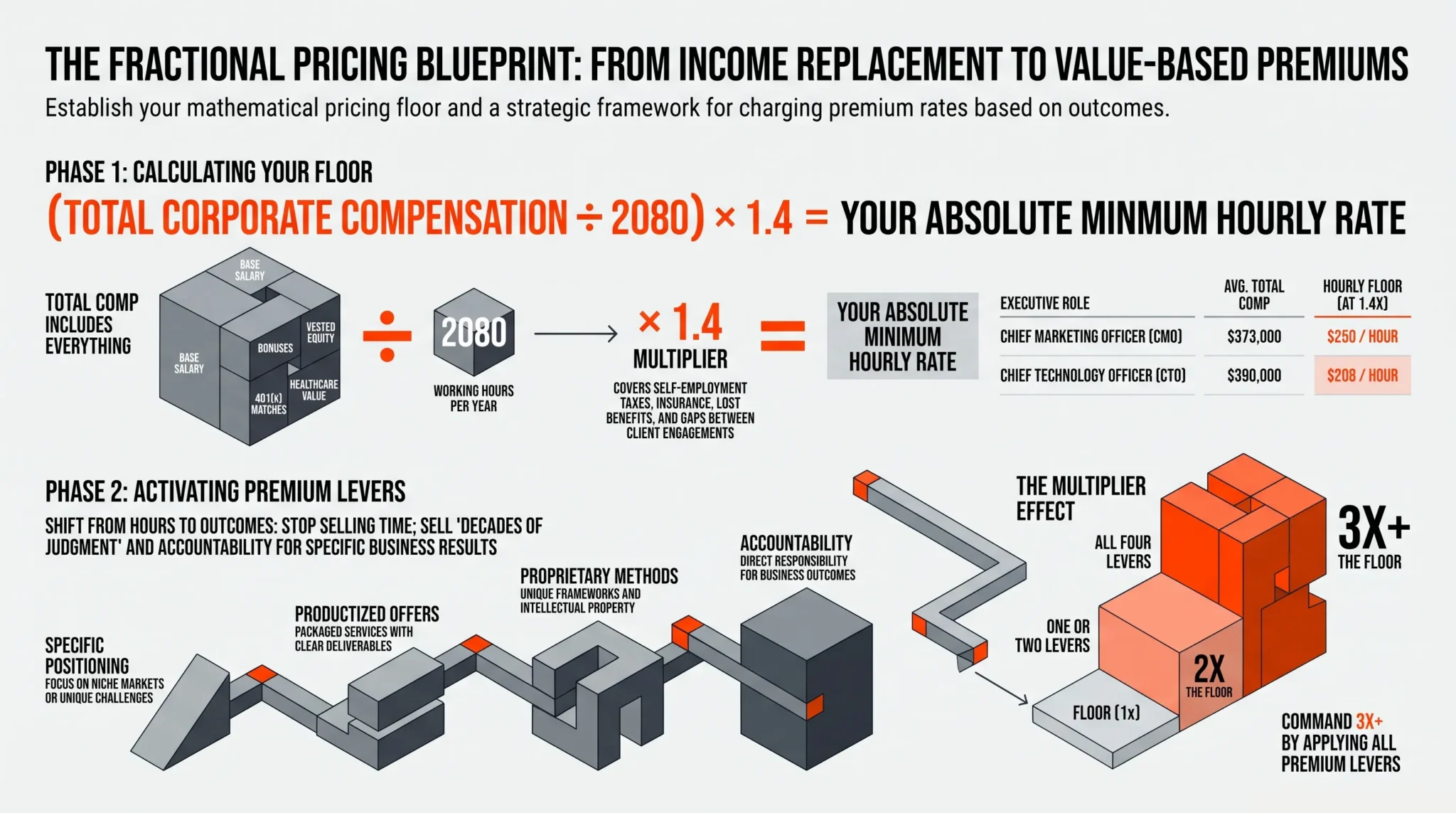
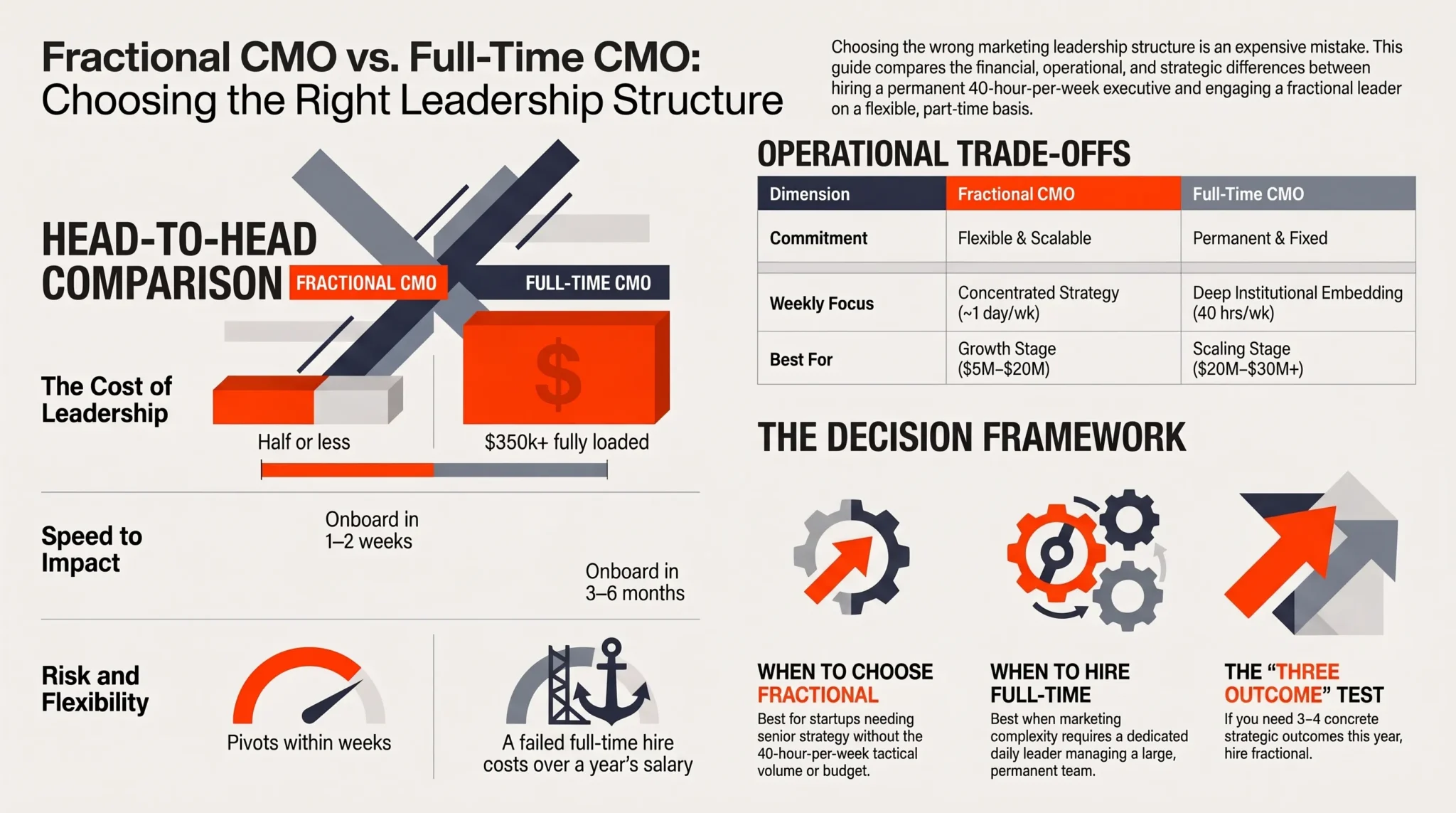
Quick answer: After quitting a corporate executive job, the highest-leverage move is not to search for another full-time W-2 role, it is to become a fractional executive. This means selling your existing expertise part-time to three or four scaling companies instead of full-time to one. It diversifies your income so one client’s downturn will not wipe out your livelihood, it removes most corporate politics and internal meetings from your week, and it can match or exceed a corporate salary while working roughly three days instead of five. The main barrier is client acquisition, which is solved with a referral-based positioning system, not cold sales.
You finally did it. You quit your corporate job. Or maybe you are sitting at your desk right now, staring at your laptop, quietly planning your exit. You spent decades climbing the corporate ladder, navigated the politics, secured the C-suite title, and earned the salary. Yet day to day, you feel exhausted, unfulfilled, and burned out.
The moment you hand in your resignation is exhilarating. Then the euphoria fades, and a terrifying question hits: what do I do now?
Most capable executives make the same mistake at this exact crossroads. The silence of an empty calendar terrifies them, so within weeks they jump back into another demanding W-2 role they will likely resent within six months.
If you want a sustainable, lucrative future, resist the urge to retreat to the familiar. This article covers:
- Why the traditional executive job search is broken
- Why financial security actually comes from diversification, not a single paycheck
- Why fractional work gets you back to the work you actually love
- The real math behind replacing a corporate salary with fewer hours
- How to find clients without becoming a sleazy salesperson

1. The Broken Executive Search: A Different Logo on the Same Building
You know exactly how the traditional corporate exit goes. You leave a high-level role, update your LinkedIn, call a few executive recruiters, and start interviewing for another VP or C-suite position.
You tell yourself this time will be different: a better culture, a more innovative product, a more understanding board. But deep down, you know what is waiting on the other side of that offer letter: the same politics, the same endless alignment meetings, the same burnout. You are trading your current misery for a different logo on the building.
The first thing to realize is that the traditional W-2 executive role is a trap. When you work full-time for one company, they own your time, your calendar, and how and when you take a vacation, and they place a ceiling on how much you can earn. You are trading the best years of your professional life for the illusion of safety.
If you genuinely want to know what to do after quitting your corporate job, the answer is simple: stop looking for a boss, and start looking for clients.
You step out of the W-2 trap and become a fractional executive. Instead of giving 100% of your time and loyalty to one company that can lay you off on a random Tuesday, you take the same elite expertise and sell it to three or four scaling companies on a permanent part-time basis.
2. The Illusion of Security and the Power of Diversification
The main reason executives fear leaving corporate life is a perceived loss of financial security. They cling to the paycheck because it feels safe. Look honestly at what that “security” really looks like.
Being a full-time corporate executive means zero diversification. You have placed your entire financial future in one fragile basket. If that company has a bad quarter, or a new CEO wants their own hand-picked team, your income can go to zero overnight, and you are left scrambling to pay your mortgage.
You did not spend 20 or 30 years building elite expertise to have your family’s security controlled by one person’s mood.
Becoming a fractional executive instantly diversifies your financial risk. Imagine a portfolio of three premium clients. If one client experiences a downturn or simply churns, you still retain roughly 66% of your income. You are not panicking, you are simply using your existing systems to find another high-value client to fill the open slot.
Operating under fractional C-Suite roles gives you back control of your career. True security does not come from a single paycheck. It comes from the ability to predictably generate revenue from multiple, diversified sources.

3. Escaping Corporate Bloat: Getting Back to the Work You Love
Beyond financial control, the second compelling reason for this shift is the work itself.
Think about your last corporate C-suite job. Over the last six months, how much of a grueling 60-hour week was actually spent on high-level strategic work that moved the business forward? For most senior executives, the honest answer is maybe 20%.
The other 80% went to managing fragile internal politics, sitting in circular cross-departmental meetings, and handling exhausting HR issues. You were hired to be a visionary leader, but you functioned as an administrative babysitter.
When you transition into fractional work, that corporate overhead disappears. Scaling mid-market companies do not hire a fractional CEO or CFO to sit in internal committee meetings. They hire you for your strategic brain, and they do not want you bogged down in office politics.
Founders want you to assess the situation, build a solid strategy, and drive results. Removed from the daily drama of a full-time employee base, you can operate with clarity and efficiency. Working across multiple companies and industries also makes the work interesting again. You get to parachute in, solve complex problems, see the direct impact of your frameworks, and move on to the next challenge.
4. The Mathematics of Freedom: Decoupling Time From Income
The final, often most paralyzing barrier is fear of the math. Many successful people are afraid to leave a large corporate salary. Look at the actual numbers.
If you make $200,000 a year in a corporate C-suite role, you are likely working 50 to 60 hours a week. Factor in evening emails and weekend catch-up, and your real hourly rate is shockingly low.
Now compare that to the math of a fractional practice. As a fractional executive, you can charge $5,000 to $15,000 a month per client for roughly one focused day of work per week. Being conservative, if you secure three clients at $6,000 a month each, you generate $18,000 a month, or $216,000 a year, while working roughly three days a week.
Comparison at a glance:
| Full-Time Corporate Executive | Fractional Executive (3 clients) | |
| Typical annual income | Around $200,000 | Around $216,000 or more |
| Typical hours worked per week | 50 to 60 | Roughly 15 to 24 (3 days) |
| Income sources | One employer | Multiple clients |
| Risk if one relationship ends | Total income loss | Partial loss, income continues from other clients |
| Control over schedule | Employer-dictated | Self-directed |
| Ceiling on earnings | Fixed by employer | Set by number and size of clients taken on |
That math represents a real transformation. You replace your corporate salary and claw back roughly two days a week. What you do with those two days is your choice: take on a fourth client and push earnings past $300,000, or use the time for family, rest, or anything else that was missing from the corporate grind.
Building a fractional practice permanently decouples your time from your earning potential. You are no longer paid for hours at a desk. You are paid a premium for the enterprise value your pattern recognition creates for a scaling company.
5. The Elephant in the Room: Client Acquisition Without the Sleaze
We have covered the benefits, the freedom, and the math. The remaining question is client acquisition.
Right after you quit, the adrenaline fades and panic sets in. You look at your empty inbox and think: I am a brilliant operator, but I am not a salesperson. How am I supposed to find high-value clients?
That fear is natural. In the corporate world, work was handed to you. As an independent business owner, you have to go get it. If you try to sell your services the way a mid-level consultant does, you risk getting trapped in a cycle of low-paying project work or aimless outreach.
Here is the reframe that fixes this: you do not need to become an aggressive salesperson. You need a system, not a hustle.
You need a predictable pipeline that engineers word-of-mouth referrals and positions you as the obvious choice for a CEO’s specific problem. Whether you are a fractional CMO building a revenue engine or a fractional CFO restructuring a balance sheet, your marketing should broadcast authority, not desperation.
When a stressed founder finds you through a well-engineered referral pipeline, the power dynamic shifts. You are not pitching. You are diagnosing a painful problem and offering your framework as the solution. You act as an authoritative peer, not a vendor chasing a deal.
The Bottom Line: Build Your Own FractionalOS
So, when we really talk about what to do after quitting your corporate job, we are talking about one clear shift: you do not have to go back to the exhausting corporate grind.
It means having the clarity and courage to see that the old W-2 model is broken, and that true long-term security comes from spreading your income across several high-value clients.
It means going back to the powerful strategic work you enjoy, without the toxic load of corporate politics. And it means seeing that you do not need to become a sleazy salesperson. You need a smart, clear system that can draw the right premium clients to you.
When you make this big shift, everything changes. You stop spending your best years building someone else’s dream, and you start building your own strong fractional operating system.
Now that you know what to do after quitting, and how to map out your new fractional business, your next step is execution. If you want to see how to turn these ideas into a scalable client pipeline, you need to learn the basic mechanics of client acquisition.
I highly recommend that you watch this video next: The System Behind a Predictable Pipeline for Fractional Executives. In that video, you will see how to turn these marketing ideas into one system that runs in the background and brings in high-value leads, even when you are busy serving current clients.
Stop waiting for a corporate board to set your worth. Claim your clear executive authority, embrace the freedom of the fractional model, and step fully into your power as a premium independent business owner. Go watch that video next.
Key Takeaways
- After quitting a corporate executive job, going fractional is often a stronger move than searching for another full-time role, since it diversifies income across multiple clients instead of one employer.
- A single-employer paycheck feels safe but carries concentrated risk. A portfolio of three or four clients means one loss does not eliminate your income.
- Fractional work removes most internal politics and low-value meetings, returning your time to actual strategic work.
- The income math often favors fractional: three clients at a few thousand dollars a month each can match or exceed a corporate salary at roughly half the hours.
- Client acquisition should run on a referral and positioning system, not cold sales or freelance marketplaces.
Frequently Asked Questions
Question: What should I do after quitting my corporate executive job?
Short Answer: Rather than immediately searching for another full-time W-2 role, consider becoming a fractional executive. This means selling your existing expertise part-time to several scaling companies instead of full-time to one employer, which diversifies your income and gets you back to strategic work instead of internal politics.
Question: What is a fractional executive, and who is it for?
Short answer: A fractional executive is a senior leader who sells C-suite skill part-time to several growing companies on a long-term, part-time basis. It is for experienced VPs and C-suite leaders who want high-impact strategy without the grind of a full-time job, office politics, and endless meetings.
Question: How many clients should I take on, and how do I structure my week?
Short answer: Most fractional executives work with three to four premium clients, and they usually spend about one focused day a week per client. That gives you about a three-day workweek with three clients, and the extra time can go to a fourth client, rest, family, or business growth.
Question: Is it risky to become a fractional executive instead of finding another full-time job?
Answer: A single full-time job concentrates all of your income risk in one employer, so losing that role can eliminate your income overnight. A fractional practice with three or four clients spreads that risk, since losing one client typically leaves the majority of your income intact while you replace the lost work.
Question: How much can a fractional executive earn compared to a full-time executive salary?
Answer: Fractional executives commonly charge $5,000 to $15,000 a month per client for roughly one day of focused work a week. Three clients at $6,000 a month each generates about $216,000 a year, which can match or exceed a $200,000 corporate salary while working closer to three days a week instead of five.
Question: How do fractional executives find clients without cold selling?
Answer: Most successful fractional executives build a referral-based positioning system rather than relying on cold outreach or freelance marketplaces. This involves signal-based targeting, clear authority-driven messaging, and word-of-mouth referrals, so prospects approach as a founder seeking a solution rather than being pitched as a sale.
Question: Does going fractional mean giving up job security?
Answer: Traditional job security depends on one employer’s decisions, which you do not control. Fractional work replaces that with diversified income across multiple clients, which many executives find more stable, since no single client relationship determines their entire livelihood.
Question: Why is a portfolio of clients safer than one secure paycheck?
Short answer: A single employer puts all your risk in one place. One bad quarter or reorg can cut your income to zero. With three or four clients, losing one usually leaves about 66% of your income in place while you fill the open slot. That turns weak income into spread-out risk and more control.