Quick answer: A fractional C-suite executive is an embedded, part-time leader, not a consultant, who takes full accountability for a specific business outcome (revenue, cash flow, operations) rather than just delivering advice or a report. Mid-market companies ($5M–$50M revenue) are moving away from full-time $250K executives because most roles at that size only need 10 hours a week of true strategic leverage, with the rest better spent on tactical execution. Fractional leaders are paid for outcomes, not hours on a timesheet.
For fifty years, the mark of a scaling business was a heavy, expensive C-suite. Founders and boards believed that crossing the $10 million or $50 million revenue mark meant hiring a full-time $250,000 CMO, CFO, and COO, no way around it.
That model is now quietly breaking down, and in the mid-market, it’s actively hurting margins.
Companies are realizing they don’t need a full-time executive to solve a specific, complex problem. They need the right expertise, applied at the moments of highest leverage. That realization has fueled the rise of the fractional executive, but most founders and professionals still misunderstand what the term actually means. Get the definition wrong, and you’ll position yourself out of the market, whether you’re hiring or building a fractional practice.
This article covers:
- The critical difference between a fractional executive and a “part-time consultant”
- Why full-time C-suite hiring is a costly mistake for mid-market companies
- How fractional leaders operate day to day (strategy, mentorship, and hard calls)
- Why unrelenting accountability is the model’s core differentiator
1. The Definitional Crisis: You Are Not a “Part-Time Consultant”
Most people hear “fractional executive” and assume it means a part-time consultant. That assumption is a fundamental misunderstanding of the business model.
Position yourself as a part-time consultant to a scaling founder, and you’ll be treated like an external vendor, micromanaged, haggled over hourly rates, and viewed as replaceable.
A true fractional C-suite executive is not an external advisor; they’re an embedded internal leader. They step directly into the chaos of a scaling company, take total accountability for a specific business outcome, and execute it on a part-time basis. They aren’t there to hand over theoretical advice and walk away. They build the operational engine, run the internal team, and own the results.
The simplest definition: a fractional executive is a hardcore operator, not a passive advisor.

2. Fractional Executive vs Consultant: Deliverables vs. Outcomes
This is the line where you either command premium strategic rates or get relegated to the tactical freelancer pile.
Consultants sell deliverables. A traditional consulting firm spends three weeks interviewing staff, analyzes the situation, and hands the CEO a 50-page slide deck, hen leaves the execution to an exhausted internal team.
Fractional executives sell guaranteed business outcomes. As a fractional CMO, fractional CFO, or fractional COO, your job isn’t to diagnose the problem from the sidelines, it’s to fix it. You manage the departmental budget. You hire and fire team members. You run the weekly leadership meetings. You take unshakeable accountability for the metrics you were brought in to move.
The only real difference between you and the full-time executive at the next desk is that you execute the mandate in two days a week instead of five. Position yourself this way, and the room stops treating you like a disposable vendor and starts treating you like a strategic partner.
3. Why Full-Time Leadership Is an Expensive Mid-Market Mistake
Understanding the definition matters but understanding the market shift explains the demand.
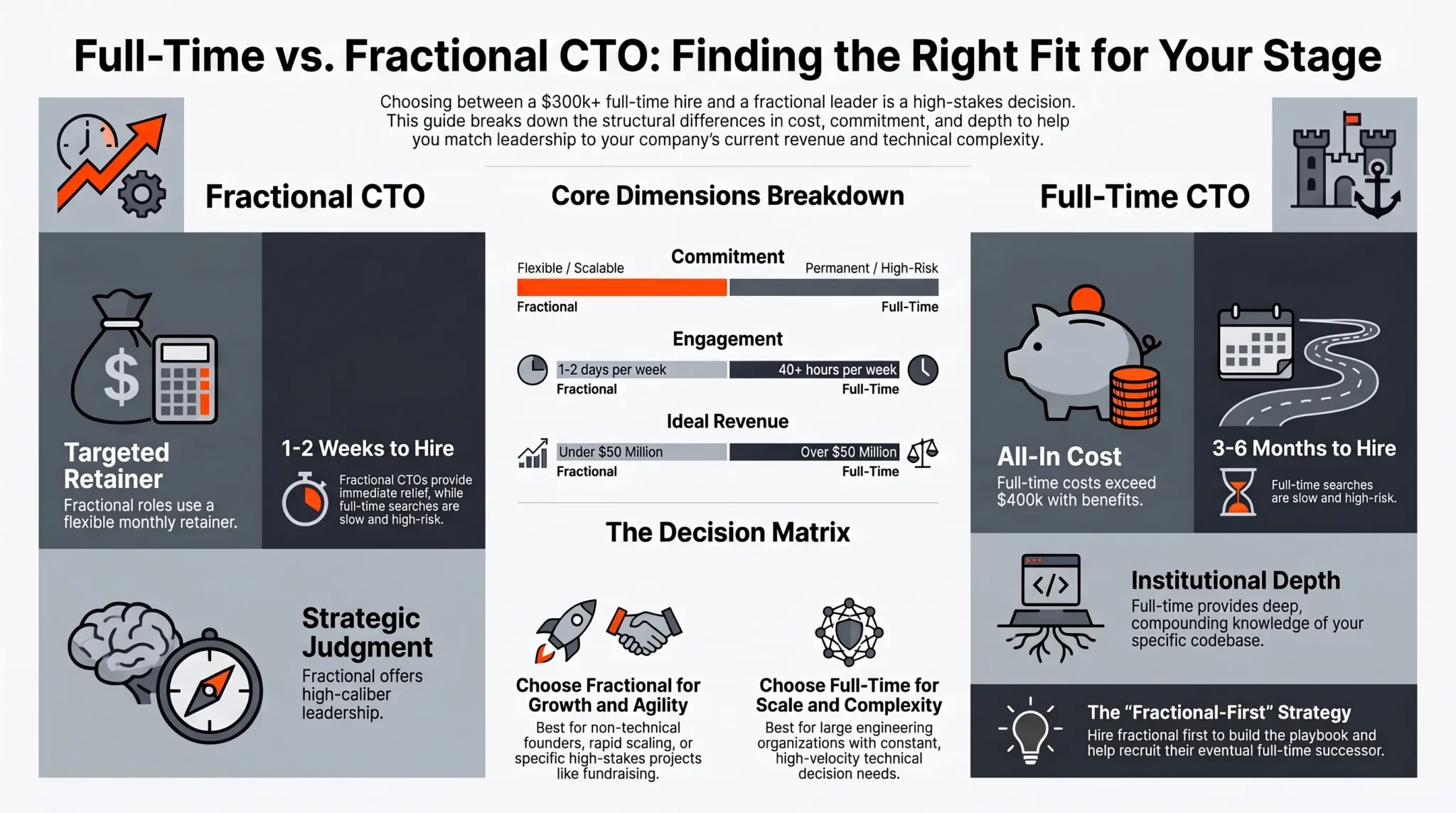
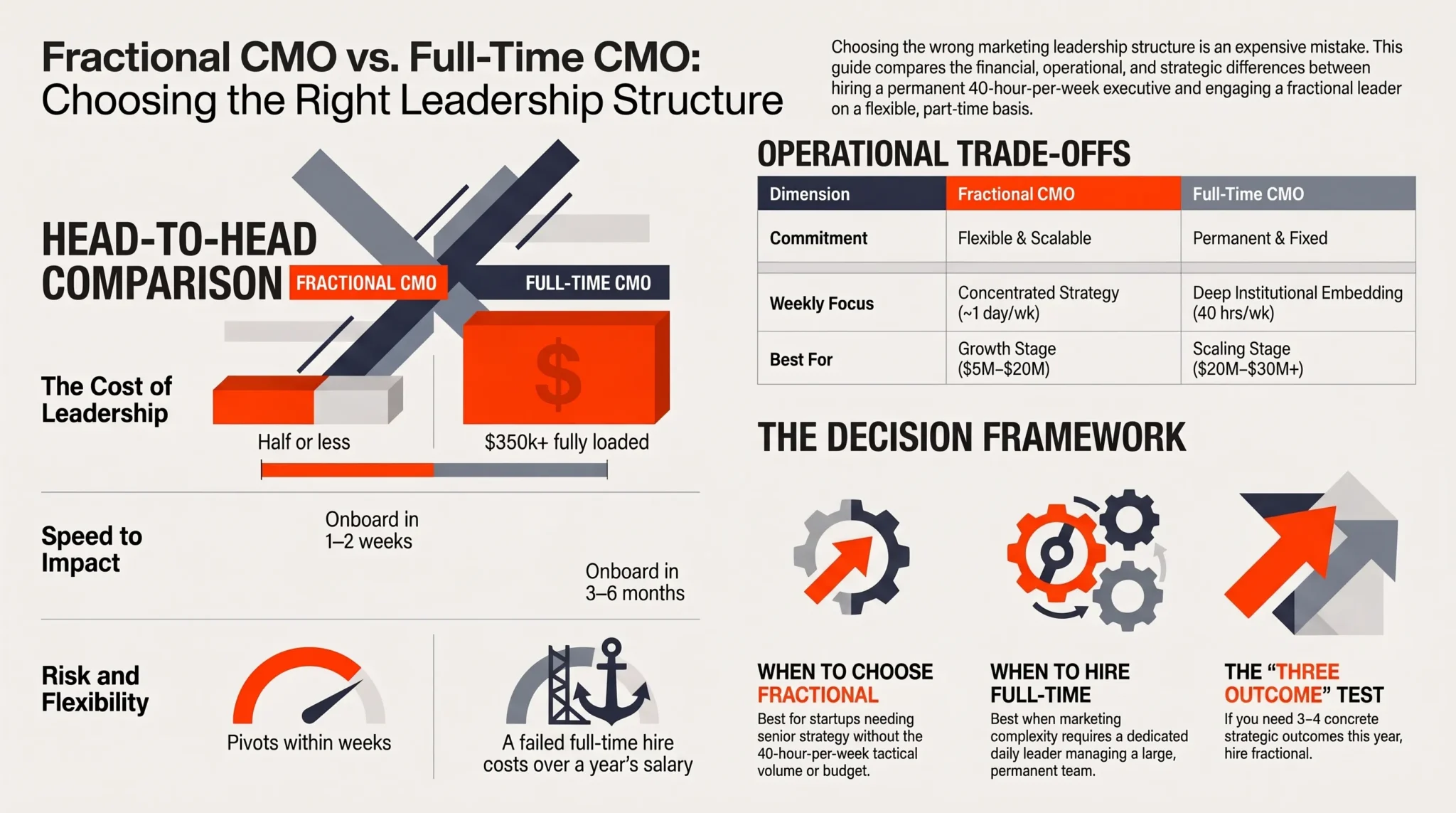
For scaling companies in the $5 million to $50 million revenue range, hiring a full-time C-suite executive is often a costly mistake. Here’s the math:
A $15 million company genuinely needs the pattern recognition of a $250,000 CFO, for debt restructuring, an acquisition, or complex financial modeling. But that company doesn’t need 40 hours a week of strategic thinking. It typically needs:
- 10 hours a week of elite, high-level strategy
- 30 hours a week of lower-level tactical execution
Hire that executive full-time anyway, and a predictable pattern emerges: they finish their strategic mandate for the week, then fill the remaining hours with $50-an-hour tactical work , tinkering with spreadsheets, micromanaging junior staff, doing admin tasks just to justify the salary. That’s a poor use of capital, and it drives executive boredom and turnover.
The fractional model solves this directly.It gives companies access to elite talent at a fraction of the full-time cost, aligned specifically to moments of highest strategic leverage.
The core mindset shift: your value isn’t rooted in hours at a desk. It’s rooted in how fast you can accurately diagnose a complex problem and how reliably you can implement the fix. You’re paid for pattern recognition, not timesheet presence.
4. Taking Point: Strategy, Mentorship, and the Hard Calls
A true fractional executive is on point for strategy and leadership, not just executing tasks in a silo. You’re the architect of your department.
Whether you step in as a fractional CEO navigating a turnaround or a fractional CMO building a revenue engine, the operational posture is the same: set the vision, define the departmental strategy, and lead the internal team to execute it.
This level of leadership includes things a standard consultant would avoid:
- Managing people directly and mentoring junior staff — including training an internal team to eventually replace you
- Making the hard calls — firing underperformers, killing failing initiatives
- Sitting in confidential executive meetings, aligning departmental goals with the CEO’s broader objectives
When something goes wrong in your department, the CEO looks to you for answers. When the company hits a major milestone, you rightfully share the credit. This is what separates a true fractional executive from a freelancer or temporary contractor — you’re a leader first, not a pair of rented hands.

5. The Ultimate Differentiator: Unrelenting Accountability
Fractional executives don’t hide behind disclaimers. They own the results.
A traditional consultant’s job ends the moment the invoice is paid and the strategy report is delivered. A fractional executive’s job ends when the agreed-upon outcome is actually hit, the revenue target reached, the cash flow stabilized, the supply chain streamlined.
This alignment of incentives is what makes the model powerful for both sides. You’re not racking up billable hours to pad an invoice. You’re motivated to deliver maximum impact in minimum time.
Comparison at a glance:
| Traditional Consultant | Fractional Executive | |
| What they sell | Deliverables (reports, audits) | Outcomes (results, metrics) |
| Engagement ends when | Invoice is paid | Target is hit |
| Team involvement | Advises from outside | Hires, manages, mentors from inside |
| Accountability | Limited to recommendations | Full ownership of results |
| Perceived as | External vendor | Embedded strategic partner |
When you take unrelenting accountability for results, you shift in the CEO’s mind from a recurring expense on the P&L to a strategic investment with a measurable return. That shift , from expense to investment, is the core of what it means to be a fractional C-suite executive.
Key Takeaways
- A fractional executive is an embedded operator who owns outcomes, not a part-time advisor who hands over recommendations.
- Mid-market companies ($5M–$50M revenue) often need only 10 hours a week of true strategic leverage. Full-time hires waste the remaining time and budget on low-value tactical work.
- Fractional executives manage budgets, hire and fire staff, and run teams. They don’t just advise from the sidelines.
- The model works because incentives are aligned: you’re paid to deliver an outcome, not to accumulate billable hours.
- Positioning yourself as accountable for results (not deliverables) is what shifts you from “vendor” to “strategic partner” in a founder’s mind.
Frequently Asked Questions
Question: What is a fractional executive?
Answer: A fractional C-suite executive is an embedded, senior operator who takes on a specific role (CEO, CMO, CFO, or COO) on a part-time basis, typically two to three days a week. Unlike a consultant, they don’t just advise; they manage budgets, lead internal teams, and take full accountability for a defined business outcome.
Question: What’s the real difference between a fractional executive and a consultant?
Answer: Consultants sell deliverables (reports, audits, and recommendations) and their engagement typically ends once those are handed over. Fractional executives sell outcomes: they stay embedded, run the team, and are accountable until the agreed-upon result (a revenue number, a stabilized cash position, a streamlined process) is actually achieved.
Question: Why are mid-market companies moving away from full-time C-suite hires?
Answer: Companies in the $5M–$50M revenue range often don’t have enough day-to-day strategic complexity to justify 40 hours a week of executive time, usually closer to 10 hours of true strategic work is needed. Hiring full-time anyway means paying a premium salary for an executive who fills the rest of their week with lower-value tactical tasks, which is an inefficient use of capital and often leads to executive turnover.
Question: How much does a fractional executive cost compared to a full-time hire?
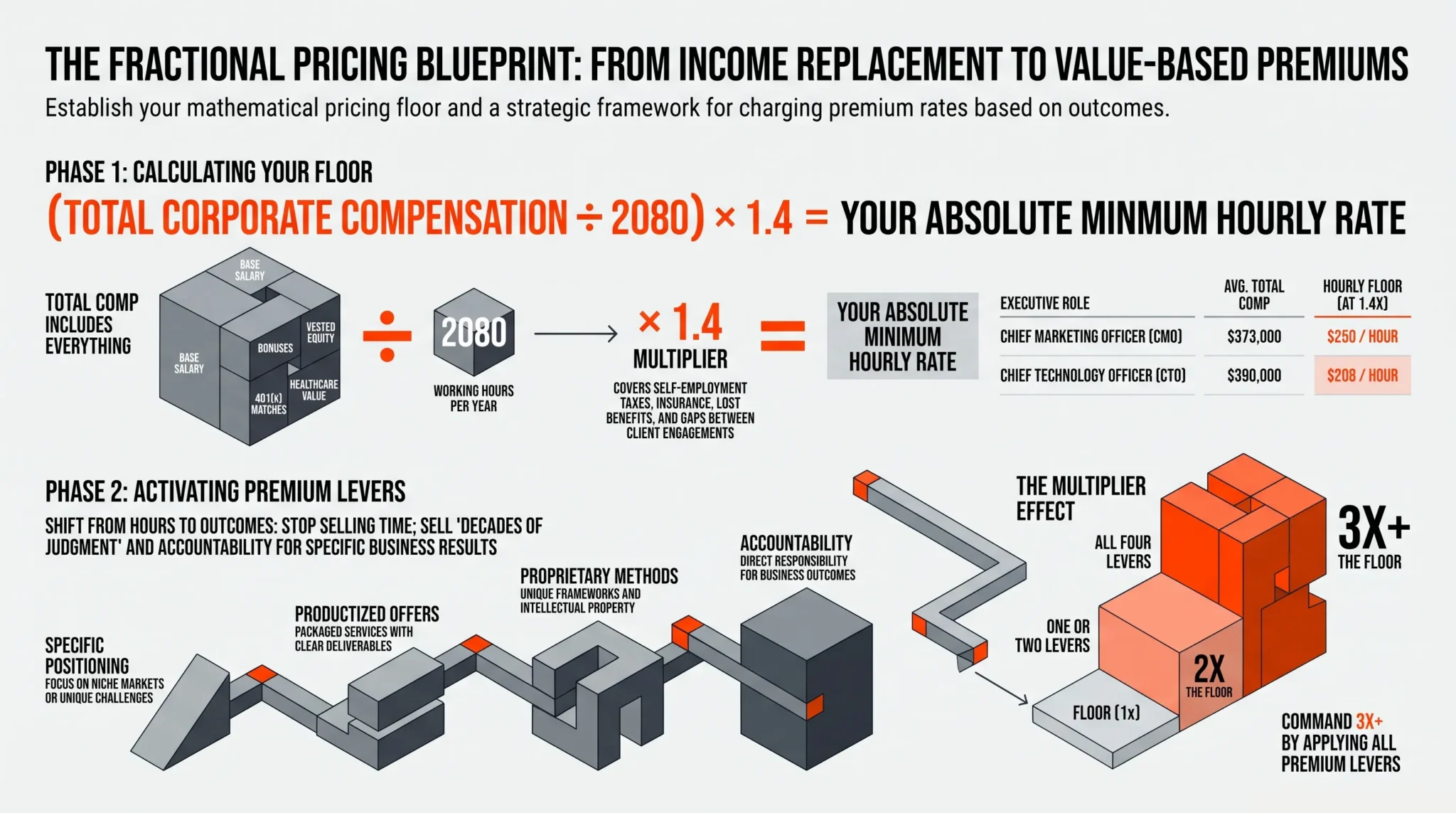
Answer: A full-time C-suite executive in this range is often benchmarked around $250,000 a year. A fractional executive is typically engaged for a fraction of that cost, since they’re paid for a defined scope of hours or outcomes rather than a full 40-hour week, giving companies access to the same caliber of expertise at substantially lower fixed cost.
Question: Does a fractional executive manage people, or just advise?
Answer: A fractional executive manages people directly. They hire and fire team members, run regular leadership meetings, mentor junior staff, and often work to train an internal successor. This hands-on management is a key difference from a consultant, who typically only advises without operational authority.