Charge What You’re Worth: The Complete Pricing and Packaging Guide for the Modern Fractional Executive
I see this painful scenario play out every single day in the business world: A highly experienced corporate leader leaves their full-time role to build a consulting or fractional practice. They have an incredible resume. They have led massive teams, scaled global companies, and delivered operational results that have added millions in tangible value to the bottom line. Yet, when it comes time to sell their own expertise to a new client, they freeze. They end up quoting an hourly rate, watching the founder’s eyes glaze over in real-time, and walking away from the negotiation table wondering, “Did I price that too high or too low?”
If this frustrating cycle sounds familiar, let me assure you of one very important truth: you are not under-earning because you lack the necessary skills. You are under-earning because no one has ever taught you how to properly package what you do into a structured system that premium clients can instantly say “yes” to.
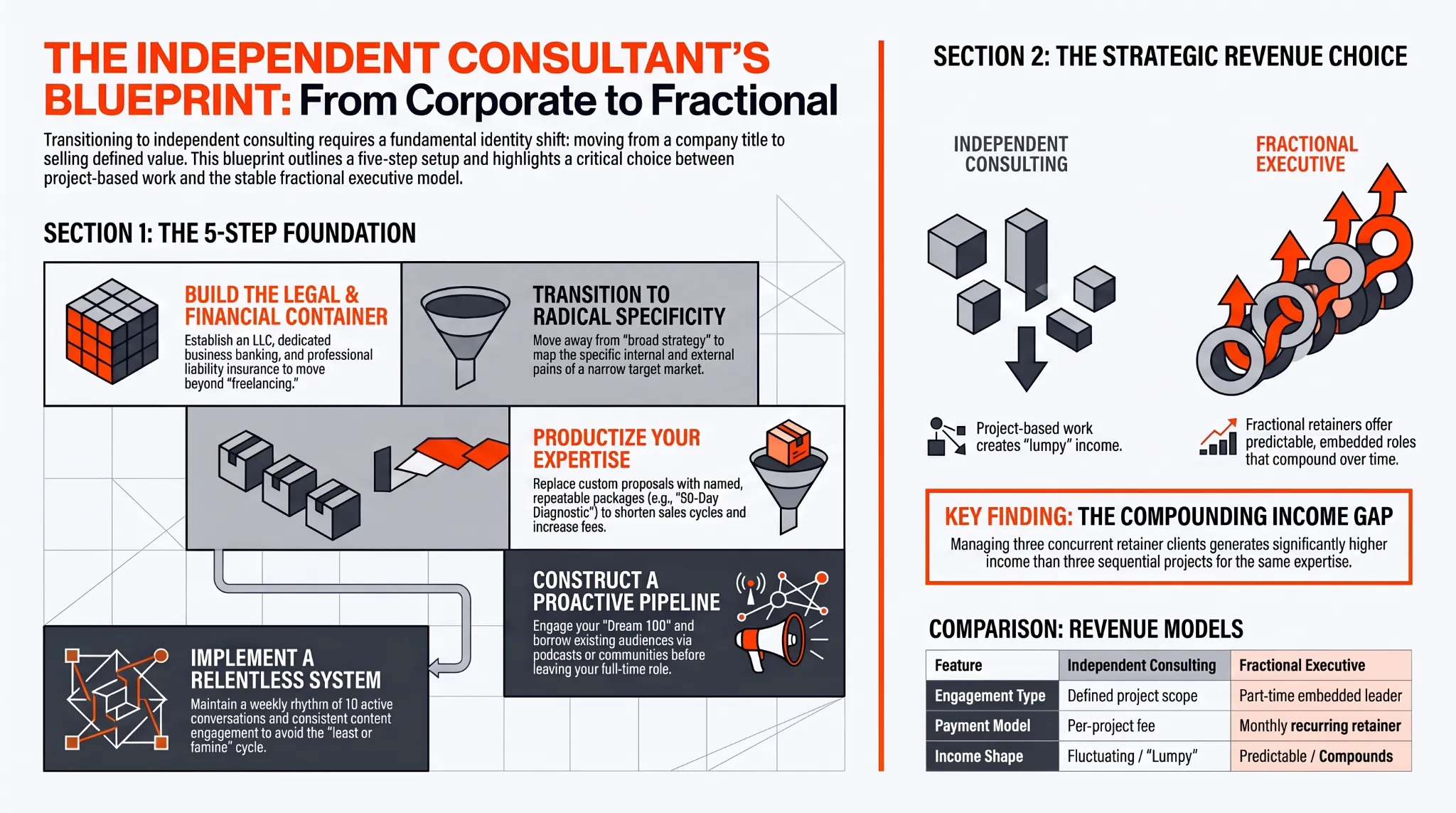
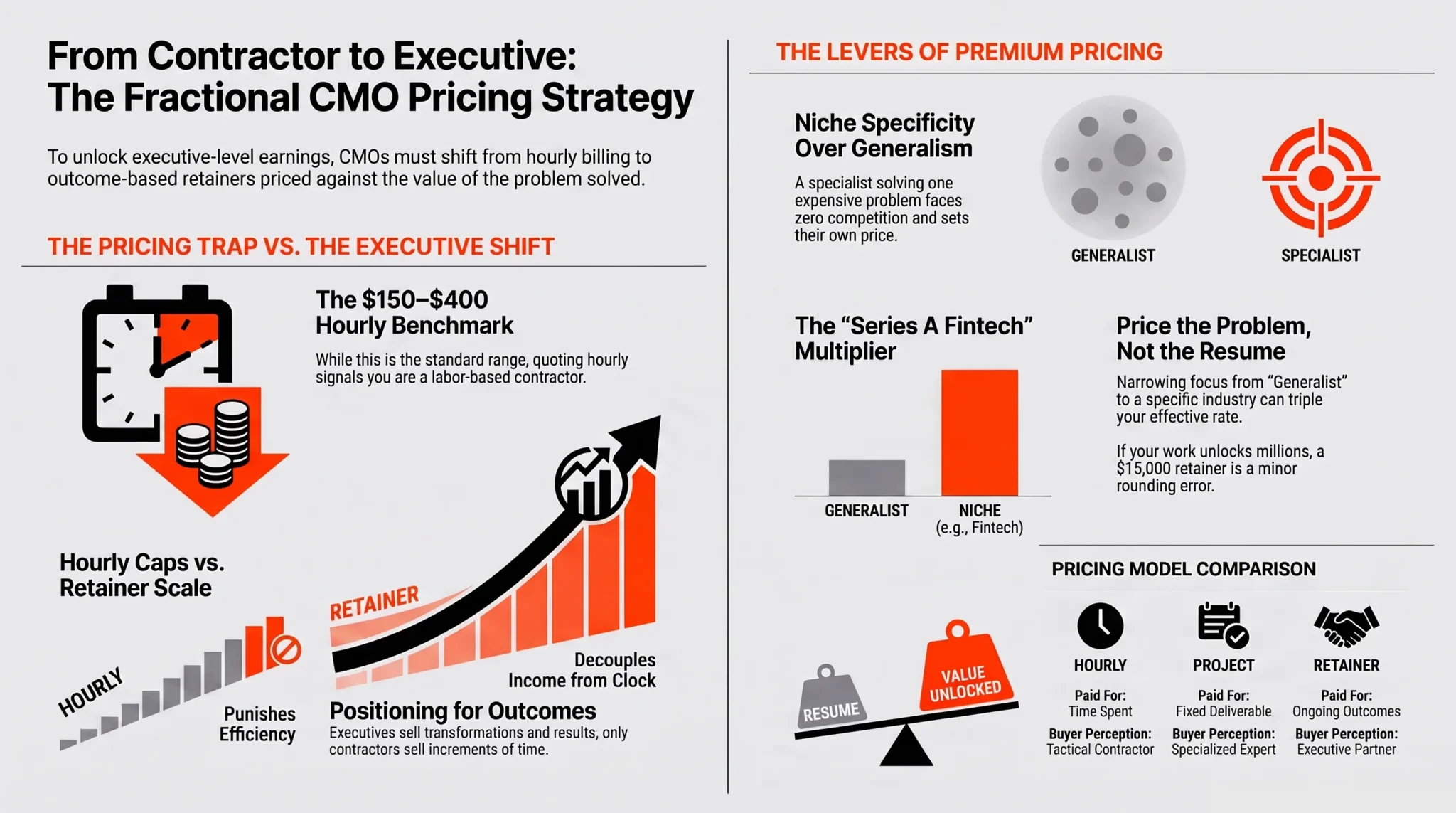
Whether you are stepping into the market as a fractional executive , a fractional CEO , a fractional COO , or a fractional CTO, your expertise is a high-value asset. But the moment you start charging by the hour, you fundamentally dilute that value. You instantly turn yourself into a commodity. You train the client to watch the clock instead of looking at the results.
In this comprehensive guide, I am going to show you exactly how to package consulting services and price your expertise using the core principles of the FractionalOSTM system. This framework is designed to help you stop selling your precious time, start charging confidently for the outcomes you deliver, execute consistently, and secure your next premium client without ever enduring an awkward back-and-forth negotiation over hourly rates.
The Danger of the Billable Hour: Why Selling Time Keeps You Stuck
Before we dive into the mechanics of packaging, we must address the fundamental flaw in how most independent executives approach the market. When you quote an hourly rate, you are operating with a freelancer mindset. You are essentially telling the client, “I am an extra pair of hands, and you can rent me by the minute.”
This positioning is disastrous for an executive. Founders and business owners do not want to buy your hours; they want to buy a solution to their most pressing bottlenecks. If your proposals read like a traditional corporate resume instead of a targeted, structural solution, you are going to lose the deal. Premium clients want clarity, certainty, and speed. They want to know that you possess a repeatable methodology to make their operational chaos disappear.
To break free from this trap, we must build a bridge between your market positioning and your promotional efforts. Inside of FractionalOSTM, we call this the “Packaging Pillar”. Once you have identified exactly who you serve and the specific results you are capable of delivering, you absolutely must translate that raw capability into a clear, outcome-based offer. Your pricing must reflect the massive value of the system you are installing into their business, not the arbitrary minutes you spend sitting on a Zoom call or staring at a calendar.
To achieve this level of leverage, we are going to build out three distinct mini-systems within your business: The Offer System, The Pricing System, and The Delivery System.

Pillar 1: The Offer System—Name It to Claim It
Every great, highly profitable offer in the fractional space effectively answers three non-negotiable questions:
- Who is this specifically for?
- What precise problem does it solve?
- What proprietary system delivers the result?
Most struggling fractional executives completely skip that third question. Because they lack a defined system, their pitches devolve into a vague promise to “help out” wherever needed. This is how you end up becoming a glorified, highly-paid administrative assistant.
Inside of the FractionalOSTM methodology, we force you to turn your broad skills into a named, outcome-driven framework. For example, instead of vaguely offering “fractional COO support” and hoping the client knows what to do with you, you package your expertise and sell a “90-Day Operations Reset”.
Listen to the difference in how that is framed. You are offering a structured engagement where you will step in, install a lightweight process map, align their internal metrics, and measurably reduce their operational chaos by 50% in exactly 90 days.
This hyper-specific framing accomplishes three critical things instantaneously:
- It creates immediate clarity for the client. They know exactly what they are buying.
- It signals systems instead of ad-hoc help. You are positioning yourself as an architect, not a bricklayer.
- It allows you to charge for a transformation, not for hours.
Every strong offer must be anchored to a defined outcome that the client can point to, track, and measure. For a fractional CTO , this might mean “faster technical decision-making and a scalable product roadmap.” For a fractional CFO, it might be “cleaner financial visibility and new revenue capacity”. The more specific and quantifiable the end result, the higher the perceived value of your engagement.

The Power of the Time-Bound Container To build your offer today, start by listing every single deliverable you are capable of performing. Group those deliverables by the ultimate result they create, and then wrap each of those results in a rigid, time-bound container. I have found that 30, 60, or 90-day windows generally work best for executive engagements.
Why? Because clients absolutely love defined time windows; it allows them to clearly see the finish line and measure what success looks like. Furthermore, you will love time-bound containers because they establish strict boundaries and keep you firmly in control of the scope. Once your offer is this crystal clear, pricing stops being a game of guesswork.
Pillar 2: The Pricing System—Aligning Value, Market, and Context
Once you are selling an outcome rather than your time, you step into a completely different realm of monetization. Inside of our framework, every single price you quote is strategically built around three core levers: Outcome, Market, and Location. If you’re wondering, ‘how much do fractional executives charge?’, the ranges below show how these levers translate into real numbers. These three factors work in harmony to ensure you are never underpricing your real impact, nor are you overpricing yourself out of smaller, context-specific markets.
Lever 1: The Outcome Your fee must be directly anchored to the measurable result your system creates for the business. How much do fractional executives charge? Let’s break down what this actually looks like in practice:
- The Diagnostic: A short, intensive diagnostic engagement that simply delivers strategic clarity to the leadership team might start around $2,000 to $5,000.
- The System Build: A comprehensive 90-day system build—where you actively install processes, establish reporting structures, and drive accountability—typically lands anywhere between $10,000 and $20,000 per month, per engagement.
- The Fractional Partnership: A long-term fractional partnership where you maintain, oversee, and optimize that installed system usually ranges from $3,000 to $5,000 a month. However, depending on the complexity of the business and how many moving parts your specific system supports, this retainer can easily scale all the way up to $15,000 or $20,000 per month.
Levers 2 and 3: The Market and Location The second and third levers require you to adjust your baseline fees based on the specific industry market and the geographic context of your client. A mid-sized manufacturing company located in the Midwest is fundamentally not going to pay the exact same premium rate as a heavily-funded, venture-backed tech startup based in San Francisco.
And you know what? That is completely expected. The context of the client’s business environment inherently defines the ceiling of what they can afford and what the problem is worth solving. Whether you are targeting growing e-commerce brands in New York, logistics firms in Texas, or SaaS companies in Silicon Valley, your pricing must intelligently adapt to the economic reality of that specific location and sector.
The ultimate key here is absolute transparency. Because you are pricing the system and the transformation rather than your time, you are showing clients the true value of predictable outcomes—results they can measure, trust, and rely on to grow their business. When you explicitly tie your pricing to these outcomes while respecting their specific market context, every single proposal you send will feel balanced, highly credible, and remarkably easy for both parties to say “yes” to.
Pillar 3: The Delivery System—Fulfill With Confidence and Scale
You can have the most beautifully packaged offer and the most perfectly calibrated pricing strategy in the world, but your entire positioning will immediately fall apart if your actual delivery feels improvised.
This is a critical blind spot. Most fractional executives do not lose deals because they lack the requisite skills; they lose deals during the pitch because their delivery process looks vague and unstructured. Founders and CEOs crave confidence. Even before they sign the contract, they want to know exactly what they are getting, what the first week looks like, and how progress will be objectively tracked.
That is exactly why we built the Delivery System—a repeatable, three-milestone framework that grants clients total visibility, rapidly builds deep trust, and dramatically accelerates your sales cycle. When prospects can visually see the system you will use to solve their problems, they make buying decisions much faster.
Here is how you structure those three crucial milestones:
Milestone 1: Kickoff and Assessment You never start an engagement by blindly changing things. You start off by mapping the current state of the business, gathering the necessary metrics, and strictly defining what “success” looks like in highly measurable terms. This initial phase builds immense trust because the client sees firsthand that your system is rooted in absolute clarity, not random guesswork.
Milestone 2: The System Build This is where your proprietary framework truly comes to life. During this phase, you are actively installing the processes, the templates, and the specialized tools that will deliver the promised outcomes—whether that means smoother daily operations for a fractional coo , cleaner financial reporting for a CFO, or highly scalable engineering workflows for a fractional CTO. To maintain momentum, you must implement weekly rhythm calls and a shared KPI tracking system. This shows the client real-time progress, ensuring they never have to ask, “What is our fractional executive actually doing this week?”.
Milestone 3: Optimization and Handoff A true fractional leader builds infrastructure; they do not build dependency. In this final milestone, you refine what is working, thoroughly document the final operating system, and proudly hand over ownership to the internal team alongside a clear continuation plan. The business walks away with a self-sustaining structure.
The backbone of this entire delivery phase is the KPI tracking system. It allows both you and your client to monitor results completely transparently, which inherently builds long-term credibility and keeps the engagement cleanly scoped to avoid “scope creep”. This delivery system is the ultimate proof that you are not simply selling advice—you are delivering highly predictable results through rigid structure. That profound clarity builds trust before the sale is even finalized, drastically shortens the buying decision, and ultimately turns every single client into walking proof that your proprietary system works.
The Bottom Line: Transitioning from Option to Logical Choice
Let’s pull all of this strategy together. Your Offer System clearly defines exactly what you sell and specifically who it is built for. Your Pricing System firmly aligns your premium fee with the massive value you create and the specific market you are operating within. Finally, your Delivery System keeps your projects highly profitable, visible, and built on an unshakable foundation of trust.
When you make the decision to package and price your executive expertise in this highly structured way, you stop being just another option in a sea of consultants. You elevate your positioning, and you immediately become the only logical choice.
If you are ready to stop leaving money on the table, stop tracking billable hours, and want to see exactly how to build these specific systems for your own fractional practice, I highly encourage you to download the free FractionalOSTM Starter Kit. Inside, you will find the offer builder worksheet, the pricing framework template, and the delivery system checklist that you can plug directly into your business today.
Your experience got you to the C-suite. Now, let your systems build the scalable, thriving fractional business you actually deserve.
FAQ
Question: What is a fractional executive?
Answer: A fractional executive is a seasoned professional who provides high-level expertise and leadership to organizations on a part-time or project basis. Unlike traditional full-time executives, fractional executives work with multiple clients, offering specialized knowledge in areas such as operations, finance, technology, or marketing.
Question: Why should I consider hiring a fractional executive?
Answer: Hiring a fractional executive allows businesses to access expert leadership and strategic guidance without the cost of a full-time hire. This model is particularly beneficial for small to mid-sized companies that require executive-level input on a flexible basis, enabling them to scale operations while managing costs.
Question: How do I package my consulting services as a fractional executive?
Answer: To effectively package your consulting services—and clarify how to package consulting services for your ideal clients—you should identify your target audience, the specific problems you solve, and the outcomes you deliver. By creating a structured, outcome-based offer instead of charging by the hour, you can emphasize the value of your expertise and provide clarity to potential clients.
Question: What are the common pitfalls that fractional executives face?
Answer: Many fractional executives struggle with underpricing their services and failing to clearly define the value they provide. Without a structured packaging and pricing strategy, they may find themselves competing on price rather than expertise, leading to frustration and missed opportunities.
Question: What’s the fastest way to turn my resume into a clear, named, outcome-based offer?
Answer: Inventory what you actually deliver, group by the result created, and wrap it in a time-bound container with a name tied to a measurable outcome. Start by listing your core deliverables, then cluster them by the specific business problem they solve (e.g., “operational chaos,” “slow technical decisions,” “poor financial visibility”). Choose a 30/60/90-day window, define what success looks like in metrics, and name the engagement accordingly (e.g., “90-Day Operations Reset”). In FractionalOSTM terms, that’s your Offer System: it specifies who it’s for, the precise problem, and the proprietary system that delivers the result—so you charge for a transformation, not time.
Question: How do I prevent scope creep when I use 30/60/90-day containers?
Answer: Set explicit outcomes, milestones, and KPIs up front—and manage the container, not the ad-hoc tasks. Define success in the Kickoff and Assessment milestone, commit to a fixed set of processes/templates you’ll install during the System Build, and use weekly rhythm calls plus a shared KPI tracker to show progress. If new requests surface, park them in a backlog for a future phase or retainer. The time-bound container keeps control on scope, and the Delivery System’s three milestones make “what’s in” versus “what’s next” unmistakably clear.
Question: How should I respond when a client asks for an hourly rate?
Answer: Reframe the conversation around outcomes and transparency, not minutes. Explain that you price the system and the transformation, then show your Delivery System (milestones, cadence, KPIs) so they see exactly what they’re buying. Offer a low-risk on-ramp like a paid Diagnostic ($2,000–$5,000) to provide strategic clarity first. Once trust is built, move into a 90-day System Build ($10,000–$20,000 per month, context-dependent) and, if appropriate, a maintenance retainer ($3,000–$5,000+, scaling with complexity). Clients don’t want hours—they want certainty, speed, and measurable results.
Question: How do I adapt pricing for different industries and locations without seeming inconsistent?
Short answer: Anchor your fee to the outcome, then transparently adjust for the market in your proposal. State the baseline value of the result you’re delivering (Outcome), acknowledge sector economics and funding profile (Market), and factor in cost norms and buyer expectations by region. Outline these levers directly in the pricing rationale so the number feels fair, credible, and tied to business reality—whether you’re serving a mid-sized Midwest manufacturer or a venture-backed SF SaaS startup.
Question: What KPIs should I track to prove value during delivery?
Answer: Choose a small set of role- and outcome-aligned metrics and report them weekly. Examples:
- Fractional COO: cycle time or lead time reduction, on-time delivery or SLA adherence, meeting cadence adoption, cross-functional handoff defects, % reduction in “operational chaos.”
- Fractional CFO: close-cycle time, forecast accuracy, cash runway/working capital visibility, gross margin or unit economics clarity, budget-to-actual variance.
- Fractional CTO: deployment frequency, lead time for changes, defect/incident rate, uptime/SLA, roadmap milestone hit rate.
- Tie each KPI to the promise in your Offer System, visualize progress in your weekly rhythm, and use the Optimization and Handoff milestone to lock in gains and transfer ownership.