The Dirty Truth and Why The Clock Is Crippling Your Practice
Every single week, a silent, expensive tragedy plays out in the inboxes and Zoom rooms of brilliant corporate marketing leaders who have recently stepped out to build an independent practice. It begins with a highly promising introductory call. The founder of a scaling five million dollar or ten million dollar company is nodding along, visibly excited as you describe your decades of experience building brand systems and scaling pipelines. They finally see a path out of their marketing chaos.
Then, right as the call is winding down, they casually drop the question that quietly costs a fractional executive tens of thousands of dollars a year:
What is your hourly rate?
If you are like most transitioning corporate leaders, your heart beats a little faster. You want to close the deal. You want to sound reasonable, accessible, and ready to help. So, you quote a number. Maybe you say two hundred dollars an hour. Maybe, if you are feeling exceptionally brave, you say three hundred and fifty dollars.
The founder smiles, nods, and tells you they will think about it.
In that single, fleeting moment, you have done two devastating things to your business at the exact same time. First, you have placed a rigid, unyielding ceiling on your earning potential. Second, and much more dangerously, you have signaled to your buyer that you are a tactical contractor to be managed, rather than an elite executive partner to be trusted.
If you are trying to figure out how to structure your fractional CMO pricing, or if you are currently running an independent practice and feeling completely exhausted by the constant pressure to hunt for more billable hours, we need to completely reframe this entire conversation.
The standard market questions around the typical cost of hiring a fractional CMO and overall fractional CMO cost structures are fundamentally broken. In this comprehensive guide, we are going to expose the structural flaws of the hourly billing system. We will look at the real market ranges for a fractional CMO hourly rate, but more importantly, we will dissect why you must almost immediately forget those hourly numbers. We will explore how the most successful modern fractional leaders package their value to earn significantly more while working fewer, highly leveraged hours. We will also dive into the underlying mechanics of value based pricing, look at how to transition clients into recurring monthly retainers, and address the critical questions every founder and elite marketer must understand to build a sustainable, high growth partnership.
The Hourly Trap: Why Selling Minutes Destroys Executive Authority
When you step out of a traditional W-2 C-suite position to offer fractional leadership, you are not just changing your tax status. You are changing your relationship to the market. Yet, the vast majority of new fractional CMOs immediately fall back on the simplest, most familiar billing mechanism they can think of: the hourly clock.
This is a massive strategic error. When you choose to price your services by the hour, three incredibly destructive things happen to your independent business.
First, you cap your income. The math is simple, brutal, and completely non-negotiable. There are only so many hours in a day, so many days in a week, and so many weeks in a year. If your revenue is directly tied to the physical hours you spend sitting at your keyboard or attending team meetings, you will quickly hit a hard financial ceiling. To make more money, you have to work more hours. This dynamic forces you right back into the exact same exhausting, high stress grind you were desperately trying to escape when you left corporate America.
Second, you actively invite your buyer to watch the clock and haggle over your minutes. The moment you tell a founder that you cost two hundred and fifty dollars an hour, they stop focusing on your strategy and start focusing on your timesheet. They begin reviewing your invoices with a magnifying glass. They wonder if that weekly internal alignment meeting really needed to take sixty minutes. They flinch every time you pick up the phone, knowing that a twenty-minute call is actively costing them money. You have transformed a high-level strategic relationship into a friction-filled, transactional accounting exercise.
Third, and worst of all, you position yourself as a low-level contractor rather than a peer. In the B2B ecosystem, contractors and freelancers sell their time by the hour. Executives do not. When you put an hourly rate in front of a CEO, you are telling them to compare you to a freelance graphic designer, an agency copywriter, or a mid-level marketing coordinator purely on price. You are signaling that you are an expense to be minimized and controlled, not a strategic investment that generates a massive, predictable return.
An elite corporate executive sells outcomes, not hours. If you want to be treated like the senior leader you are, you must stop pricing yourself like raw corporate labor.

The Real Ranges: What Fractional CMOs Actually Charge by the Hour
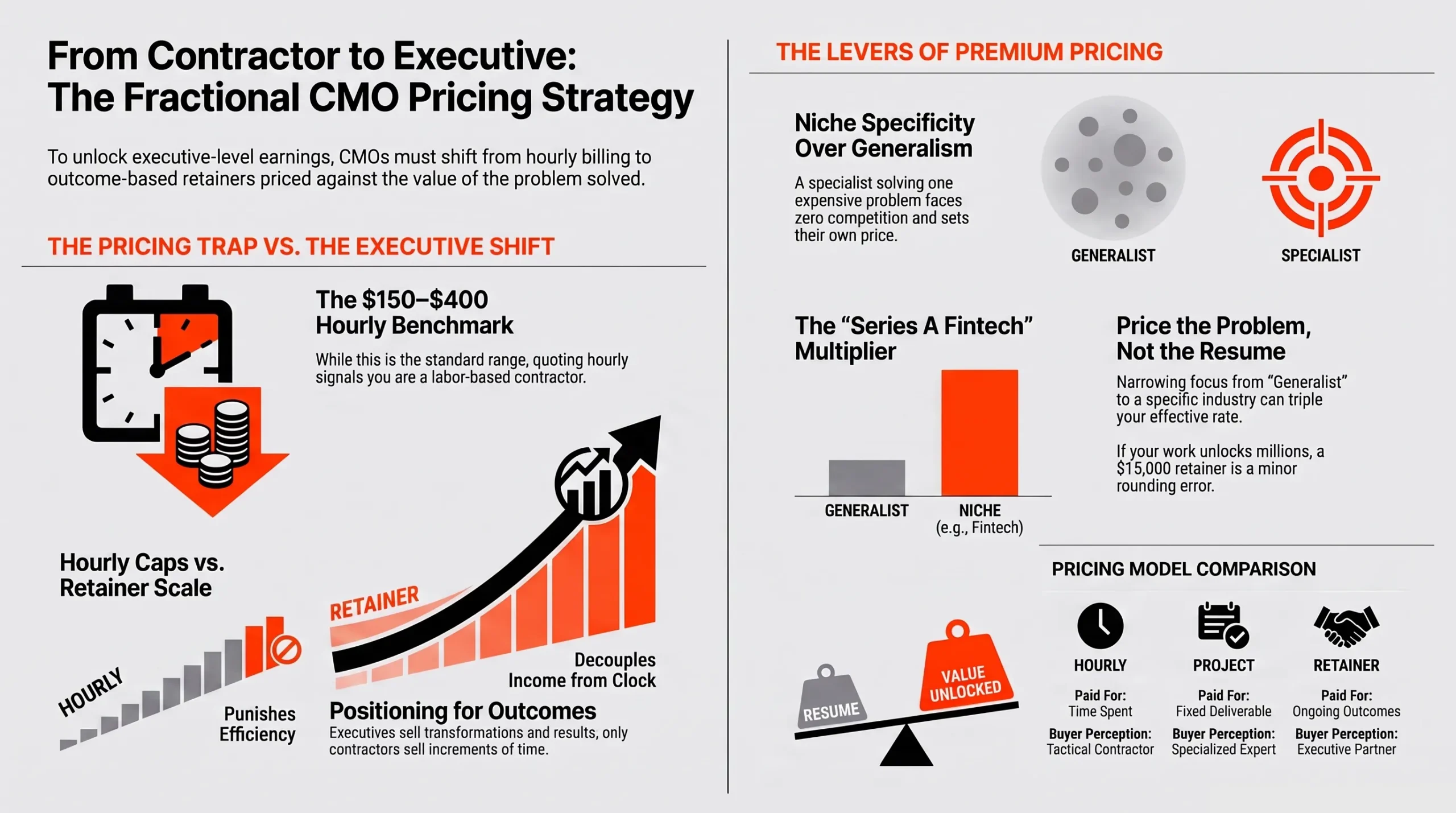
Since you are here to understand the landscape, let us look at the actual numbers. Fractional CMOs who still operate on an hourly model typically quote rates between $150 and $400 an hour.
At the lower end, around $150 to $200 an hour, you typically find generalist marketers, former agency account managers, or corporate directors who are brand new to the fractional space. They are often using a low hourly rate as a safety net to lower the barrier to entry for their first few clients.
At the mid to upper end, from $250 to $400 an hour and beyond, you find highly experienced, battle-tested operators who possess a strong industry niche, a history of scaling multi-million-dollar brands, and a proven track record of executive leadership. These are the leaders who understand the deep complexity of B2B demand generation, product positioning, and organizational scale.
You should know these ranges because they exist in the market. But I want you to treat this information as nothing more than a behind-the-scenes sanity check. It is a tool you can use privately in your own head to verify your math, but it is never, under any circumstances, a pricing model you should put in front of a client.
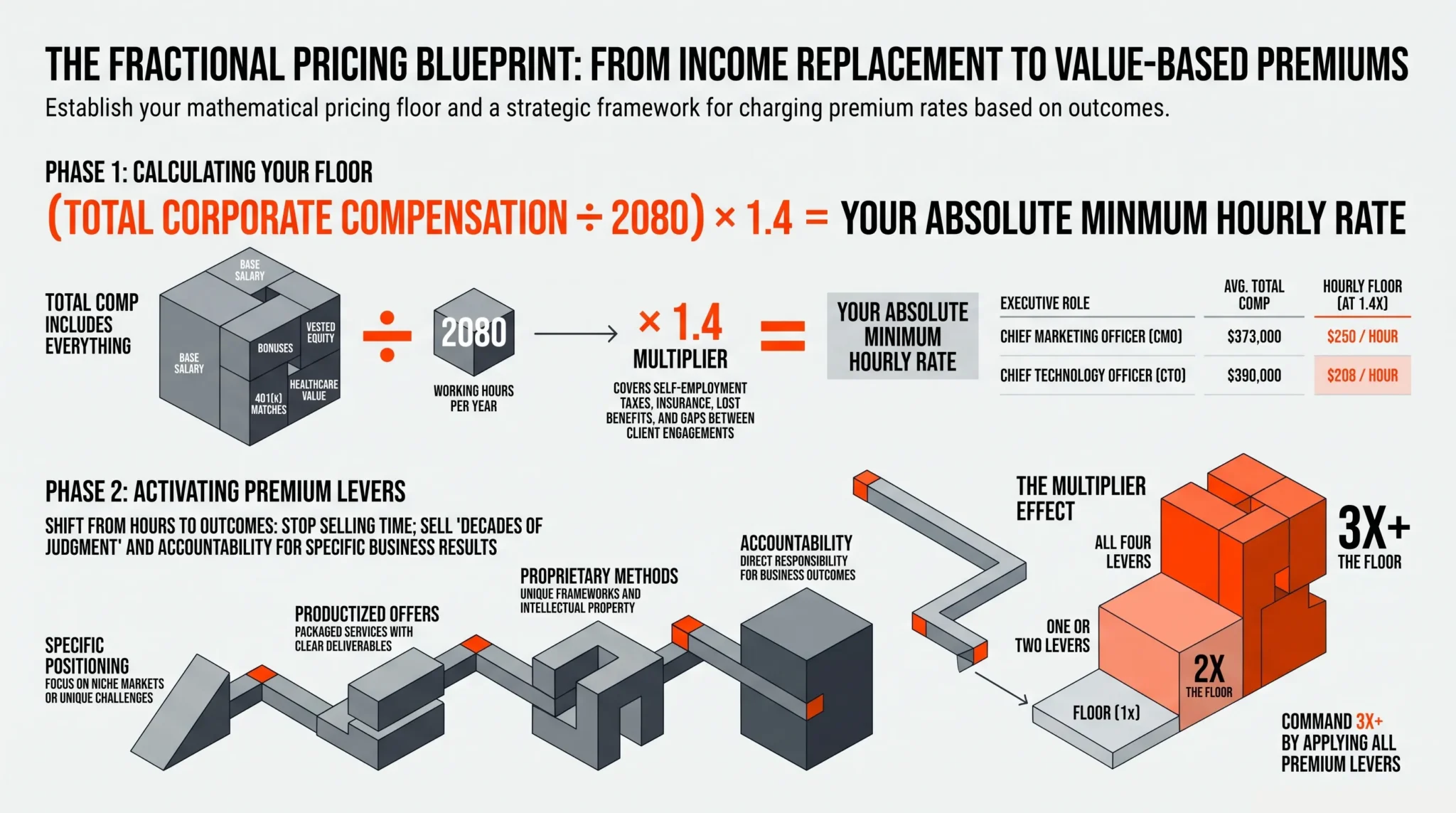
Here is how that behind-the-scenes sanity check actually works. Imagine you decide that your independent practice needs to generate fifteen thousand dollars a month in recurring revenue to meet your financial goals. If you calculate that you want to work roughly fifty hours a month across your client base, that breaks down to a target of three hundred dollars an hour.
But instead of going to a prospective client and saying, I charge $300 an hour, and I estimate this project will take fifty hours, you throw the clock away. You package your overall involvement and quote a flat fifteen thousand dollar monthly retainer to fully own the marketing outcomes.
The underlying financial math in your head is identical, but the commercial positioning is completely different. One option frames you as an expensive, hourly laborer whose time must be monitored. The other option frames you as an indispensable, embedded partner who is worth the long-term investment.
The Retainer Solution: Why Flat Retainers Are The Ultimate Win-Win
If not hourly, then what? The default commercial structure for every serious, elite fractional executive must be the flat monthly retainer.
A recurring monthly retainer is not just better for your business, it is also infinitely better for your clients. Let us look at why this model represents the ultimate operational alignment for both parties.
For you, the fractional CMO, a monthly retainer provides predictable, stable income that you can actually build a life and a business on. You no longer have to stress over wild income swings based on how many billable hours you managed to scrape together or log during a busy month. It frees you from the tedious, frustrating task of tracking every six-minute increment of your day like a billing lawyer.
Most importantly, a retainer allows your income to scale with the sheer value you create rather than the time you physically spend. If you are a seasoned leader with decades of experience, you can often solve a massive, complex corporate problem in ten brilliant hours of high-level strategic work that would take a junior employee eighty hours of chaotic trial and error. Under an hourly billing model, you are actively punished for your speed, your efficiency, and your brilliant pattern recognition. The faster you solve the problem, the less money you make. Under a flat retainer, you are paid for the massive outcome, not the clock.
For the client, a flat monthly retainer is a massive relief. It allows them to start budgeting their marketing leadership costs with absolute, predictable clarity. They know exactly what their marketing executive expense is every single month, with zero surprises on the invoice.
Furthermore, a retainer completely changes the client’s psychological relationship with you. They get your brain on call instead of on a meter. They stop hesitating to invite you to key strategic meetings or call you for quick executive advice because they are no longer worried about the clock ticking. They get an embedded, dedicated partner who is fully invested in the long-term business results, rather than an external contractor who is financially incentivized to stretch out the hours just to pad their billing.
A monthly retainer aligns both you and the founder around one single, critical focus: delivering the business transformation.
How to Move Your Pricing Power: Seniority and The Lever of the Sharp Niche
The price of your fractional services is never a random number, and it should never be dictated by what a client thinks is fair. Your overall pricing power inside the independent market is moved by two primary levers: seniority and niche.
Seniority is the most obvious lever. A seasoned executive who has successfully scaled multiple mid-market companies, managed massive budgets, and owned real corporate revenue targets will naturally command a far higher premium than someone with a thinner resume or a background focused purely on execution.
But the second lever, the niche, is the one that most fractional CMOs badly underuse.
If you market yourself as a generalist fractional CMO who helps any company with their marketing, you are actively choosing to play a commodity game. Because you look and sound exactly like every other marketer on LinkedIn, the buyer has all the power. They can easily find ten other generalists to talk to before lunch, which means they will inevitably compare you on price and try to beat your rate down. A generalist will struggle to maintain even a basic two hundred dollar hourly rate.
But watch what happens when you aggressively sharpen your niche.
Instead of being a generalist, you position yourself as the specialized fractional CMO for Series A B2B fintech companies who need to fix their messy demand generation engine and scale their pipeline.
Suddenly, your target market shrinks, but your pricing power sky-rockets. Your effectively hourly rate quietly doubles or triples. Why? Because there are probably only five people on the planet who can credibly claim that exact level of specific, highly relevant pattern recognition. You have completely eliminated the competition. You are no longer compared to a commodity, you are the definitive solution to a highly specific, highly expensive business problem. Your skill set did not change overnight, but your specificity did.
The Four Pillars of the High Value Premium Offer
If you want to command premium monthly retainers, you cannot just raise your prices and hope for the best. You must construct a high-value, highly irresistible commercial position. The elite fractional leaders who easily secure retainers of ten thousand, twelve thousand, or fifteen thousand dollars a month build their businesses on four foundational pillars.
Pillar One: A Track Record of Concrete Outcomes
Premium pricing is never justified by a long list of past corporate responsibilities or a fancy resume filled with job descriptions. It is justified by concrete, measurable business outcomes. You should never pitch yourself by saying, I ran marketing for an enterprise brand. You must pitch yourself by saying, I took an enterprise B2B brand from two million to ten million in recurring revenue in exactly eighteen months. Results are the ultimate currency of the fractional market. When you can point to proven, historical results, a premium retainer ceases to feel like an expensive risk to a founder and starts to look like a highly logical investment.
Pillar Two: A Productized, Named Offer
A general consultant sells vague, undefined services. They say, I will come in and help you with your marketing. An elite fractional executive sells a proprietary, named program that delivers a highly specific outcome. For example, instead of offering fractional marketing services, you offer the B2B Pipeline Accelerator System. A named, structured program immediately feels like a proven, predictable system to a buyer. A system commands a massive premium because it promises a repeatable outcome, whereas rented time only promises hours on a calendar.
Pillar Three: Sizing the Problem You Solve
If you want to charge high-value rates, you must focus your marketing entirely on expensive, high-stakes business problems. If your strategic work successfully unlocks five million dollars in new pipeline or protects three million dollars in existing customer revenue, then a ten thousand dollar a month retainer is a complete rounding error for the business. When you are on a sales call, you should never price your services against the cost of your time. You must always price your services against the sheer scale and financial impact of the problem you are solving for the business.
Pillar Four: Positioning and Scarcity
The independent market is ruled by the laws of supply and demand. A fractional CMO who is constantly chasing down every single lead, writing highly customized, fifty-page proposals for tiny projects, and offering steep discounts has zero pricing power. An elite fractional executive who is highly visible in their niche, possesses a strong, authoritative point of view, and operates with a visible waitlist commands immense pricing power. Scarcity and professional authority allow you to set the rules of the engagement, choose your clients, and command premium compensation.
The Three Pricing Models: Hourly, Project, and Retainer
To build a highly profitable and sustainable independent practice, you must understand where each of the three major pricing models fits into your overall business strategy. Each model has a highly specific purpose, and knowing when to deploy them is the secret to scaling your revenue while protecting your time.
Model One: Hourly Pricing
Under the hourly model, you are paid strictly for your physical time. Your overall income is highly unpredictable, strictly capped by your physical capacity, and your client constantly views you as an expensive contractor. This model should be used almost never. The only acceptable scenario for hourly billing is a genuine, one-off, short-term advisory or strategy call with a client who simply needs to pick your brain for an hour or two.
Model Two: Project-Based Pricing
Under the project-based model, you charge a flat, fixed fee for a highly defined set of deliverables within a specific timeframe. For example, you might charge a flat ten thousand dollars to execute a comprehensive 90-day marketing audit and build a strategic go-to-market roadmap. This model is exceptional as an entry point for new clients. I often call this a paid first date. It allows the client to experience your elite strategy and leadership style without committing to a long-term contract, and it gives you the opportunity to deeply audit their business before committing to a permanent retainer. The only downside is that project income is naturally lumpy and eventually ends.
Model Three: Retainer-Based Pricing
Under the monthly retainer model, you are paid a flat, recurring fee for ongoing, embedded leadership and outcomes. This is your default commercial home. It provides highly predictable, recurring revenue, positions you as a peer and a long-term partner, and allows your business to scale. Your ultimate goal must be to use short-term project work to open the door, and then seamlessly transition every single high-value client into a permanent monthly retainer.
Real Story: The Transformation A Caped Hourly Marketer
Let me make this incredibly real for you by sharing a story of an executive I worked with recently. When she first left her corporate marketing role, she did what most people do: she started billing clients at two hundred dollars an hour.
She was incredibly good at what she did, so she quickly filled her calendar. Within a few months, she was working sixty hours a week, juggling five different clients, and tracking every single minute of her day in a complicated spreadsheet.
She was making good money, but she was completely, utterly exhausted. Her income was strictly capped because she had zero physical hours left to sell. If she wanted to make another thousand dollars, she had to sacrifice another five hours of her personal life. She had essentially built herself a high-paying, high-stress corporate job inside her own home office.
Then, we made two critical changes to her business model.
First, we aggressively sharpened her niche. We stopped letting her market herself as a generalist and positioned her as a specialized fractional leader focusing on demand generation specifically for B2B software companies.
Second, we completely threw away her hourly clock. We repackaged her entire offering as a flat, ten thousand dollar a month recurring retainer tied directly to pipeline growth.
The results were immediate and mind-blowing. She was the exact same person, with the exact same marketing skills she had the week before. But by changing her positioning and pricing model, her effective hourly rate more than doubled. Her income stopped lurching up and down every month, her burnout vanished, and she clawed back two full days of her week. She did not get better at marketing that year. She got dramatically better at pricing.
That exact transformation is available to you on the very next proposal you send to a client.
The Bottom Line: Claim Your Value and Stop Trading Your Time
The traditional corporate corporate org chart is permanently broken for mid-market companies. Founders have finally realized that buying guaranteed, strategic business outcomes is infinitely more profitable and efficient than blindly buying forty hours of an executive’s physical time.
If you are an elite corporate marketing leader stepping into this independent space, you must align your business model with this market reality. Stop letting clients buy your time by the hour. Stop tracking your life in tiny, stressful increments. Stop allowing yourself to be compared to low-level contractors on price.
Claim your undeniable executive authority. Sharpen your niche until you have zero competition. Package your decades of hard-earned expertise into a structured, productized system. And when you stand in front of a founder, always default to a monthly retainer that reflects the true, transformative value you deliver.
When you make this critical shift, you stop selling your time by the hour, and you finally start building the highly profitable, highly impactful fractional practice you actually deserve.
Now that you deeply understand the mechanics of elite fractional pricing, your very next step is securing a consistent flow of founders who understand this value. The absolute best pricing model in the world means nothing if your pipeline is dry. If you want to see the exact system required to attract premium clients predictably without the constant, exhausting freelancer hustle, watch my next video, The System Behind a Predictable Pipeline for Fractional Executives. I will walk you through the exact system we install to make your independent practice highly scalable and incredibly profitable.
FAQ
To help both scaling founders and transitioning executives navigate this complex landscape, let us address the most common, high-stakes questions surrounding fractional CMO pricing, fractional CMO cost, and engagement structures.
Question: What does a fractional CMO do?
Answer: A fractional CMO is not a consultant who sits on the sidelines and hands over theoretical strategy decks, nor are they a freelancer who executes basic marketing tasks like writing social media posts or setting up ad campaigns. A fractional CMO is an embedded, senior executive who operates on a permanently part-time basis. They take full, strategic ownership of your entire marketing department. This means they build the overarching marketing strategy, align your marketing efforts with your high-level business goals, manage and mentor your internal marketing team, evaluate and hire external agency vendors, and take absolute, unshakeable accountability for driving predictable pipeline and revenue growth.
Question: What is the typical cost of hiring a fractional CMO?
Answer: While some newer marketers charge a fractional CMO hourly rate behind the scenes, the vast majority of high-caliber fractional executives operate on flat monthly retainers. Depending on the size of your company, the complexity of your marketing goals, and the cadence of the executive’s involvement, a professional fractional CMO retainer typically ranges from three thousand to fifteen thousand dollars a month. For early stage startups under five million dollars in revenue, a standard retainer is often three thousand to six thousand dollars a month. For growth-stage companies between five and twenty million dollars, the investment is typically six thousand to ten thousand dollars a month. For scaling mid-market firms between twenty and fifty million dollars, a comprehensive retainer ranges from eight thousand to fifteen thousand dollars or more per month.
Question: How does fractional CMO pricing compare to hiring a full-time CMO?
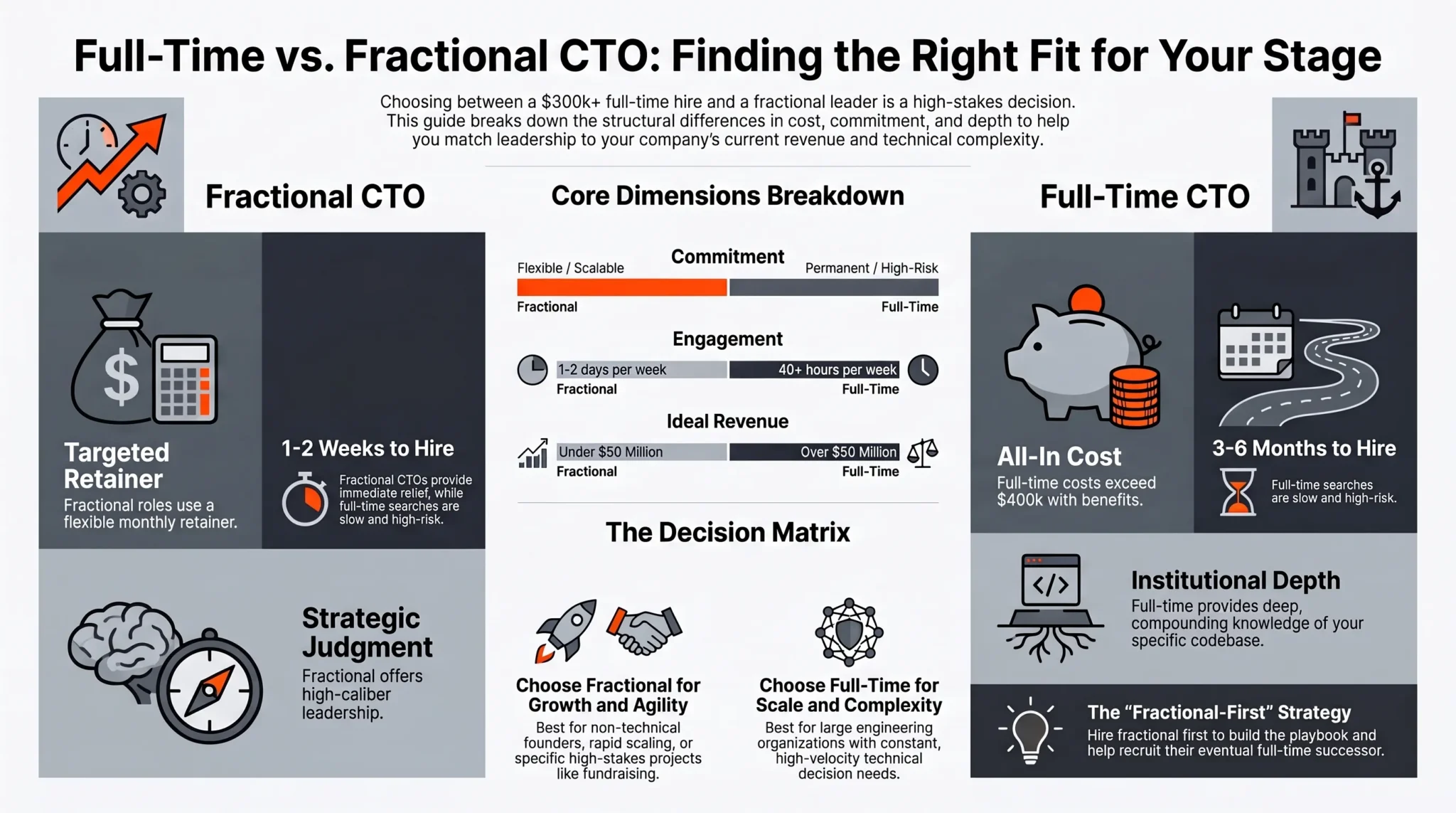
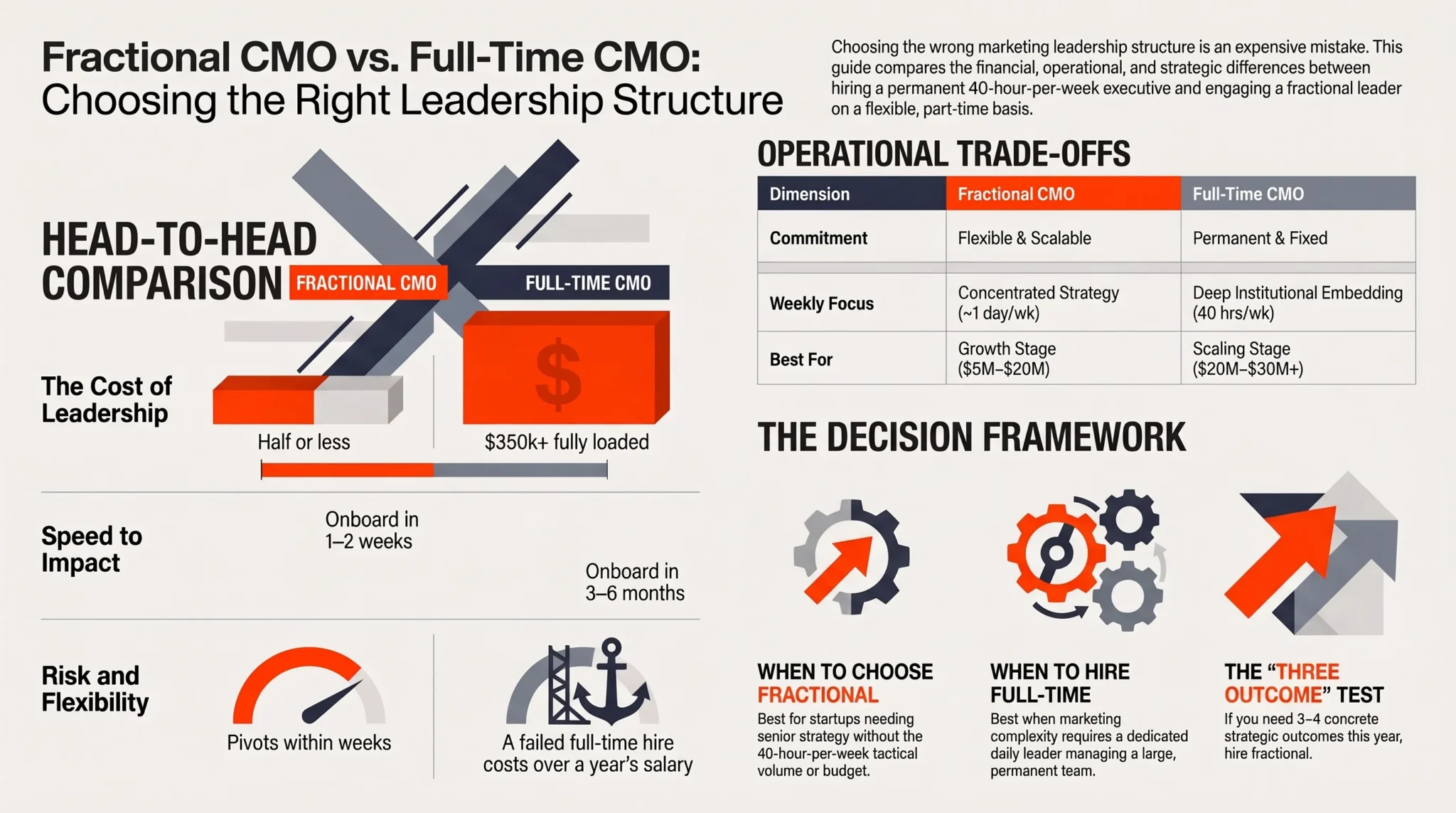
Answer: Hiring an elite, full-time W-2 Chief Marketing Officer is an incredibly expensive proposition for a scaling company. A high-caliber, traditional CMO commands a base salary of two hundred and fifty thousand to three hundred thousand dollars, along with substantial performance bonuses, corporate benefits, recruitment fees, and precious equity. The total annual cost of a full-time hire can easily top four hundred thousand dollars. Furthermore, a mid-market company rarely has forty hours of pure strategic work to keep a senior leader occupied, meaning you end up paying executive rates for tactical execution. A fractional CMO provides the exact same level of top-tier strategy and veteran pattern recognition, but on a permanently part-time basis, costing the company a fraction of the traditional full-time expense. You save hundreds of thousands of dollars in overhead, which can then be directly invested into your actual marketing campaigns and team expansion.
Question: How do I transition a client from an hourly rate to a monthly retainer?
Answer: The key to transitioning a client is to shift the conversation entirely away from your time and focus it on the value of the outcome. When a client asks for your hourly rate, you must confidently reframe the question. You can say: I do not bill by the hour because hourly billing actively punishes efficiency and incentivizes service providers to stretch out the work. Instead, I work on a flat monthly retainer model. This aligns our incentives completely around delivering real business results, gives you absolute predictability for your budgeting, and ensures my strategic brain is fully on call for your business without a meter running.
Question: Is it acceptable to use hourly rates for initial audits or short consulting projects?
Answer: While you should never use an hourly rate for ongoing fractional leadership, project-based pricing is an exceptional alternative for initial advisory work. If a founder is hesitant to commit to a long-term retainer, or if you want to thoroughly audit a company’s internal marketing engine before committing to a partnership, you can charge a flat, fixed fee for a 30-day or 90-day diagnostic project. This allows both parties to experience a paid first date and establish a strong foundation of trust. Once the initial project is complete and the roadmap is delivered, you can naturally transition the relationship into a recurring monthly retainer to execute that roadmap.