The Four Upstream Systems To Close Premium Clients Without The Feast Or Famine Roller Coaster
Every single Monday morning, thousands of brilliant corporate executives who recently stepped out to launch an independent practice sit down in front of their screens and experience a quiet, cold wave of anxiety. You spent decades inside the corporate machine. You mastered high-stakes boardrooms, led massive projects, and wore your prestigious title like a suit of armor.
But today, your calendar is completely empty. There are no corporate alignment meetings, no urgent emails, and no built-in teams waiting for your direction.
In your first few weeks of freedom, you probably felt an incredible sense of relief. You slept past six, drank your coffee while it was actually hot, and celebrated your escape from toxic corporate politics. But eventually, the silence becomes deafening. You start looking at your empty pipeline, and you panic.
Your immediate instinct is to throw yourself into a flurry of frantic activity. You tell yourself that you need to post more on LinkedIn, build a complex marketing funnel, send cold emails, or attend every local networking breakfast in your city. You spend your precious days trying to figure out how to get consulting clients, shouting into the void and hoping someone notices your experience.
But after three months of exhausting yourself, your phone is still not ringing. You are stuck on a brutal feast or famine roller coaster, riding high when a random project lands, and plunging into deep anxiety the moment that project wraps up.
Let me be completely direct with you: you do not have a pipeline problem.
When independent operators struggle to get clients, they almost always misdiagnose the disease. They assume they simply need to do more marketing. But pipeline is a downstream result. If you are not getting consistent, high-paying clients, the upstream systems of your business are broken.
If you try to fix your pipeline by doing more of what is not working, you will only accelerate your path to burnout. To build a highly profitable, sustainable business, you must step off the execution treadmill and fix the four upstream systems.
Here are the four upstream principles that actually work, along with the structural transition that will double your earnings for the exact same effort.

Principle One: Specific Positioning (The Death Of The Generalist)
The first upstream system that ruins most independent businesses is positioning that is far too broad.
When you leave corporate, casting a wide net feels like the safest strategy. You tell yourself that because you have thirty years of experience across operations, finance, and team leadership, you can help any business solve any problem. You put generalist slogans in your LinkedIn headline like Strategic Advisor, Business Growth Consultant, or Executive Leader.
You do this because you are terrified of missing out on a deal. You worry that if you specialize in one specific area, you will alienate fifty other companies that might want to hire you.
But let me tell you the hard truth: when you speak to everyone, you connect with no one.
The premium clients you actually want to work with do not hire generalist advisors. A founder running a fast-growing, chaotic startup does not wake up at two in the morning thinking, I really need some strategic advisory work today.
They wake up sweating about a highly specific, painfully expensive operational bottleneck. They are panicking because their engineering team has missed three consecutive product launch deadlines, or their customer acquisition costs have suddenly spiked by forty percent, or their cash flow is so tight they might miss payroll next month.
In those high-stakes moments, a CEO is looking for a specialist who has solved that exact problem ten times before. They want a surgeon, not a general practitioner. And they will gladly pay a massive premium for that specialized pattern recognition.
If you want to get consulting clients who will respect your expertise, you must fix your positioning and get incredibly specific about who you serve and the exact, expensive problem you solve for them.
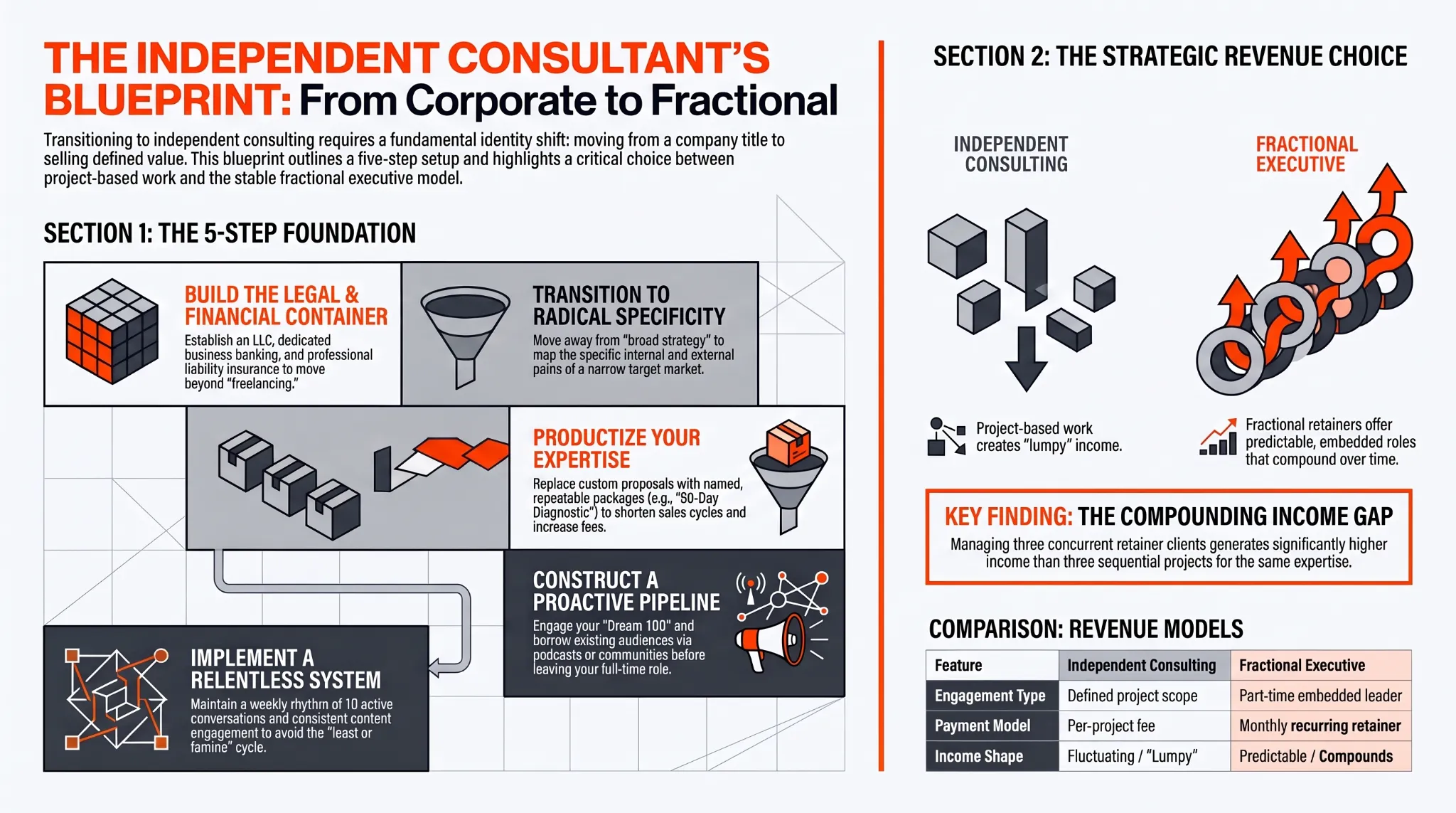
You can use my four-quadrant mapping framework to do this. Draw a square and divide it into four quadrants:
THE FOUR-QUADRANT MAPPING FRAMEWORK
| 1. EXTERNAL PAINS
Visible, measurable business bottlenecks (e.g., flatlining revenue, high sales turnover, broken systems). |
2. INTERNAL PAINS
Private stress and personal anxieties (e.g., board pressure, reputation risk, payroll anxiety). |
| 3. EXTERNAL WINS
Visible, celebrated organizational victories (e.g., successful funding rounds, timely product launches, 15% net margin gains). |
4. INTERNAL WINS
Private emotional relief and peace of mind (e.g., taking an uninterrupted family vacation, regaining confidence). |
First, map their external pains. These are the visible, measurable problems that everyone in the company can see. Examples include flatlining revenue, high sales-team turnover, or outdated technology architecture.
Second, map their internal pains. This is the private stress, the personal anxiety that the CEO does not talk about in public. They worry about looking foolish to their board of directors, losing their hard-earned reputation, or having to lay off employees who depend on them.
Third, map their external wins. These are the visible outcomes that would be celebrated by the team and the investors. This might mean successfully raising a Series B funding round, launching a new product line on time, or increasing net profit margins by fifteen percent.
Fourth, map their internal wins. These are the private desires they privately crave. It is the relief of finally being able to take a real vacation with their family, feeling secure in their leadership role, or regaining their peace of mind.
When you can describe all four of these quadrants with absolute precision, you stop guessing at your messaging. You do not have to creatively brainstorm what to say on a call or in an article. You are simply translating what they are already privately feeling. That is the exact moment clients start booking calls with you.
Principle Two: Productize Your Offers (Stop Writing Custom Proposals)
The second upstream system you must fix is your packaging. You must stop writing custom proposals.
This is the single biggest time-wasting trap in the consulting and advisory space. The typical sales cycle looks like this: you have a decent discovery call with a prospect, you get excited, and you spend five hours writing a comprehensive, custom proposal. You detail every single step you will take, map out a customized timeline, and offer three different pricing tiers.
You send the PDF off with high hopes. Then, silence.
The prospect stalls. They tell you they need to discuss it with their board, or they ask you to revise the scope, or they try to negotiate your price down. Even when the deal eventually closes, the project drags on forever because the boundaries of the work were never clearly defined.
Custom proposals make you look like a commodity vendor. They invite the client to negotiate over your process, your timeline, and your hourly rates.
You must replace custom proposals with productized offers.
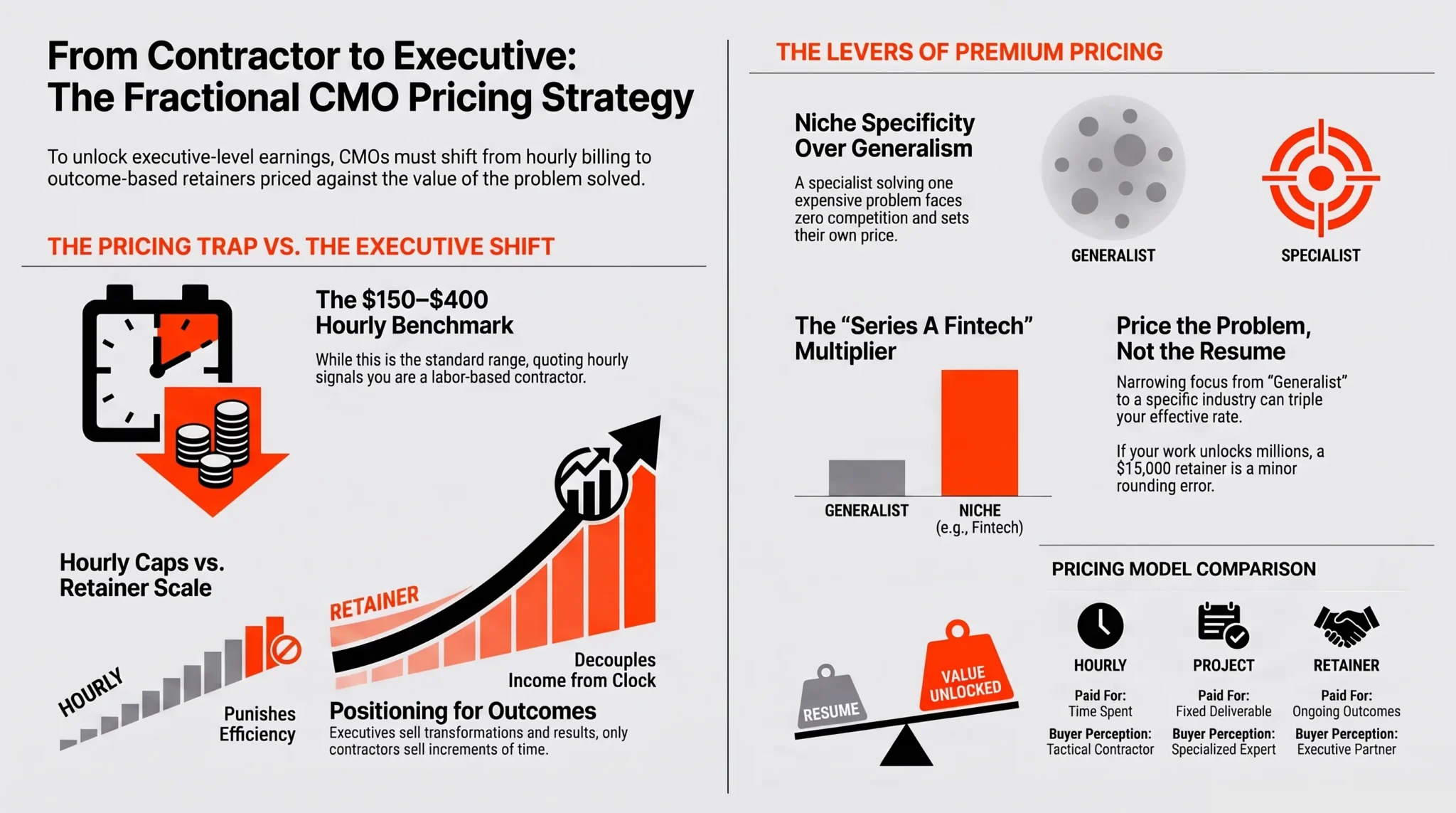
Instead of saying, I can do some strategy consulting for you at two hundred and fifty dollars an hour, you must package your elite expertise into a clearly defined, repeatable engagement with a set scope, a set flat price, and a guaranteed outcome. You need a specific, named thing with a clear before and after.
For example, you could offer a Ninety-Day Marketing Engine Diagnostic, or a Series A Cash Flow Roadmap, or an Engineering Team Velocity Audit.
When you package your knowledge into a productized offer, three powerful shifts happen immediately:
First, your sales cycle shrinks dramatically. Because the offer is a clearly defined product, the prospect knows exactly what they are buying, what it costs, and what they will get. There is no confusing gray area to negotiate over, which means a yes can happen on a single call.
Second, your overall pricing goes up. You are no longer selling your physical time by the hour, which is inherently capped. You are selling a premium, packaged solution to a highly painful problem, which means you can charge based on the massive enterprise value you create.
Third, your delivery becomes incredibly easy and highly profitable. Because you are running the exact same structured playbook for every client instead of constantly reinventing the wheel, you can deliver exceptional results in a fraction of the time.
But there is an even bigger benefit that most people overlook: a productized offer is highly referable.
If you tell your network that you do general business consulting, they will have a very difficult time referring clients to you because they do not know what that means. But if you tell them you run a Ninety-Day Go-To-Market Alignment Blueprint for B2B software companies, they will immediately think of you the second they meet a software founder who is struggling to align their sales and marketing teams. Your offer has a specific, memorable shape that they can easily describe to others.
Principle Three: Build Your Dream 100 And Engage More Than You Post
The third upstream system is your relationship strategy. You must transition from a broadcast mindset to a relationship-building system.
Most independent operators spend ninety percent of their marketing energy posting generic content on LinkedIn, hoping that the right decision-maker will happen to scroll past it, read it, and send them a message.
While content creation is useful for building long-term authority, relying on it as your primary client acquisition system is a slow, highly unpredictable game. You are essentially playing the social media algorithm lottery with your livelihood.
When you are trying to understand how to get consulting clients, there is a far more precise, high-conversion method: building your Dream 100.
Instead of shouting at a massive, disengaged crowd of thousands, you must identify the exact one hundred people in the world who could most easily transform your business. These are the individuals who can either hire you directly or refer you to those who can.
Your Dream 100 should be divided into three distinct categories:
First, founders and CEOs of companies that fit your ideal buyer profile.
Second, institutional investors, such as venture capital and private equity partners, who back the exact types of companies you serve. These investors have dozens of portfolio companies that desperately need your strategic help to protect their capital.
Third, complementary fractional executives and consultants who serve the exact same audience but do not compete with you. If you are a marketing leader, your Dream 100 should include fractional chief financial officers, fractional chief technology officers, and operations consultants. They are sitting in the exact same boardrooms as you, and they can easily refer adjacent work to you.
Once you have meticulously researched and built your list of one hundred people, you must stop trying to get them to look at you, and start being useful in their world.
Go to where they are already active. Read their articles, listen to their interviews, and study their posts. Then, engage with them thoughtfully. Do not send them copy-and-paste sales pitches in their direct messages. Instead, leave high-value comments on their content. Add real, strategic insight to their conversations. Share their work with your own network, and publicly credit them.
If you do this consistently, making a small number of meaningful, high-value interactions every single week with the same one hundred people over months, something incredible happens.
Most people quit after two weeks because they do not get instant gratification. But if you are the rare professional who stays consistent, these one hundred people will not just recognize your name. They will begin to view you as an authoritative peer. And the exact moment one of their portfolio companies or colleagues experiences the specific problem you solve, you will be the absolute only logical professional they call.
Principle Four: Leverage Other People’s Audiences
The fourth upstream system is leverage. You must stop trying to build your own audience entirely from scratch and start leveraging existing platforms.
Building your own email list, social media following, or newsletter from zero takes years of relentless, daily effort. It is a slow, grinding process that does not solve your immediate need for premium clients.
But here is the shortcut: you do not need to build your own stage when there are already hundreds of established stages that your ideal buyers are actively watching.
There are already industry-specific podcasts, private professional communities, specialized newsletters, and virtual event stages whose audiences are composed entirely of the exact people you want to reach.
Your strategy should be to identify these platforms and pitch yourself as a high-value guest or speaker.
Do not pitch yourself to sell your services. Pitch yourself to deliver highly valuable, educational content that solves a specific operational problem for their audience.
For example, instead of asking a host if you can come on their podcast to talk about your consulting business, offer a highly specific, tactical topic: The Three Core Metrics That Series A Founders Must Monitor To Avoid Cash Crises.
When you step onto someone else’s established stage, you instantly inherit the profound trust, credibility, and authority that the host spent years building with their audience. A single thirty-minute podcast appearance or a guest presentation inside a private mastermind group can put you in front of more highly qualified prospects than six months of cold outreach or personal posting ever could.
This is the ultimate version of leveraging other people’s audiences, and it is a compounding asset that will consistently bring high-value inbound leads directly to you.
The Ultimate Shift: From Projects To Premium Retainers
If you implement these four upstream systems, you will successfully solve the client acquisition puzzle. You will have specific positioning, productized offers, a relationship engine with your Dream 100, and a steady stream of visibility through other people’s audiences.
But now, I want to share the honest truth that most business coaches will never tell you out loud.
You can apply these exact same four systems to a traditional consulting model, and you will certainly get clients. But you will still be stuck on a lumpy, project-by-project income rollercoaster. You will still have to constantly find the next deal the moment a project ends.
If you apply these exact same four principles to a slightly different model, you will roughly double what you earn for the exact same level of effort.
That model is the fractional executive model, which represents the pinnacle of modern fractional leadership. Many corporate marketing leaders transition to become a fractional cmo because they realize that selling fractional leadership is far more lucrative than traditional consulting.

The difference between consulting and fractional leadership is entirely structural:
A traditional consultant is brought in from the outside to execute a specific, short-term project. You write a report, build a strategy deck, or complete a specific audit. Once the project is delivered, your contract ends, your income drops back to zero, and you have to go back to the market to find a new client.
A fractional executive, however, is not an external contractor. You are an embedded, high-level internal leader who joins the company’s executive leadership team on a permanently part-time basis. You do not just hand over a strategy deck and walk away; you actively own the strategy, manage the internal team, and take full, ongoing accountability for the final business results.
Because your role is ongoing and operational, your contract is structured as a premium, monthly recurring retainer.
Let’s look at the actual mathematics of this model.
If you are a consultant, you might land three projects over the course of a year, charging ten thousand dollars per project. That is thirty thousand dollars of lumpy, unpredictable income.
As an elite fractional executive, you can easily secure three retainer clients, charging each of them a conservative monthly retainer of six thousand dollars. That translates to eighteen thousand dollars a month of predictable, recurring revenue. Over the course of a year, that same level of expertise and effort compounds into over two hundred and sixteen thousand dollars.
And because you are operating on a part-time basis, you are only working three days a week.
This is the ultimate business model for experienced corporate leaders. You get to step off the corporate hamster wheel, completely bypass toxic internal politics, and focus entirely on the high-impact strategic work you actually love. You gain complete control over your calendar, while building a diversified, highly lucrative business that pays you for the massive value of your pattern recognition instead of the hours you sit at a desk.
If you are going to invest the time, focus, and energy to build an independent business, choose the structure that respects your lifestyle and rewards your expertise.
FAQ: Everything Executives Need To Know About Client Acquisition
Question: How long does it typically take to secure a premium fractional client using these upstream systems?Answer: When you stop casting a wide net and focus entirely on specific positioning and your Dream 100, you can realistically land your first retainer client within thirty to sixty days. This happens because you are no longer trying to convince cold prospects of your general value; you are actively presenting a highly targeted, productized solution to a founder who is already experiencing an expensive operational crisis.
Question: What is the primary difference between a consultant and a fractional CMO?
Answer: A traditional marketing consultant is hired from the outside to complete a specific project, such as running a brand audit or writing a launch strategy, and then they leave. A fractional CMO, conversely, is an embedded leader who joins the company on a part-time basis, manages the internal marketing team or external agencies, and takes complete, ongoing accountability for driving predictable revenue and pipeline growth.
Question: I am not a sales professional. How can I confidently close premium retainer clients without sounding pushy?
Answer: You do not need to become a aggressive salesperson because you are not selling your services; you are diagnosing a business problem. When you use a productized offer with a clear scope and a set price, you act as an authoritative peer, not a desperate vendor. The sales conversation simply becomes a strategic diagnostic session where you assess the client’s problem, share your proven framework, and offer a clear path forward.
Question: Why should I avoid charging an hourly rate for my strategic services?
Answer: Charging an hourly rate actively commoditizes your expertise and invites the client to micromanage your calendar. It creates a misalignment of incentives, because the faster and more efficiently you solve a problem, the less money you make. Flat monthly retainers decouple your physical time from the enterprise value you create, ensuring you are paid for your decades of executive pattern recognition rather than the clock.
Question: Do I need a massive personal brand or social media following to get consulting or fractional clients?Answer: Absolutely not. You do not need to spend years building a massive, public audience of thousands of random followers. By focusing on your Dream 100, which consists of the exact one hundred key decision-makers and referral partners in your specific niche, and leveraging established industry platforms, you can build a highly profitable, six-figure business with a very small but highly targeted network.
The Bottom Line: Transition From An Advisor To A True Ceo
If you are ready to permanently end the exhausting feast or famine hustle, stop looking for quick-fix marketing hacks. Step back, look at your business objectively, and systematically install these four upstream systems.
Get incredibly specific about who you serve. Productize your knowledge into named, repeatable offers. Meticulously build and nurture your Dream 100. And strategically leverage other people’s existing audiences to build immediate authority.
When you combine these powerful systems with the recurring, embedded structure of the fractional model, you will finally build the highly profitable, deeply fulfilling business you actually deserve. You will stop acting as an invisible, overworked contractor, and you will finally step into your power as the definitive CEO of your own elite career.