


The System Behind a Predictable Pipeline for Fractional Executives: How to Stop Chasing and Start Choosing
If you have been paying close attention to the reality of the independent consulting market, you have likely noticed a highly frustrating pattern. You have read about why most fractional pipelines inevitably break under pressure. You have seen exactly why traditional volume-based sales funnels simply do not work for high-level fractional executives. You have likely realized that relying entirely on exhausting hustle creates severe instability, and you inherently know that what you truly need is calm, compounding momentum.
But if you are completely honest with yourself right now, simply understanding those individual concepts does not automatically fix your business. Why? Because none of those ideas work effectively in isolation.
Every single one of those concepts merely addresses a symptom of a much larger issue. Pipeline problems are fundamentally not symptom problems; they are systems problems.
When highly experienced operators hit a wall in their client acquisition, they almost always misdiagnose the root cause. Today, we are going to zoom out and look at the entire structural picture. I am going to show you exactly why your client pipeline is almost never the actual first problem in your fractional business. I am going to walk you through the definitive system that creates a highly predictable client pipeline, whether elite fractional leaders realize they are actively using it or not. I will share a real-world example of a seasoned senior executive who severely struggled until this exact framework finally clicked into place. Finally, I will show you exactly how to implement this system so you can permanently stop reacting to the market and start confidently commanding it.
The Illusion of the Pipeline Problem
When you step back and meticulously analyze what actually works for the most successful fractional executives in the market, you will discover that they all utilize the exact same underlying structure. It does not matter what specific industry they operate in; the foundational mechanics of their success are identical, whether or not they have explicitly named it.
This underlying structure is absolutely not a random tactical marketing stack, and it is certainly not a generic sales funnel. It is a comprehensive business operating system.
I call this definitive framework the Fractional Operating System. I do not use that term just because it sounds clever; I use it because this system is exactly how you intelligently govern every single moving piece of your independent consulting practice and ensure it all works together seamlessly. This system is built upon four core pillars, and your pipeline will only function predictably when all four of these pillars are firmly in place, and most importantly, executed in the exact right order.
Let’s walk through the four pillars of the Fractional Operating System so you can diagnose exactly where your current business model is breaking down.
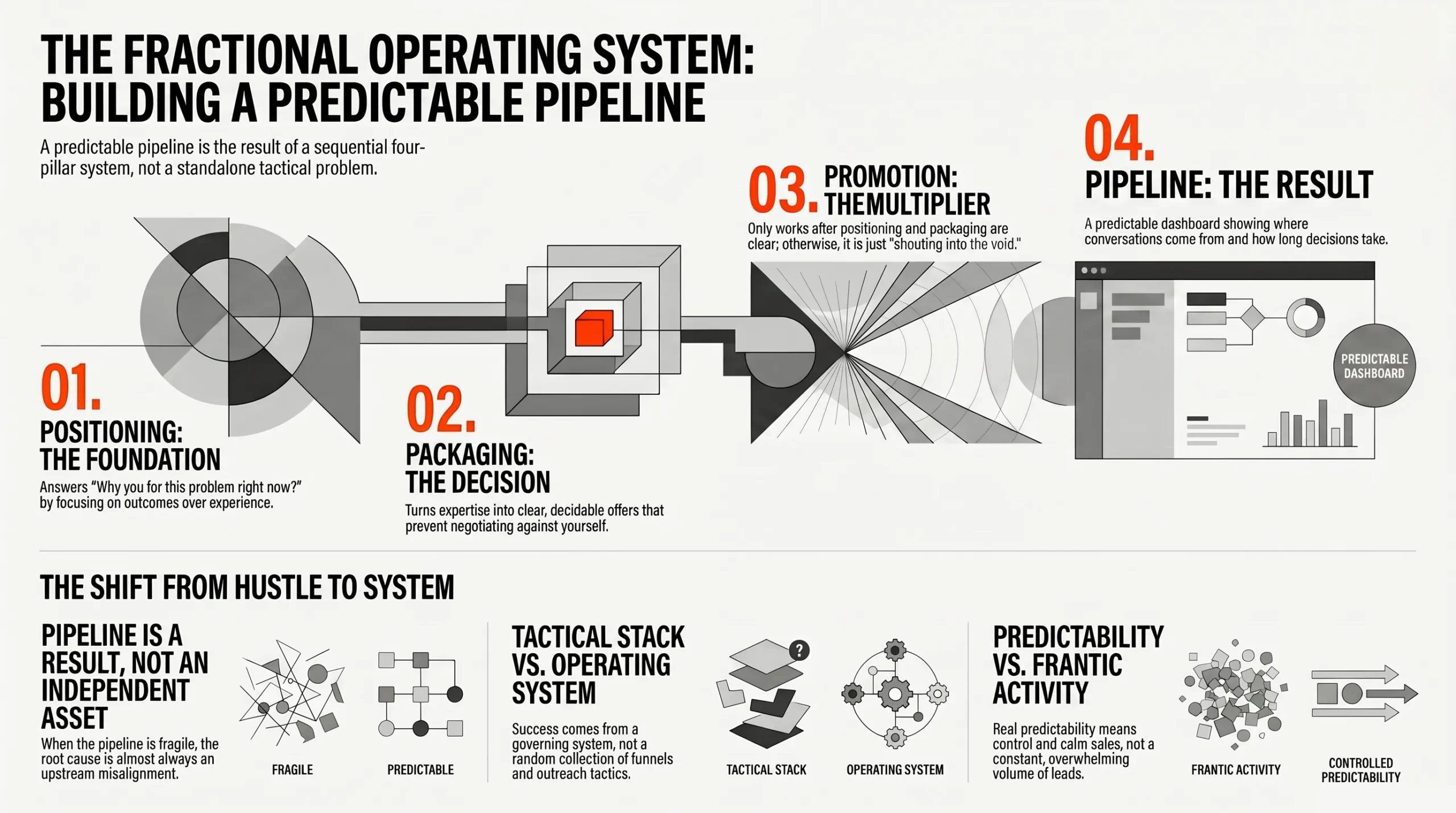
Pillar 1: Positioning (The Upstream Advantage)
Everything in your fractional business must start with your positioning.
Let me be incredibly clear about what positioning actually means. True positioning is not about listing your impressive corporate titles, it is not about reciting your resume, and it is not simply declaring yourself a fractional executive . True positioning answers one very specific, highly critical question in the premium buyer’s mind: “Why you, for this exact problem, right now?”.
The biggest mistake most senior executives make when they transition into the fractional space is remaining far too broad. They attempt to describe their vast, generalized experience instead of rigidly defining specific business outcomes. But premium B2B buyers—whether they are searching for a fractional ceo to lead a regional turnaround or a fractional coo to fix a broken global supply chain—are not buying your past experience. They are exclusively buying absolute clarity and guaranteed outcomes.
When your positioning is weak, your pipeline will immediately begin leaking. A weak positioning strategy guarantees that you will attract the completely wrong conversations, forcing you into exhausting cycles where you have to constantly explain your fundamental value. Ultimately, poor positioning makes you sound entirely interchangeable with every other consultant in the market.
Conversely, when your positioning is strong, your entire pipeline gets exponentially easier before you ever do a single ounce of promotion. When your message is laser-focused, premium buyers can instantly recognize their own organizational pain in your marketing. They actively self-select, and they enter your discovery conversations already half-sold on your value. They do not come in half-sold because you aggressively persuaded them, but because they finally feel deeply understood.
Without rigid positioning, pipeline activity becomes an exhausting, daily grind. With strong positioning, your pipeline becomes an upstream asset that magnetically pulls the right founders directly to you.
Pillar 2: Packaging (Turning Expertise into a Decision)
Once your positioning is crystal clear, the next massive failure point usually shows up incredibly fast: your packaging.
This is the exact operational stage where the vast majority of fractional executives completely stall out. Because they lack a structured system, they naturally default to vague, open-ended offers. They pitch hourly consulting rates, unstructured advisory retainers, or they utter the most dangerous phrase in the fractional landscape: “Let’s just see what you need”.
That sheer vagueness instantly kills your business momentum. This stall does not happen because buyers do not value your expertise; it happens because they simply do not know how to make the decision to actually choose you.
Elite packaging systematically turns your raw, complex expertise into a simple, binary decision. It rigidly defines the exact problem that is being solved, outlines what ultimate success actually looks like, and clarifies exactly what the engagement means operationally.
When you build strong, outcome-based packaging, it does something remarkably subtle but incredibly powerful: it creates massive confidence. It does not just create confidence for the anxious buyer; it creates unshakeable confidence for you, the executive.
When your fractional offer is highly structured and clearly defined, your sales conversations permanently stop feeling slippery and unpredictable. You completely stop awkwardly negotiating against yourself on pricing. Your pipeline instantly stabilizes because founders and CEOs know exactly what business outcome they are saying “yes” to. Whether you are a fractional cto selling a defined 90-day technical architecture reset or a finance leader selling a cash-flow stabilization protocol, your packaging is the critical bridge that makes your expertise buyable.
Pillar 3: Promotion (Compounding Trust, Not Just Noise)
Only after your positioning and your packaging are completely clear does your promotion actually begin to work.
This sequence is exactly where most independent leaders get it entirely wrong. They start their fractional journey by focusing heavily on promotion, and that is exactly why they burn out so quickly.
Let me state an undeniable truth of the B2B market: posting more content on social media will absolutely not fix broken positioning. Sending hundreds of cold outreach messages will never fix vague, unstructured offers. And attending endless local networking events will not fix market confusion.
Effective promotion is not about being obnoxiously everywhere all at once; it is entirely about being deeply consistent in the exact right places, with the exact right message.
When your promotional efforts are perfectly aligned with your rigid positioning and your structured packaging, your marketing effort begins to compound. This creates a highly predictable chain reaction: your strategic visibility creates market recognition, that recognition builds undeniable trust, and that deep trust seamlessly turns into high-value conversations.
When your marketing is not aligned with the first two pillars, your promotion simply feels like exhausting shouting into the void. This distinct lack of alignment is exactly why some executives feel completely exhausted and burned out, while other fractional leaders feel entirely calm while executing the exact same amount of marketing work.
Promotion is absolutely not supposed to be a draining, desperate activity. It is a strategic mechanism specifically designed to quietly support your overall business system.
Pillar 4: Pipeline (The Dashboard, Not the Engine)
Finally, we arrive at the pipeline itself. Notice that the pipeline comes absolutely last in this framework, not first. It is only in this final pillar where true business predictability actually shows up.
There is a massive misconception in the marketplace about what a predictable client pipeline actually entails. A predictable pipeline absolutely does not mean that you have a constant, overwhelming flood of cheap leads.
True predictability means that you intimately understand exactly where your high-value conversations are coming from. It means you understand exactly how long premium buying decisions actually take. It means you can clearly identify what specific factors are slowing those decisions down, and you know exactly how to strategically correct those bottlenecks.
Your pipeline is your business dashboard; it is not the engine.
When the first three pillars of the Fractional Operating System—Positioning, Packaging, and Promotion—are perfectly aligned, the pipeline naturally becomes incredibly boring. And in the world of B2B consulting, “boring” is highly profitable.
When your system is aligned, premium conversations arrive consistently. Your sales calls feel entirely calm and authoritative. Most importantly, when you get busy delivering massive ROI for a current client, that heavy delivery schedule does not kill your future demand.
That is what a predictable client pipeline actually means. It does not mean engaging in frantic, daily marketing activity; it means possessing absolute operational control.
The Real-World Transformation: From Reaction to Control
To truly ground this system, let me share a real-world example.
Think of a highly experienced senior executive. They possess a incredibly strong corporate background, they are deeply respected in their industry, and they have plenty of operational experience. When they first stepped out of the corporate world to go fractional in independent consulting, everything looked fantastic on the surface. Their early sales conversations came easily, and warm referrals successfully carried their business for quite a while.
But inevitably, those warm referrals dried up, and things severely slowed down. Their immediate reaction was to push harder. They tried utilizing more random marketing tactics, and they began feeling immense, exhausting pressure caught between their current client delivery and the desperate need to generate new demand. Nothing in their business felt explicitly broken, but it felt incredibly unstable.
Their breakthrough only happened once they firmly stopped treating their pipeline as the primary problem and instead focused on aligning the three pillars of the system underneath it.
Once they implemented the full Fractional Operating System, everything changed. Their inbound conversations suddenly became highly relevant. The sales process felt much calmer because the buyers already understood the offer. The pipeline permanently stopped spiking and stalling.
But the single biggest change for this executive wasn’t just a higher volume of leads; it was an incredible surge in executive confidence. Because they had a reliable system, they completely stopped reacting to the whims of the market and finally started choosing exactly who they wanted to work with.
That level of absolute autonomy is the real, ultimate outcome of installing a working business system.
The Bottom Line: Stop Guessing and Start Building
Understanding this four-pillar system conceptually is not the hard part; implementing it into your own practice in the exact right sequence is where the real challenge lies.
Most brilliant executives waste months, or even years, trying to piece this entire puzzle together from random advice, disjointed social media content, and painful trial and error. That approach is not only incredibly slow, but it is deeply frustrating.
You did not leave the demanding corporate C-suite to build an independent consulting practice that feels like an endless guessing game. You left to build a highly structured, scalable business that reflects your true executive worth.

To make this transformation incredibly practical for you, I have created a comprehensive implementation guide that walks you through exactly how to apply this entire system step by step. This guide is designed to help you accurately diagnose exactly where your current pipeline is breaking, seamlessly align your four core pillars, and systematically build absolute predictability without ever relying on exhausting hustle.
Now that you understand the true system behind a predictable pipeline for fractional executives, it is time to put it to work. This implementation guide includes the clear strategic frameworks, the practical templates, and the exact step-by-step sequence you need so that you are never left guessing what you should do next to grow your business.
If you are ready to stop chasing clients, stop relying on unpredictable referrals, and start building the scalable fractional executive practice you actually deserve, click the link to get your copy of the implementation guide today. Claim your leverage, install your systems, and take absolute control of your professional future.
FAQ
Question: Why isn’t my pipeline the first problem to solve?
Answer: Because pipeline issues are almost always symptoms of deeper system failures. The most successful fractional executives run a comprehensive operating system built on four pillars—Positioning, Packaging, Promotion, and Pipeline—in that order. If your positioning and packaging are unclear, promotion won’t compound and your pipeline will leak. Treat the pipeline as your dashboard that reflects upstream health, not as the engine that creates it.
Question: In what order should I implement the four pillars, and why does the sequence matter?
Answer: Implement them in this exact order: Positioning → Packaging → Promotion → Pipeline. Clear positioning answers “Why you, for this exact problem, right now?”; strong packaging turns your expertise into a simple, buyable decision; aligned promotion compounds trust instead of generating noise; only then does the pipeline become predictable. Skipping ahead or starting with promotion/pipeline leads to exhaustion, confusion, and feast-or-famine demand.
Question: What does strong positioning look like for a fractional executive, and what happens if I stay broad?
Answer: Strong positioning rigidly defines the specific problem you solve and the outcomes you deliver so premium buyers immediately see themselves in your message. Staying broad forces you to explain your value in every conversation, attracts the wrong discussions, and makes you interchangeable. With sharp positioning, ideal buyers self-select and arrive half-sold—not because you pushed hard, but because they feel understood.
Question: How do I turn my expertise into a buyable offer?
Aanswer: Use outcome-based packaging that makes saying “yes” binary. Define the exact problem solved, what success looks like, and the operational mechanics of the engagement. Avoid vague advisory retainers, hourly billing, and “let’s see what you need.” Clear packaging creates confidence for both buyer and executive, stabilizes pricing, and makes sales calls calm and predictable—for example, a defined 90-day technical architecture reset or a cash-flow stabilization protocol.
Question: How can I diagnose which pillar is breaking in my practice?
Answer: Look for these signals:
- Positioning: You attract generic or misfit inquiries and must constantly explain your value.
- Packaging: Sales feel slippery, buyers hesitate, and pricing turns into awkward negotiation.
- Promotion: You’re active but exhausted; content/outreach feels like shouting into the void.
- Pipeline: Demand spikes and stalls, and delivery work kills future demand—signaling you’re treating the pipeline as the engine instead of the dashboard.
- Realign Positioning and Packaging first, then tune Promotion; predictability in the Pipeline follows.
Question: What is a fractional executive?
Answer: A fractional executive is a highly experienced professional who works part-time or on a project basis with businesses to provide leadership and strategic direction without the commitment of a full-time role.
Question: How can I become a fractional executive?
Answer: If you’re wondering how to become a fractional, start by leveraging your past experience, define your unique value proposition, establish clear positioning and packaging for your services, and develop a consistent promotion strategy to attract clients in independent consulting.
Question: What are the benefits of hiring a fractional leader? Fractional leaders bring expertise, flexibility, and cost savings to organizations. They can address specific business challenges without the expense of a full-time executive, providing strategic insights and guidance tailored to the company’s needs.
Answer: How do I create a predictable client pipeline as a fractional executive? A predictable client pipeline requires a cohesive business operating system built on four pillars: positioning, packaging, promotion, and a solid pipeline framework. Each element must be aligned to ensure consistent lead generation and client acquisition.


