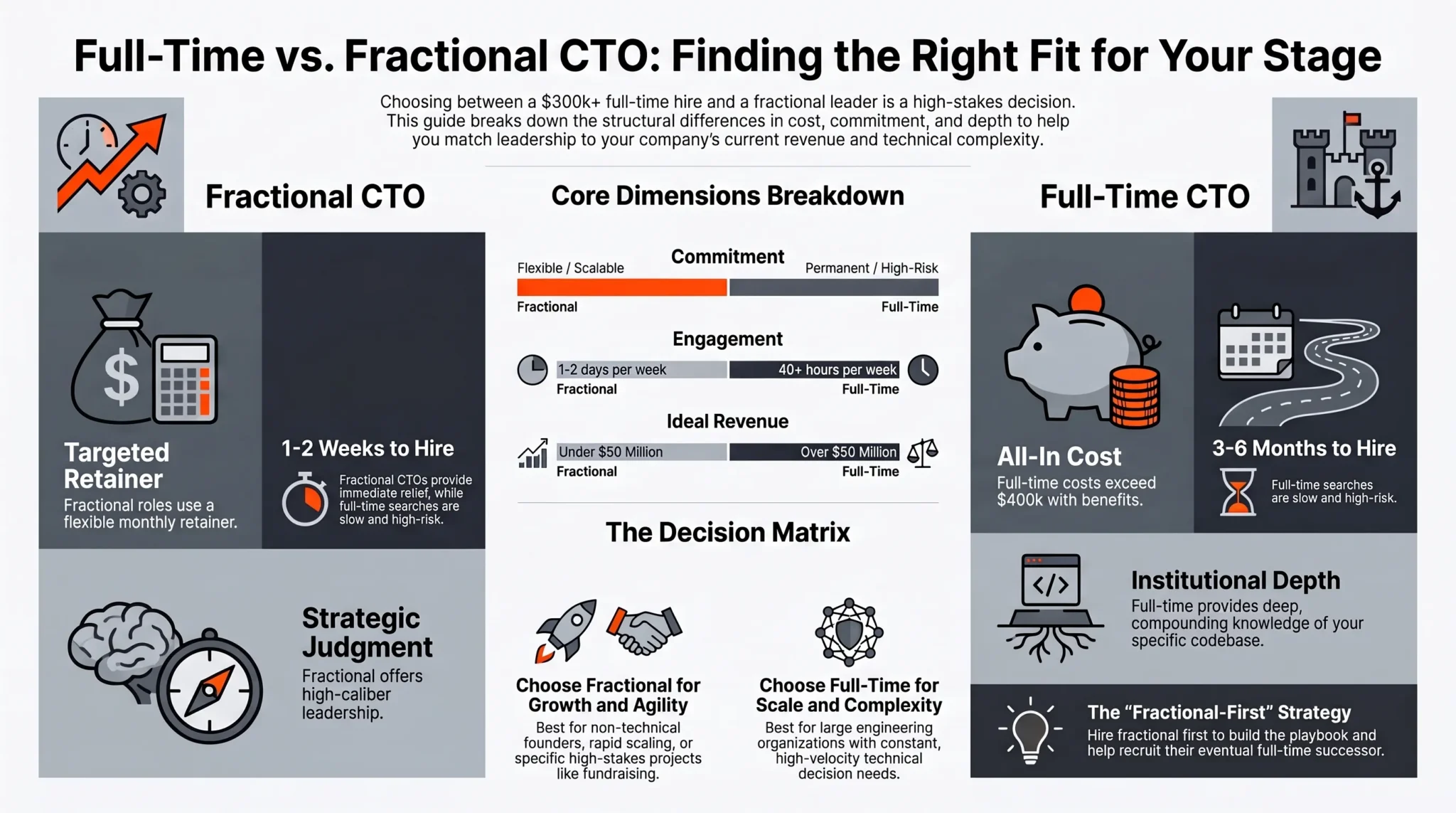
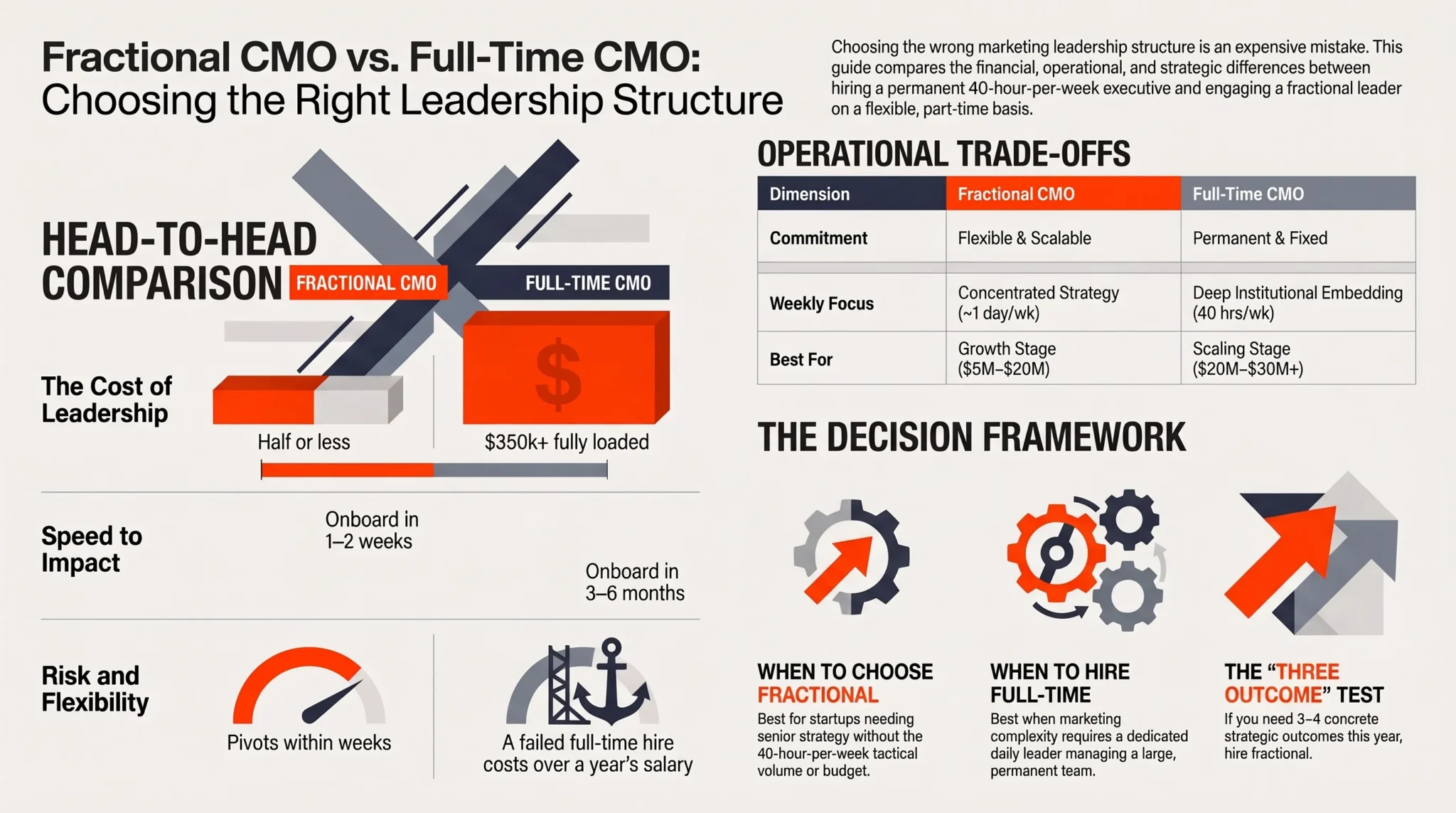
A founder is sitting in a crowded Silicon Valley coffee shop, leaning across the table toward an early-stage investor. The founder’s startup has just closed a promising seed round, the product is in a good place, and the sales pipeline needs immediate fuel.
“We need a serious marketing leader,” the founder says, rubbing their temples. “Our current team is full of junior executors, but we do not have a strategy. We cannot afford to drop two hundred and fifty thousand dollars on a full-time Chief Marketing Officer right now, and a standard agency will just blow our budget on random ad campaigns. Who do you know?”
This is the exact conversation happening in every major startup hub across the globe.
When a fast-growing company reaches that painful breaking point, their default reaction is no longer to go out and post a W-2 job listing on a public board. The modern market has realized that full-time leadership is no longer the default for scaling firms. Instead, they look to bring in an elite fractional executive.
Yet, despite the massive boom in the fractional leadership space, a major question remains: where to find fractional CMOs?
More importantly, once you understand how to find a fractional CMO, what kind of deal are you actually getting?
Almost nobody in this industry explains that not all the channels and platforms that connect growing companies with fractional executives operate the same way. In fact, there are three completely different commercial models hiding behind the exact same simple promise of finding you a marketing leader. The differences between these models are massive. If you get it wrong, the founder ends up paying a massive markup, or the executive ends up keeping barely half of their hard-earned rate for the exact same strategic work.
Whether you are a founder looking to hire elite strategic talent, or an independent leader looking to protect your business margins, you must understand the exact mechanics of how these professionals are sourced, vetted, and contracted.
Let’s pull back the curtain on the startup sourcing playbook, dissect the hierarchy of trust, and permanently demystify the platform layer.

1. The Sourcing Playbook: Sifting Through the Hierarchy of Trust
The first, and most critical, concept to internalize is that fractional CMO hires almost never start with a founder opening up a search engine and googling a basic vendor list.
In the high-stakes world of startup operations, trust is the ultimate currency. When a CEO is preparing to hand over the keys to their brand, their marketing budget, and their entire go-to-market strategy, they do not trust an algorithmic search page. They trust people.
Because of this, the sourcing channels in the fractional marketplace naturally stack into a rigid hierarchy of trust.
The Peak: Warm Referrals
At the absolute top of this hierarchy sit warm, personal referrals. These are the recommendations that come directly from the people who sit closest to the founder’s immediate marketing problems.
If a startup is backed by a venture capital or private equity firm, the founder’s first call is to their investment partners. Investors have an intense, highly motivated interest in protecting their capital, and they keep a tight roster of battle-tested operators they can parachute into struggling portfolio brands at a moment’s notice.
The second major referral source is fellow founders. If a CEO sees a peer startup successfully scale their pipeline from three million to ten million dollars, they will immediately ask that founder who built their operational engine.
The third, and often overlooked, referral source is other fractional executives. A fractional CFO or a fractional COO who is already embedded inside a company’s leadership team knows exactly how messy the internal operations are. If they see a broken marketing pipeline, they will immediately reach out to their own trusted network of fractional marketing executives to find a peer who can solve the problem.
The Mid-Tier: Peer Communities and Founder Networks
Directly below personal referrals are peer communities and elite founder networks. These are the warm, closed-door digital rooms where founders, advisors, and independent operators interact daily.
Whether it is a private Slack group, a highly curated mastermind, or an industry-specific executive association, these spaces act as powerful recommendation engines. When a member posts a specific query like, “We need an enterprise B2B SaaS marketing leader for ten hours a week,” the community immediately responds with vetted, peer-endorsed recommendations. The trust in these rooms is incredibly high because the members have a reputation to maintain within their professional tribe.
The Base: The Platform Layer
When a founder’s personal network and peer communities do not yield the perfect match, they move to the third tier: the formal platform layer.
These are established businesses whose entire professional mandate is connecting scaling companies with fractional executives. In recent years, this platform ecosystem has exploded. But this is exactly where the entire commercial structure starts to get incredibly complex, and it is the part that nobody actually teaches you.
2. Demystifying the Platform Layer: The Three Commercial Models
When a startup founder engages a platform to source a fractional CMO, they assume the platform is simply a matchmaking service. They assume that every marketplace functions under the same basic rules.
That assumption is a highly expensive mistake.
Underneath the simple marketing promise of “we will find you an executive,” there are three distinct commercial models operating in the market today. These models dictate exactly how much the founder ultimately pays, how much of that fee the executive actually keeps, and who ultimately owns and controls the client relationship.
Let’s break down these three models side by side.
The Three Platform Commercial Models
| Model Type | Sourcing, Billing, and Margin Dynamics |
| 1. Client-Direct Matching
(High Transparency) |
|
| 2. Client Markup (Medium Transparency) |
|
| 3. W-2 Agency Firms (Low Transparency) |
|
Model One: Client-Direct Matching Platforms
This is the cleanest, most transparent, and most operator-friendly model in the modern business landscape.
Under this model, the platform acts strictly as a matching and vetting engine. They pre-screen elite marketing leaders, catalog their specific industry niches, and present them to founders who need those exact skills. But the moment the introduction is made, the platform steps out of the operational way.
The founder and the fractional CMO negotiate the scope of work directly, sign a direct contract with each other, and manage the billing directly. The platform is not a contracting party, and they do not stand between the client and the executive.
A premier example of this specific framework is Hire a Fractional. On this platform, the executive pays a subscription or a small commission, while the startups pay nothing to browse and source talent. The founder pays the exact, clean rate that the executive sets. The executive keeps their full professional fee, minus their own predictable platform cost.
There is absolutely no spread or hidden markup sitting in the middle of the deal, quietly siphoning money from both sides of the table.
- For Founders: This model guarantees absolute pricing transparency. You know exactly where every single dollar of your marketing budget is going. You are not paying a bloated agency markup, and you are not subsidizing a massive company’s administrative payroll or expensive back-office infrastructure.
- For Fractional Executives: This is the ultimate model that respects and protects your business independence. You are not an outsourced contractor; you are a true business owner. You set your own rates, control your own billing, and completely own the strategic client relationship.
Model Two: Client Markup Marketplaces
The second model looks incredibly similar to the client-direct model on the surface, but the underlying financial engine is fundamentally different.
These marketplaces connect independent fractional leaders with startups, but they position themselves directly inside the financial stream. Instead of charging the executive a flat fee, the platform adds a percentage-based markup to every single invoice that the client company pays.
Typically, this markup sits around ten percent. For example, if the independent fractional CMO sets their professional strategic rate at ten thousand dollars a month, the platform will bill the client startup eleven thousand dollars a month. The platform pockets the one thousand dollar difference as their matching and billing fee.
Furthermore, these marketplaces almost always include strict conversion fees. If a founder works with a fractional leader for six months and realizes they desperately want to hire them as a full-time, W-2 employee, they cannot just sign a new contract. The marketplace will charge a heavy conversion fee, typically around fifteen percent of the executive’s projected first-year annual compensation, to release them from the platform.
- For Founders: This model is still relatively transparent because you can easily spot the markup line item on your monthly invoice. However, that ten percent markup adds up to a massive amount of capital over a long-term, multi-year engagement. And if you eventually want to bring that leader on full-time, the conversion fee can be a massive financial sting.
- For Fractional Executives: While the marketplace does not actively compress your base rate, you are forced to surrender control of your billing. All payments must run directly through the platform’s proprietary software. More importantly, the platform enforces strict anti-circumvention rules that legally prevent you from working directly with that client outside of their process. You do not fully own your own client relationships.
Model Three: Agency or W-2 Firm Models
This is the traditional, corporate approach to fractional placement, and it is the model that the vast majority of founders do not even realize they are using.
A W-2 fractional firm does not actually connect you with an independent executive who is running their own boutique practice. Instead, these firms hire senior marketing leaders as W-2 staff employees and then place them into client startups as outsourced resources.
In this structure, the firm sits permanently between the startup founder and the placed executive. Because they are employing the executive, they capture a massive percentage of the client’s monthly fee, which is often estimated at up to fifty percent. They use this heavy spread to fund their bench depth, pay for their administrative back-office, cover their sales teams, and subsidize the placed executive’s benefits and payroll.
For example, if a startup founder pays a premium executive rate of twenty thousand dollars a month to the firm, only about ten thousand dollars of that actual fee reaches the hands of the executive who is actually doing the hard strategic work.
- For Founders: The value proposition of this model is centered around security. You get immediate access to a deep bench of talent. If the placed executive does not work out, or if they suddenly get sick, the firm can immediately provide a replacement leader. You also get a highly standardized, managed back-office experience. The massive tradeoff is the hidden cost. You are paying a premium executive rate, but half of your capital is going toward supporting the firm’s heavy corporate overhead rather than driving your actual marketing strategy.
- For Fractional Executives: This model is almost always a raw deal for highly experienced, elite operators. While it provides you with a steady, reliable flow of placed clients and relieves you of doing your own sales and marketing, it quietly costs you a massive portion of your overall earning potential. You are forced to surrender half of your professional rate, lose absolute control over your client relationships, and forfeit the legal right to talk to the client outside of the firm’s rigid process. Most elite, highly experienced fractional executives, once they analyze these numbers, choose to walk away from W-2 placement firms entirely.
3. The Playbook for Founders: How to Navigate Sourcing and Vetting
If you are a startup founder preparing to enter the market to bring on a fractional CMO, you must navigate this landscape with absolute strategic intent. You cannot afford to throw capital at the first platform you encounter.
To secure the absolute highest ROI on your leadership spend, you should execute this exact sourcing and vetting playbook:
Step 1: Start with Warm Referrals
Before you look at any external platforms, exhaust your warmest networks. Reach out to your investors, your board members, your fellow founders, and your trusted fractional executives.
When you make these inquiries, you must be incredibly specific about your marketing problems. If you ask a vague question like, “Do you know any good marketing people?”, you will get silence or generic resumes.
Instead, ask a highly targeted, specific question:
“We are looking for a fractional CMO who has successfully built a B2B demand generation engine for a company at our exact scale. Who is the absolute best operator you know?”
Specific, targeted questions force your network to filter their memories and deliver highly qualified, specific names.
Step 2: Ask the Disarming Platform Question
If your warm referrals do not yield the perfect strategic partner, you will naturally transition to the platform layer. The moment you begin speaking with a platform representative, you must immediately ask one critical, non-negotiable question to cut through the marketing noise:
“Are your fractional executives independent operators or are they W-2 employees of your firm? And what exact percentage of my monthly fee actually goes directly to the person doing the work?”
This simple, disarming question is a massive pattern interrupt.
A client-direct matching platform will proudly tell you that their executives are entirely independent and that you will negotiate and pay them directly. A client markup marketplace will immediately disclose their flat ten percent markup percentage.
But a W-2 agency or corporate placement firm will likely get incredibly cagey and defensive about their internal fee breakdown. They will attempt to redirect the conversation by talking about their “vetted bench,” their “managed processes,” and their “replacement guarantees.”
You must hold the line. You have a right to know exactly where your capital is going before you sign a contract. If a firm refuses to be transparent, you must realize that you are paying a massive premium to support their infrastructure, rather than your actual marketing outcomes.
Step 3: Vet on Ownership, Not Credentials
Once you have sourced a candidate, do not fall into the trap of interviewing them like a traditional W-2 employee. You are not hiring an extra pair of hands to execute tasks; you are hiring a strategic partner who is there to run the entire department.
When you sit down to vet a fractional CMO candidate, evaluate them against these core pillars:
- Accountability for Outcomes: Are they willing to take absolute ownership of specific, agreed-upon departmental metrics, or are they hiding behind W-2 style tasks and deliverables?
- Strategic Focus: Do they demand a rigorous diagnosis phase in the first thirty days, or do they immediately jump to proposing generic tactics like “we need to post more on social media”?
- Team Leadership: How do they plan to manage, mentor, and upskill your existing junior team members so that the internal team can eventually scale?

4. The Playbook for Fractional CMOs: Protecting Your Independence
If you are a senior marketing executive transitioning out of corporate life to build your independent fractional practice, you must realize that these three platform models are absolutely not created equal.
In the early days of your practice, you might feel incredibly tempted to sign up for W-2 placement firms simply because the promise of steady, automated deal flow feels safe. But you must look closely at the math.
By surrendering up to fifty percent of your professional fee to an agency, you are actively recreating the exact same corporate wage-slavery you just fought so hard to escape. You are letting an external entity place a massive ceiling on your earning potential, control your daily schedule, and dictate how you interact with your clients.
If your ultimate goal is to build a highly profitable, highly impactful business that gives you back your freedom, you must prioritize the platforms and channels that protect your absolute independence.
- Focus on Client-Direct Matching: Lean heavily into matching platforms like Hire a Fractional that let money flow directly from the startup founder to your business with the smallest, most transparent fee in the middle. This is the only model that allows you to set your own rates, run your own billing, and completely own the client relationship.
- Build Your Own Sourcing Engine: Do not rely on platforms as your sole source of income. The elite fractional CMOs who win in this market are not the ones who depend on third-party marketplaces. They are the ones who have built their own predictable, automated pipeline.
You must install your own business operating system. You need a system that consistently positions you as an undeniable authority, builds deep trust with founders, and generates premium, high-value referrals completely on autopilot.
FAQ: Everything Founders and Operators Need to Know
Q: How much does it cost to hire a fractional CMO compared to an agency?
The cost of hiring a fractional CMO typically operates on a flat monthly retainer basis, ranging from three thousand to fifteen thousand dollars a month depending on your growth stage and the required cadence.
A marketing agency, conversely, usually bills a flat retainer that covers raw tactical execution. However, agencies are “hands” without a “head.” They will gladly execute a flawed strategy and burn through your budget because they are not accountable for your ultimate revenue outcomes. A fractional CMO acts as the strategic “head,” building the engine and managing the agency to ensure your marketing capital is deployed with maximum efficiency.
Q: What does a fractional CMO actually do inside a startup?
If you ask, “what does a fractional CMO do?”, the answer is that they act as the definitive architect of your entire marketing department. They do not just write copy or manage social media accounts.
They step directly into your executive team, define the go-to-market strategy, set the budget, hire and manage external agencies, mentor your internal junior team, and take absolute accountability for building a predictable, scalable revenue generation engine.
Q: Do startups ever hire a fractional CFO or fractional CEO through these same platforms?
Absolutely. The exact same trust hierarchy and platform models apply across the entire C-suite. Startups aggressively utilize fractional leadership to bring in a fractional cfo to manage complex debt restructuring or prep for fundraising, or a fractional ceo to navigate a major operational pivot.
Regardless of the specific role, the underlying commercial models remain identical. You must always seek direct, transparent relationships that minimize the middleman spread.
Q: Why is a fractional CMO hourly rate a red flag?
If a fractional marketing executive quotes you an hourly rate, you should view it as a massive warning sign. Hourly billing is the domain of freelancers and contractors, not strategic executives.
When an operator bills by the hour, their incentives are fundamentally misaligned with yours. They are financially motivated to work slowly to increase their billable hours. A true fractional executive bills a flat monthly retainer because they sell outcomes and transformation, not units of physical time.
Q: How many hours a week does a fractional CMO typically work?
Most fractional CMOs operate on a “permanently part-time” basis, which usually translates to five to fifteen hours a week depending on the complexity of the organization.
But you must completely stop measuring executive value by the hour. You are not paying for their time; you are paying a premium for their decades of pattern recognition. An elite fractional leader can diagnose a complex marketing bottleneck in fifteen minutes and implement a solution that would take a junior employee three months of stressful guesswork to figure out.
The Bottom Line: Prioritize Transparency and Independence
The explosive rise of the fractional economy has forever changed how scaling startups secure elite executive talent. Founders no longer have to settle for under-qualified junior hires or burn their capital on bloated W-2 salaries.
But to win in this new landscape, you must navigate the sourcing channels with absolute clarity.
Whether you are a founder looking to scale your brand, or an executive looking to scale your practice, the golden rule remains the exact same: the further you move away from a direct relationship between founder and executive, the more money sits in the middle, and the less either side controls the deal.
Prioritize the networks, the referral channels, and the matching platforms that let money flow directly, respect executive independence, and demand absolute commercial transparency.
If you are an elite corporate leader ready to make the transition, stop trying to guess your way through the market. Stop hoping for accidental referrals or giving away half of your hard-earned revenue to W-2 placement firms.
Your next critical step is installing a system that predictably brings high-intent founders directly to you on your own terms. I highly recommend watching my next video: The System Behind a Predictable Pipeline for Fractional Executives. In that session, I will show you the exact frameworks you need to build your own client acquisition engine, allowing you to completely bypass the middleman platforms, command your true worth, and scale your independent practice like a CEO.