

The Complete Roadmap (And The Hidden Structural Trap To Avoid)
Standing at the edge of corporate life is one of the most intoxicating and terrifying moments you will ever experience. You might be winding down a twenty year career inside a Fortune 500 company, completely exhausted by the endless politics, arbitrary restructuring, and bureaucratic inertia. Or perhaps you have been quietly picking up side projects on the weekends, testing the waters, and realizing that your true talent is being buried under corporate overhead. Either way, you are standing at a major professional crossroads. You are deciding whether to step out as an independent consultant.
What most executives do not realize in this pivotal moment is that the paperwork, the website, and the corporate entity are the easy parts. The real challenge is not logistical; it is psychological. And even more critically, there is a massive structural choice facing you right now. It is a decision that most new consultants make completely by accident, yet it dictates whether you end up trapped on an exhausting project based hamster wheel or building a highly lucrative, predictable business asset.
If you are wondering how to become an independent consultant without taking a massive pay cut or burning yourself out, you need to understand both the practical launch sequence and the business model choice that lies beneath it. Here is the complete roadmap to make your transition smooth, professional, and extraordinarily profitable.
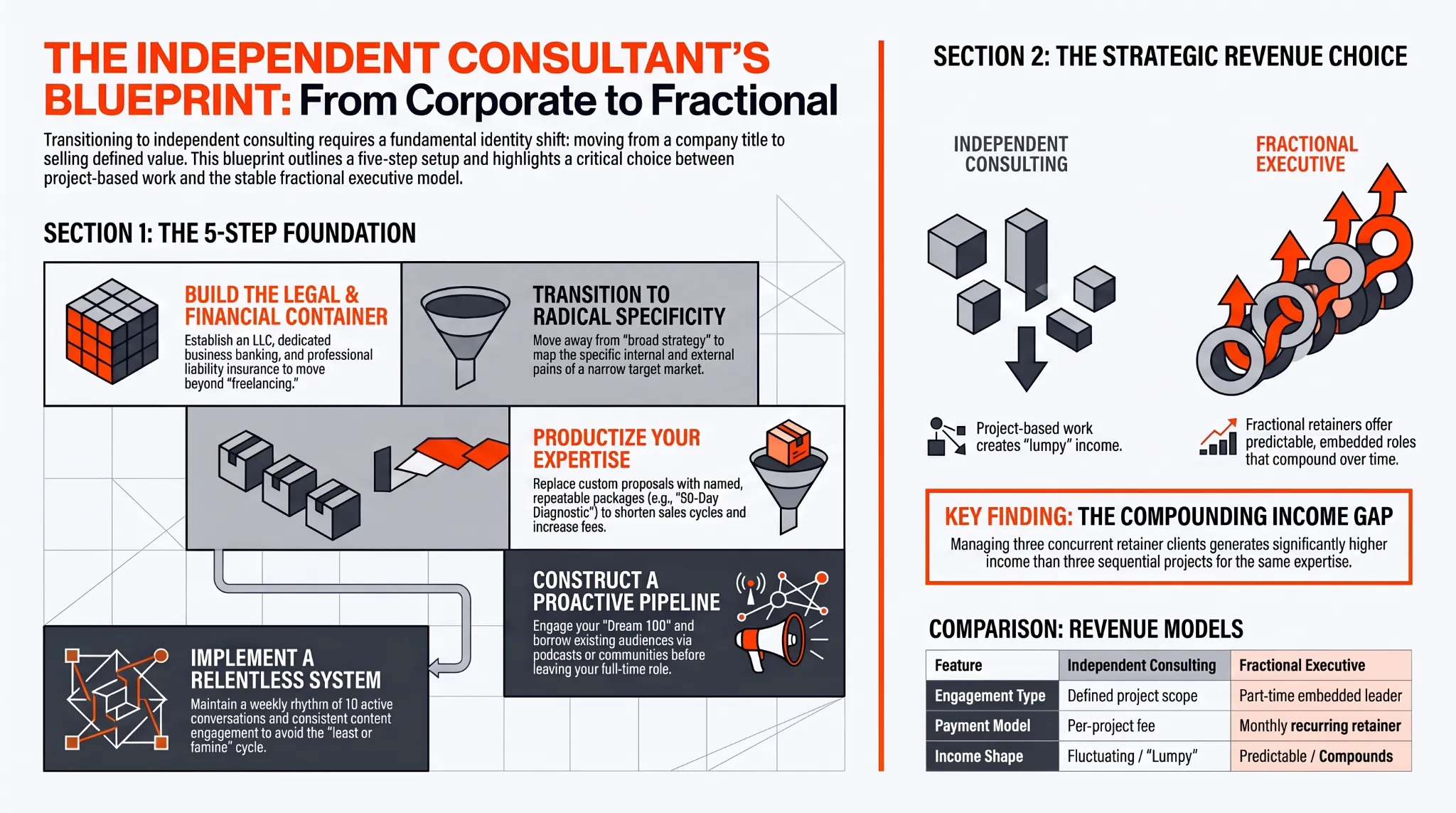
The Psychological Identity Shift: Giving Yourself Permission
Before you file a single piece of legal paperwork or buy a domain name, you must address the invisible shift that stops most talented executives in their tracks.
For your entire professional life, your identity and credibility have been tethered to a company name and a title on a business card. When someone asked you what you did at a dinner party, you gave them the shorthand: I am the Vice President of Marketing at a major software company, or I run global supply chain at a Fortune 500 enterprise. The company brand provided your credibility, your authority, and your social validation.
The moment you step out into independent consulting, that security blanket vanishes. Your brand is no longer the logo on your paycheck. The brand is you. The authority is you. The credibility is you.
Most executives deeply underestimate how uncomfortable this shift feels. Because their authority was tied to an institution, they set up an LLC, build a sleek website, print business cards, and then sit back, waiting for the market to grant them permission to begin. They wait for a former boss, a recruiter, or a corporate client to validate them with a contract.
Permission does not come from the market. Permission comes from you.
You have to rewire your self-perception from “I am what the corporate hierarchy says I am” to “I am what I sell, and I sell what I am.” Until you make that psychological leap, you will act like an insecure freelancer hoping for a gig instead of a confident business owner offering an elite solution.
Step One: Set Up The Legal And Financial Container
Once you have claimed your authority, the first practical step is to build the legal and financial container for your business. This is the operational foundation, and you can get it completed in less than two weeks.
First, establish your business entity. For most independent practitioners, a simple Limited Liability Company is the cleanest, most effective starting point. It separates your personal assets from your business liabilities and gives you a professional container for tax planning. Consult a qualified accountant to determine whether an S-Corporation election makes sense for your specific income targets.
Second, open a dedicated business bank account and credit card. Never allow personal and business finances to mix. Every dollar of revenue must flow into your business account, and every business expense must originate there. This single habit will save you countless hours of accounting headaches and protect your tax deductions.
Third, set up simple accounting software to track income, record expenses, and generate clean invoices. Do not manage your business finances out of a messy spreadsheet.
Fourth, solve your health insurance and benefits structure. Moving from a corporate group health plan to an individual or small business health plan can be a shock, but it is simply a cost of doing business that must be factored into your pricing.
Fifth, secure professional liability insurance, specifically Errors and Omissions coverage. When you are advising founders and C-suite teams on consequential business decisions, you must protect your business against potential legal disputes.
Getting this foundation built quickly is what separates a legitimate business owner from someone freelancing in the gaps. Do it early, handle it cleanly, and then shift your focus to what actually generates revenue.

Step Two: Get Uncomfortably Specific About Your Positioning
The second step in learning how to become an independent consultant is where the vast majority of talented professionals undermine their own success before they even launch. Their immediate instinct is to adopt broad, generalist positioning.
Because you have spent decades solving a wide variety of problems across operations, leadership, finance, and strategy, you tell yourself that you can help any company solve any problem. You write generalist slogans on your profile like Strategic Advisor, Business Transformation Consultant, or Executive Coach. You do this out of deep insecurity, believing that if you specialize, you will turn away potential revenue.
Broad positioning is precisely what makes you invisible in a noisy marketplace.
High-paying clients do not hire generalists. A founder or CEO facing an urgent, painful crisis does not look for general strategic advice. They look for a specialist who has solved their exact, specific problem multiple times before. They want a surgeon, not a general practitioner, and they pay a massive premium for specialized pattern recognition.
If you want to command high fees, you must get uncomfortably specific. You must define exactly who you serve, what growth stage they are in, what industry they operate in, and the specific expensive problem you solve for them.
To nail your positioning, map out your client world across four distinct dimensions:
External Pains: These are the visible, measurable metrics that everyone in the company can see. Examples include flatlining pipeline, high customer churn, or missed product deployment deadlines.
Internal Pains: This is the private stress that the founder or executive keeps to themselves. It is the anxiety of failing in front of their board, feeling overwhelmed by operational chaos, or fearing they might miss payroll.
External Wins: These are the public victories celebrated by the board and team, such as successfully closing a funding round, launching a flagship product line, or doubling net margins.
Internal Wins: These are the personal desires they crave, such as regaining control over their calendar, feeling confident in their leadership, or taking a vacation without checking email every ten minutes.
When your positioning mirrors all four dimensions in the client’s precise language, your marketing stops sounding like a generic sales pitch and starts sounding like immediate recognition. The prospect reads your material and thinks, “This person understands my exact world.” That is the moment they book a call.
Step Three: Productize Your Expertise And Stop Selling Time
The third step is to revolutionize how you package and sell your knowledge. You must stop selling your time by the hour, and you must stop writing custom proposals.
Writing custom proposals is an exhausting, non-billable time sink. You have a great initial conversation with a prospective client, get excited, and spend eight hours drafting a complex, customized project proposal. You detail every step, list your hourly rates, and email the PDF with high hopes. Then you enter a black hole of silence. The prospect stalls, asks for scope revisions, or tries to negotiate your price down.
Custom proposals treat your expertise like a flexible commodity and invite the client to debate your process, your hours, and your fees.
You must replace custom proposals with productized offers.
Instead of offering generic advisory services at an hourly rate, package your expertise into a clearly defined engagement with a set scope, a fixed price, and a predictable outcome. Give your offer a distinct, memorable name that highlights the result. Examples include a Ninety Day Revenue Architecture Audit, a Growth Stage Tech Stack Diagnostic, or a Series A Financial Roadmap.
Productizing your offers delivers four major advantages for your business:
Shorter Sales Cycles: The prospect understands exactly what they are buying, what it costs, and what outcome they will receive. There is no confusing scope to negotiate, enabling a closing decision on a single call.
Higher Profitability: You decouple your income from the clock. Instead of billing for physical hours worked, you price based on the value of the outcome delivered, dramatically increasing your effective hourly earning rate.
Streamlined Delivery: Because you run the exact same structured playbook for every client instead of reinventing the process, your delivery becomes faster, easier, and higher quality.
Maximum Referability: Broad advisory work is almost impossible for colleagues to refer because it lacks shape. A named, productized offer gives referrers a clear, memorable concept they can easily describe to peers in their network.
Step Four: Build Your First Clients Before You Leave Your Job
The fourth step is executing a proactive client acquisition strategy. The biggest mistake new consultants make is quitting their job, setting up an LLC, announcing their launch on social media, and then sitting quietly waiting for the phone to ring.
Desperation is a terrible negotiating posture. You should build your client pipeline while you still have the safety net of a corporate salary or a severance buffer.
Start by mining your warm professional network. Reach out to former colleagues, industry peers, vendors, and executives you respect. Do not approach them with a desperate sales pitch. Reach out for strategic catch-up conversations, explain the specific problem you are solving in your new practice, and ask about the challenges they are seeing in their market. Many of these conversations will naturally evolve into your first paying clients or warm introductions.
In addition to your warm network, build your Dream 100 relationship system. Identify the exact one hundred key individuals who represent your ideal clients, institutional investors, or referral partners. Instead of broadcasting generic content to a cold audience, engage thoughtfully with these one hundred people. Comment on their insights, share their work, and offer genuine value without asking for anything in return over several months.
Finally, leverage existing platforms. Rather than trying to build a massive personal social media audience from scratch, seek out established podcasts, private executive communities, and industry conferences where your ideal clients already gather. Pitch valuable, educational topics that solve specific problems for their audience. Borrowing established trust is the fastest way to generate qualified inbound leads.
Step Five: Install A Repeatable Pipeline System
The fifth step is building a simple, operational system to manage your business growth. The reason so many independent consultants suffer through years of the feast or famine cycle is that they only market when their calendar is empty. When they secure a project, they drop all marketing to focus on delivery. When the project ends, they wake up to an empty pipeline and enter panic mode.
To escape this trap, you must install a simple, non-negotiable weekly business system.
Set up a basic Customer Relationship Management tool, an automated scheduling link, and a weekly operational rhythm. Commit to maintaining at least ten active sales conversations every single week. Make three high-value engagements on your Dream 100 list every week, and publish one piece of sharp, original insight to establish your authority.
When you execute this simple pipeline system relentlessly, your client acquisition stops being mood-dependent. It becomes a predictable, operational engine that runs smoothly regardless of whether you are delivering client work or taking time off.
The Hidden Choice: Independent Consulting Versus Fractional Leadership
| Dimension | Traditional Independent Consulting | Fractional Executive Leadership |
| Core Role | External advisor or project contractor | Embedded part-time C-suite leader |
| Income Structure | Lumpy, project-by-project fees | Predictable, monthly recurring retainers |
| Accountability | Deliverables, reports, and strategy decks | Ongoing team management and business outcomes |
Now we arrive at the critical fork in the road that most new independents miss entirely. Everything we have covered so far, including setting up the legal structure, defining your positioning, productizing your offers, and building a pipeline system, applies equally to two completely different business models.
You are about to choose between these two models, often without realizing it. And that decision will dictate your lifestyle, your work hours, and your income trajectory for years to come.
Model One: Traditional Independent Consulting
In the traditional consulting model, you sell standalone projects. A client hires you to solve a defined problem, complete an audit, or write a strategy deck. You execute the scope, deliver the report, and collect your fee. The engagement ends, your revenue from that client drops back to zero, and you must return to the market to find your next project.
While independent consulting is a valid model, it is inherently project-based and lumpy. You are constantly hunting for the next deal, and your income resets every time a deliverable is completed.
Model Two: The Fractional Executive Model
In the fractional executive model, you do not sell short-term projects or external advice. Instead, you are hired as an embedded, part-time leader on a monthly recurring retainer that continues for six, twelve, or eighteen months.
Rather than standing outside the company handing over a strategy deck, you step inside as an active member of the executive team. You take on defined leadership roles such as a fractional CMO, fractional CTO, or fractional CFO. You own the strategy, lead the team, manage external agencies, and take ongoing accountability for business outcomes.
The comparison between these two structures is eye-opening:
If you operate as a traditional consultant, you might secure three separate projects over the year at fifteen thousand dollars each, earning forty-five thousand dollars of lumpy income while constantly prospecting.
If you structure your practice around fractional leadership, you can comfortably hold three concurrent retainer clients charging a conservative monthly retainer of seven thousand dollars each. That generates twenty-one thousand dollars a month in predictable, recurring revenue, compounding to over two hundred and fifty thousand dollars annually while working a balanced three-day workweek.
Same expertise, same positioning effort, but a dramatically superior business structure.
It is far easier to choose the fractional model from day one than it is to rebrand your business after spending years positioned as a traditional project consultant. If you want predictable income, recurring revenue, and deep operational impact, structure your practice around fractional executive leadership from the very beginning.
The Bottom Line: Claim Your Authority And Build An Asset
Stepping out of the corporate world to become an independent consultant or fractional executive is one of the most empowering professional moves you will ever make. But success requires far more than technical expertise.
Claim your authority and make the psychological shift from corporate employee to business owner. Build your legal container, define uncomfortably specific positioning, and package your knowledge into productized offers. Build your relationships through a Dream 100 system, and install a simple, non-negotiable pipeline rhythm.
Most importantly, choose the right business model from the start. By structuring your expertise around the recurring retainer power of fractional leadership rather than lumpy project consulting, you will build a predictable, highly lucrative business that rewards your decades of experience while giving you complete freedom over your life.
FAQ: Everything You Need To Know About Becoming An Independent Consultant
Question: How long does it take to transition from corporate to independent consulting?
Answer: The operational setup, including entity creation and banking, takes about two weeks. If you build your positioning and mine your network while still employed, you can secure your first paying client within thirty to sixty days of launching.
Question: What is the main operational difference between an independent consultant and a fractional CMO?
Answer: An independent consultant works from the outside on a defined project, delivering strategy decks or audits and leaving when the report is submitted. A fractional CMO is an embedded executive who joins the company on a part-time basis, manages the marketing team, oversees budgets, and takes ongoing accountability for revenue growth and pipeline performance.
Question: How does fractional CMO pricing work and what is the typical fractional CMO cost?
Answer: When evaluating fractional CMO pricing models or calculating the overall cost of hiring a fractional CMO, founders quickly realize that while new practitioners sometimes calculate an internal floor using a fractional CMO hourly rate of one hundred and fifty to two hundred and fifty dollars, elite operators do not quote hourly rates to clients. They price their services as flat monthly retainers, typically ranging from six thousand to fifteen thousand dollars per month depending on company stage, scope, and strategic value.
Question: What does a fractional CMO do on a day to day basis?
Answer: A fractional CMO conducts initial strategic diagnostics, defines brand positioning, aligns marketing programs with sales targets, manages internal teams and external agency partners, and reports directly to the CEO and board on revenue performance.
Question: How do I handle pricing conversations without sounding pushy or insecure?
Answer: Never quote rates on the spot or sell time by the hour. Use a productized offer with a fixed scope, flat monthly retainer, and clear deliverables. Present your offer as an authoritative diagnostic solution to an expensive problem, transforming the sales call from a pitch into a strategic consultation.


