The Fork In The Road: Reframing The C-Suite Marketing Decision
Imagine sitting in a high-stakes board meeting where your lead investors are pressing you for predictable growth. You know beyond a shadow of a doubt that your company requires serious, executive-level marketing leadership to scale to the next level. Your product is solid, your sales team is working hard, but your demand generation engine is inconsistent, your positioning feels outdated, and your brand lacks a cohesive strategic narrative.
At that exact moment, you find yourself staring directly at a high-stakes fork in the road. Do you post a job listing for a full-time Chief Marketing Officer, bringing on a permanent, six-figure corporate executive? Or do you engage a fractional CMO to embed directly into your leadership team on a part-time, flexible basis?
This is one of the most critical structural decisions a scaling CEO will ever make. Choosing incorrectly in either direction is extraordinarily expensive. If you hire a full-time executive too early in your company evolution, you saddle your operational balance sheet with a quarter million dollar commitment that you cannot genuinely afford or keep fully utilized. Conversely, if you bring in a fractional executive when your business actually requires a dedicated, 40-hour-a-week operational leader in the building every single day, you severely under-resource a critical revenue engine.
Most founders approach this dilemma by asking a simple question: Which option is better? That is completely the wrong starting point. Neither model is inherently better or worse. They are two entirely different structural tools designed for completely different stages of corporate growth.
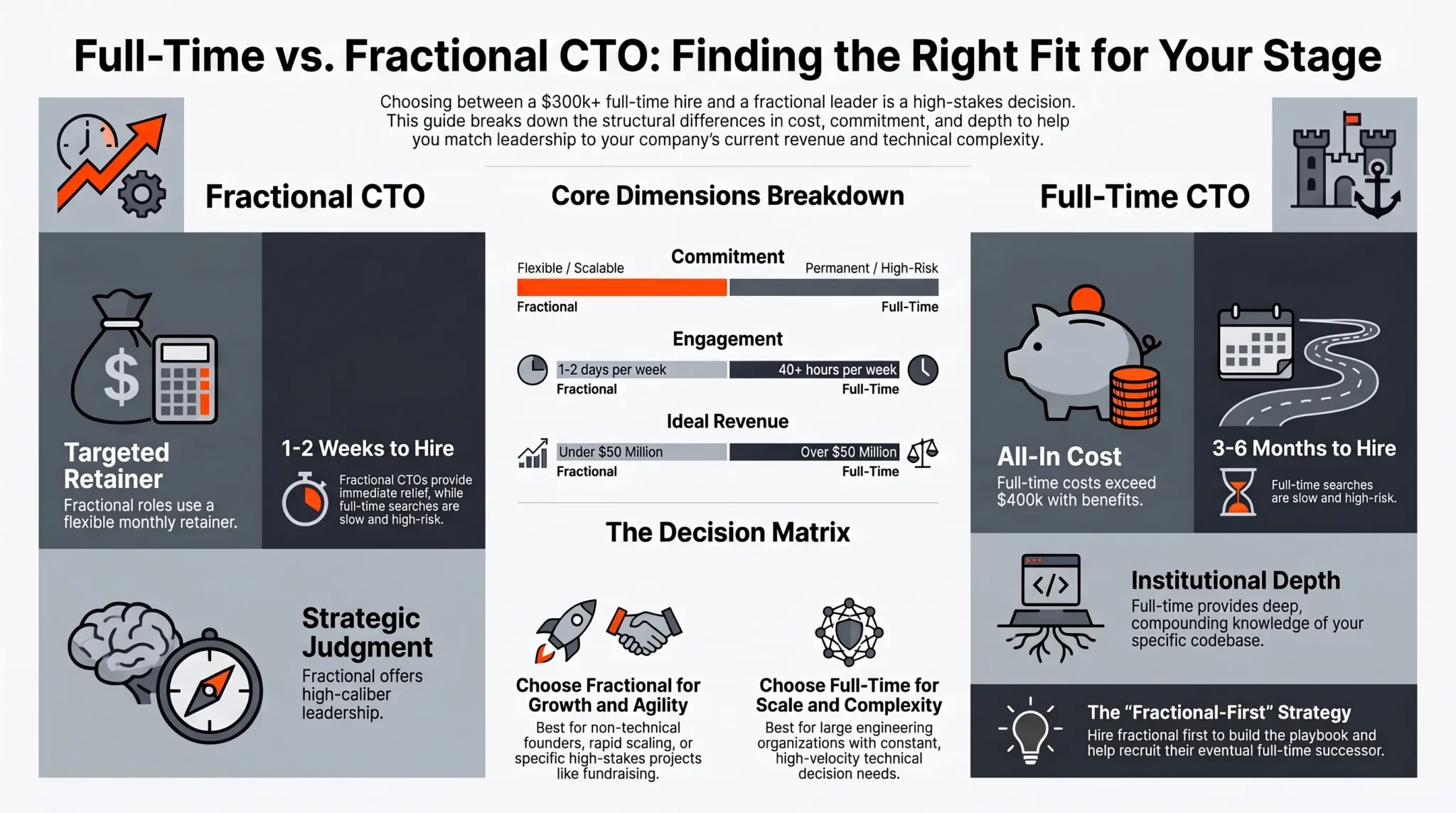
A full-time CMO is a permanent, dedicated W-2 executive who lives inside your organizational structure for 40 hours a week, managing internal teams and making dozens of micro-decisions every single day. A fractional CMO is an experienced executive who brings that exact same high-caliber strategic leadership on a flexible, part-time basis, typically serving around one day per week while guiding a small portfolio of complementary non-competing companies.
Both professionals are real C-suite leaders. Both can take complete ownership of your marketing strategy, align your sales pipelines, and direct your execution team. The core difference is not talent, experience, or seniority. The difference lies entirely in structure, financial commitment, and organizational capacity. The real question you must answer is simply this: Which structure aligns with where your company is operating right now?
The Economics Of Marketing Leadership: Salaries, Retainers, And Hidden Overhead
When evaluating a fractional executive versus a full-time executive, financial cost is usually the first dimension that hits a founder. However, most CEOs calculate this cost completely wrong because they compare a contractor invoice against a base salary, overlooking the massive loaded overhead and operational drag that accompanies a full-time executive hire.
The True Cost of a Full-Time CMO
According to industry market data, the average base salary for a Chief Marketing Officer in the United States ranges between $200,000 and $300,000 per year. But base salary is only the starting point. When you factor in annual performance bonuses, equity grants, comprehensive health benefits, employer payroll taxes, 401k matching, and executive onboarding perks, the true cost of hiring a fractional CMO alternative on a full-time basis climbs rapidly.
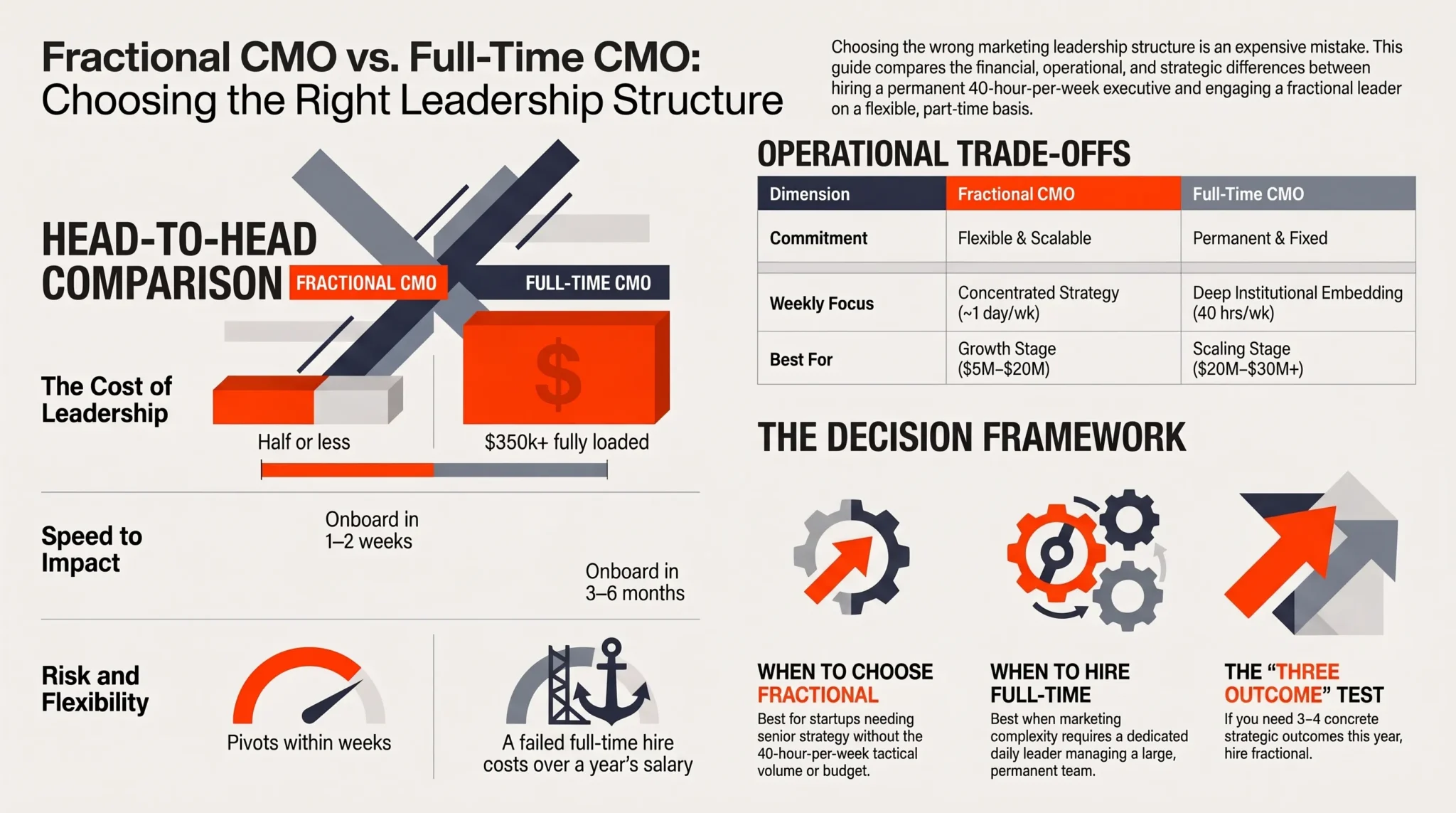
A market-rate corporate CMO with a $250,000 base salary ultimately represents an all-in annual financial commitment of $350,000 or more to your business. This full-time CMO cost is a fixed, non-negotiable overhead commitment that hits your cash flow every single month regardless of market volatility or company performance.
The Capacity Problem: Paying Executive Rates for Tactical Work
There is a deeper, quieter financial drain that affects companies generating under $20 million in annual revenue. Most businesses at this stage simply do not have 40 hours a week of high-level, strategic executive work to be done. Strategy, positioning frameworks, and demand engine architectures do not require 160 hours of executive time every single month.
When you place a $350,000 full-time CMO into an early or growth-stage business, that executive quickly runs out of high-level strategic tasks. To fill their 40-hour work week, they inevitably end up doing low-level, tactical work: reviewing ad copy, adjusting email graphics, managing software settings, or sitting in routine status updates. You end up paying a top-tier executive price tag for $50-an-hour execution work.
The Fractional CMO Retainer Advantage
Understanding fractional CMO pricing is simple when you look at the structure. A fractional CMO operates on a flat monthly retainer that typically ranges between $6,000 and $15,000 per month, representing an annual cost of $72,000 to $180,000. The cost of hiring a fractional CMO is roughly half or less of the total loaded cost of a full-time executive. More importantly, you are paying exclusively for concentrated senior strategy and pattern recognition.
You are not buying physical hours on a clock; you are buying executive judgment. You get the exact amount of executive leadership your company actually needs without absorbing the bloated cost of idle full-time capacity.
The Hidden Team Overhead
A full-time CMO rarely operates alone. When a corporate executive steps into your C-suite, their immediate priority is usually to build out a full internal department underneath them. They will request dedicated copywriters, media buyers, SEO specialists, graphic designers, and marketing operations managers.
Therefore, the true financial comparison is not merely a retainer versus a salary. The real financial comparison is a fractional CMO cost that makes your existing team and external agencies vastly more efficient versus a full-time executive salary plus the substantial headcount budget that executive will insist on building.
Speed, Commitment, And Risk: Quantifying The Cost Of A Mis-Hire
Speed to market, contract flexibility, and risk mitigation are three critical leadership factors that always travel together in growth-stage companies.
Time to Onboard and Execute
Conducting a traditional executive search for a full-time CMO is a grueling, slow process. Retaining an executive search firm, screening candidates, conducting multiple interview rounds, negotiating equity packages, and accommodating a notice period typically takes between 90 and 180 days. Once the executive finally arrives, they usually require another 60 to 90 days to onboard and fully understand your business before making major strategic decisions.
If your company is facing a stalled revenue pipeline, a critical product launch, or an immediate competitive threat, waiting six to nine months for strategic impact is an existential risk. A fractional CMO can be vetted and engaged in one to two weeks, diving directly into your business and driving strategic clarity within their first ten days.
Contract Flexibility and Agility
A full-time CMO is a hard, permanent structural commitment. If your revenue trajectory shifts, if market conditions tighten, or if your strategic focus pivots, unwinding a full-time executive relationship is slow, emotionally draining, and financially painful. Severance packages, legal negotiations, and team disruption can destabilize your organization for months.
Conversely, fractional leadership is designed from the ground up for maximum flexibility. You can scale the engagement up during major growth pushes, adjust the scope as your internal team matures, or transition out cleanly with standard notice. This agility dramatically lowers your operational risk profile.
The Staggering Cost of an Executive Mis-Hire
Put a concrete number on executive risk for a moment. Industry data indicates that a failed full-time executive hire costs a company well over one full year of that executive’s total salary. When you combine lost market momentum, wasted recruitment fees, severance payouts, internal cultural disruption, and the expense of starting the entire executive search over, a bad full-time CMO hire easily costs a scaling business over $400,000.
If a fractional engagement proves to be an imperfect fit, your total downside exposure is limited to a month or two of retainer fees and a quick, clean conversation. These two scenarios are not remotely on the same level of business risk.

Depth, Focus, And Bandwidth: Where The Full-Time CMO Wins
To make a truly objective decision, you must understand where the full-time model genuinely excels. There are specific organizational environments where a full-time CMO is unquestionably the right choice, and attempting to put a fractional executive into that seat would shortchange your business.
The Value of 40 Hours of Dedicated Presence
A full-time CMO is completely dedicated to your company 40 or 50 hours a week, every single week. Over time, they develop deep institutional knowledge regarding every minor nuance of your product line, every customer quirk, and every subtle personality dynamic on your leadership team. They are physically or virtually present for every hallway conversation, every informal brainstorming session, and every spontaneous operational challenge.
A fractional CMO provides highly concentrated senior strategy, but operates on limited weekly bandwidth while serving a small portfolio of other non-competing clients. They will never be as deeply immersed in the daily micro-details of your company as a full-time executive who sits in your building every day.
Navigating Complexity at Scale
If your company has scaled beyond $30 million or $50 million in annual revenue, operating across multiple international territories with dozens of complex product lines and a 30-person internal marketing department, your daily operational volume genuinely requires a dedicated, full-time leader. In that environment, the sheer volume of daily meetings, cross-departmental alignment calls, and direct report management demands a full 40-hour presence.
However, for growth-stage businesses generating between $3 million and $20 million, high-level strategic direction and clear execution playbooks are far more vital than 40 hours of daily physical presence. You do not need a full-time executive to supervise daily tasks; you need an elite fractional executive to set the strategy and hold your execution team accountable.
Head-To-Head Comparison: Full-Time Vs. Fractional CMO
The table below details the six core dimensions comparing a full-time Chief Marketing Officer with an embedded Fractional CMO, allowing you to evaluate both options against your current organizational requirements.
| Dimension | Full-Time CMO | Fractional CMO |
| All-in Financial Cost | High: $350,000+ per year fully loaded (salary, bonus, equity, benefits, taxes). | Moderate: $72,000 to $180,000 per year (flat monthly retainer, zero benefit overhead). |
| Time to Onboard | Slow: 90 to 180 days to recruit, interview, negotiate, and onboard. | Fast: 1 to 2 weeks to vet, contract, and begin driving strategic impact. |
| Contract Commitment | Hard Commitment: Permanent W-2 hire with high severance and legal friction. | Flexible: Retainer agreement that can scale up, dial down, or end cleanly. |
| Hours & Capacity | 40+ Hours/Week: Dedicated physical presence, often filled with tactical tasks. | Concentrated Bandwidth: Focused strategic leadership (~1 day per week). |
| Organizational Depth | Deeply Embedded: Present in every hallway talk and micro-decision over time. | Focused High-Level Impact: High strategic leverage without corporate echo chambers. |
| Downside Mis-Hire Risk | Extremely High: $400,000+ total loss including momentum, severance, and search fees. | Low: Downside capped at 1 to 2 months of retainer fees before pivoting. |
Key Takeaway: The key takeaway from this comparison matrix is clear: a full-time CMO provides deep operational volume at a high fixed cost, while a fractional CMO provides concentrated strategic horsepower at a fraction of the financial commitment and risk.
The Diagnostic Framework: Which Camp Are You In?
To make a confident hiring call, you can apply two simple diagnostic tests developed through years of executive advising. These tests instantly reveal whether your business requires a fractional executive or a full-time hire.
Test 1: The Three Strategic Outcomes Test
Sit down with a clean sheet of paper and write down the core marketing goals your company must achieve over the next 12 months. If you can clearly define three or four concrete, high-value strategic outcomes, you have a fractional CMO role. Examples of concrete strategic outcomes include:
- Building a repeatable demand generation engine that delivers 50 qualified sales leads per month.
- Repositioning your core product offering to transition from SMB clients to enterprise accounts.
- Restructuring your sales and marketing technology stack to reduce customer acquisition costs by 30 percent.
- Establishing a unified brand narrative and content architecture across all acquisition channels.
Achieving these high-level outcomes requires deep strategic judgment, system design, and leadership. It does not require 160 hours of executive presence every month. An elite fractional CMO can step in, design the strategic architecture, guide your internal team, and achieve those outcomes efficiently.
Test 2: The Hundred Micro-Decisions Test
Conversely, if you look at your marketing function and say: I need a senior executive physically sitting in this building 50 hours a week, managing 20 internal employees, sitting in daily operational updates, and making a hundred tactical micro-decisions every single week, you have a full-time CMO role. Do not attempt to put a fractional executive into that seat, as you will under-resource the function and frustrate both parties.
Revenue Stage Benchmarks
While every company is unique, organizational revenue provides an exceptionally reliable guide for determining executive structure:
Under $5 Million: Seed to $5 Million Revenue: You do not need an executive CMO of any kind. Your primary need at this stage is founder-led sales combined with tactical execution from hungry junior marketers, specialized freelancers, or execution agencies.
$5 Million to $20 Million Revenue: Fractional CMO is almost always the exact right answer. You require high-level strategic pattern recognition, positioning, and pipeline architecture, but your business cannot justify or keep a $350,000 full-time executive fully engaged.
$20 Million to $30 Million Revenue: This is the transition zone. If your marketing complexity is exceptionally high, or if you manage a massive multi-product portfolio, you begin transitioning toward a full-time CMO.
Over $30 Million Revenue: A full-time CMO becomes the right choice. Your revenue scale, departmental headcount, and market complexity justify a dedicated, permanent executive sitting in the building every day.
The Fractional-to-Full-Time Bridge Strategy
One of the smartest corporate growth strategies utilized by sophisticated founders is using a fractional CMO as a bridge to a full-time hire. Bringing in a fractional executive allows you to stabilize your marketing engine immediately, build predictable pipeline metrics, and determine the exact skill set required for a full-time role before you ever post a job listing.
In many cases, the fractional CMO actually helps author the full-time job description, establishes the department KPIs, and assists the CEO in recruiting and vetting their own full-time successor. This eliminates the risk of hiring a full-time executive into a chaotic, unstructured environment.
Pricing And Value Alignment: How Fractional CMOs Structure Engagements
Understanding how fractional executives structure their pricing helps CEOs evaluate proposals and recognize authentic C-suite operators.
The Math-Defensible Floor Formula
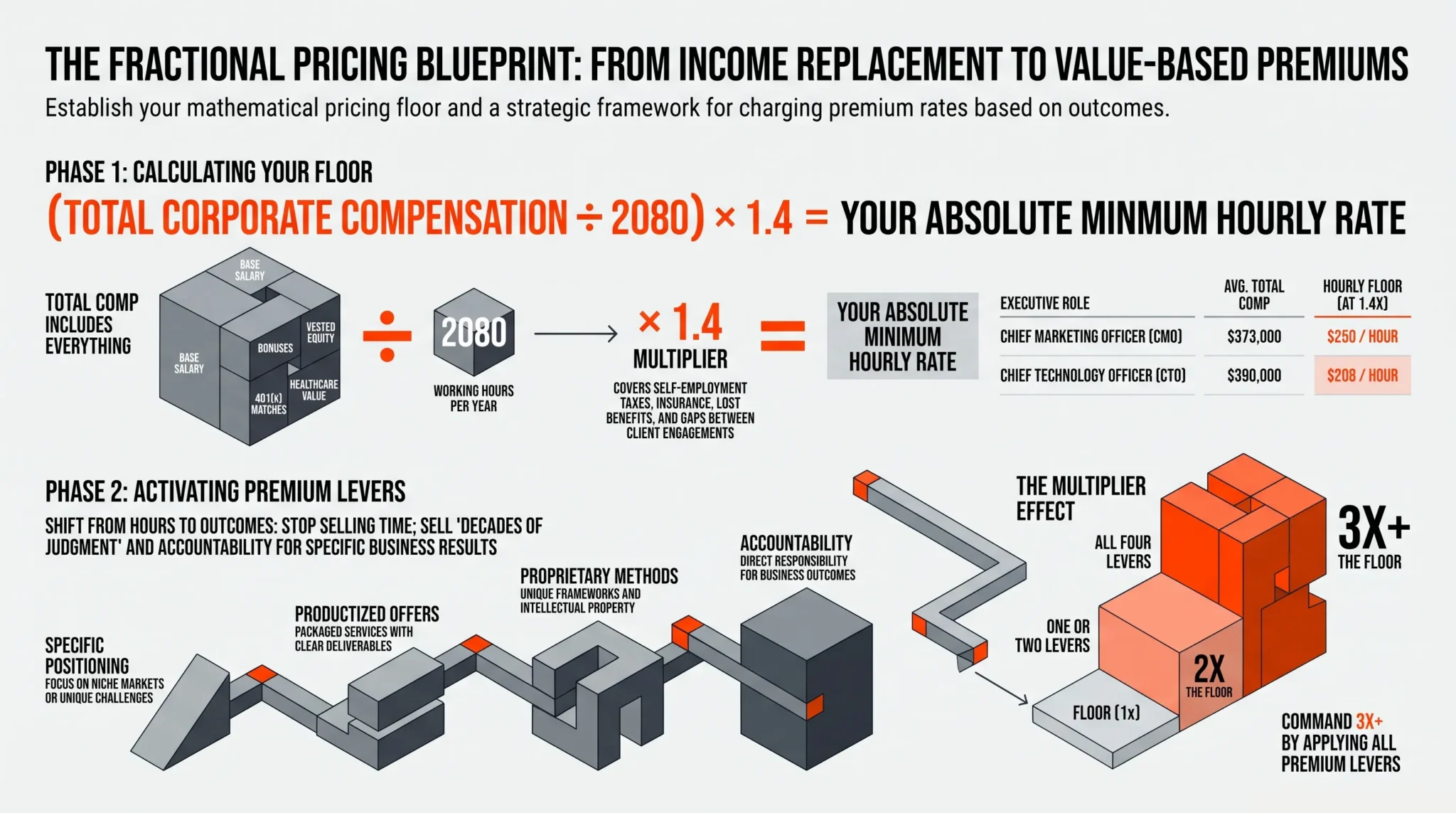
Top-tier fractional executives do not pull numbers out of thin air, nor do they charge soft hourly rates. They calculate their baseline pricing using a mathematical floor formula designed to replace full-time executive compensation. Total corporate W-2 compensation is divided by 2,080 hours and multiplied by a 1.4 baseline factor.
The 1.4 multiplier accounts for the self-employment costs that disappear when an executive leaves corporate W-2 employment: self-employment taxes, health insurance premiums, professional liability coverage, unbilled administrative time, and business overhead.
For a CMO with a market-rate corporate compensation of $373,000, this formula yields a fractional CMO hourly rate floor of $250 per hour. For a standard fractional engagement of 40 hours per month (roughly 1 day per week), the absolute baseline monthly retainer lands at $10,000 per month.
Value-Based Retainers vs. Hourly Billing
While the floor formula establishes the minimum baseline, elite fractional CMOs move beyond cost-plus math by utilizing value-based fractional CMO pricing. They justify premium retainers of $15,000 to $20,000 per month by leveraging four specific value drivers:
- Specific Positioning: Focusing on a specific industry niche (such as B2B SaaS companies scaling from $5M to $20M) rather than acting as a generalist marketing advisor.
- Productized Offers: Replacing custom proposals with clearly defined, repeatable engagements with set outcomes.
- Proprietary Methodologies: Utilizing a documented, step-by-step framework (such as the Fractional Operating System) that gives clients clarity and speed.
- Outcome Accountability: Taking direct ownership of specific revenue and pipeline targets rather than merely delivering advice.
When an executive brings these four levers to your business, a $12,000 monthly retainer represents an extraordinary bargain compared to the multi-million dollar enterprise value created by a predictable demand generation engine.
The Bottom Line: Making The Right Call For Your Growth Stage
Choosing between a full-time Chief Marketing Officer and a fractional CMO is not a matter of prestige or personal preference; it is a strategic decision dictated entirely by your current stage of corporate maturity.
If your business generates over $30 million in revenue with a massive internal team and constant operational complexity requiring 50 hours of daily executive presence, invest in a permanent full-time CMO. You have both the balance sheet capacity to absorb the $350,000+ loaded cost and the operational volume to keep that executive fully engaged.
However, if you are a growth-stage company generating between $3 million and $20 million in revenue, hiring a full-time CMO too early is an expensive, unnecessary risk. Bringing in an elite fractional CMO provides the exact same high-caliber strategic pattern recognition, demand engine architecture, and executive leadership at roughly half the cost, with zero benefit overhead and complete contract agility.
Very few scaling companies regret starting with a fractional executive to build their revenue foundation. Countless companies deeply regret saddling their balance sheet with a full-time executive hire before they were truly ready.
Step back, evaluate your 12-month strategic outcomes objectively, run the honest math on your capacity needs, and select the executive leadership structure that positions your company for sustainable, profitable growth.
Ready to Explore Fractional Leadership for Your Business?
If you are ready to evaluate whether your business is prepared for a fractional executive, join my live weekly workshop where we break down the exact frameworks for structuring high-impact executive engagements. You will learn how to audit your marketing engine, structure outcome-based retainers, and build a predictable client acquisition pipeline.
Register Today: Visit SueMysko.com or click the registration link in our newsletter to reserve your spot for this Tuesday’s live executive session.
Frequently Asked Questions: Everything CEOs Need To Know
Below are answers to the most common strategic questions founders and board members ask when evaluating fractional leadership versus full-time hires.
Question: What does a fractional CMO do on a day-to-day basis?
Answer: When founders ask what does a fractional CMO do, the answer centers on strategic ownership. A fractional CMO operates as a true C-suite peer. On a weekly basis, they establish your overarching marketing strategy, audit and optimize your customer acquisition pipelines, refine your brand messaging and market positioning, align your sales and marketing teams, manage external agency relationships, and hold your internal execution team accountable to specific revenue metrics. They attend key leadership meetings and provide board-level reporting, bringing elite pattern recognition without needing to be in your office 40 hours a week.
Question: What is the typical cost of hiring a fractional CMO compared to a full-time CMO?Answer: The full-time CMO cost ranges between $300,000 and $400,000+ per year when including base salary, bonuses, equity, health benefits, and payroll taxes. Conversely, the cost of hiring a fractional CMO ranges between $6,000 and $15,000 per month in flat retainer fees, which equals $72,000 to $180,000 per year. There are zero equity requirements, zero benefit overheads, and zero severance risks, representing a total savings of 50 to 70 percent.
Question: How does a fractional CMO hourly rate compare to a flat monthly retainer?
Answer: While some fractional CMOs calculate an internal fractional CMO hourly rate floor (typically $200 to $350 per hour), professional fractional executives do not bill by the hour. Hourly billing misaligns incentives by penalizing an executive for solving problems quickly. Instead, elite fractional CMOs work on flat monthly retainers based on scope and outcomes. This gives your business complete budget predictability while focusing the engagement entirely on high-impact business results.
Question: Can a fractional CMO effectively manage our existing internal team and external agencies?
Answer: Yes, this is one of the primary responsibilities of a fractional executive. A fractional CMO provides experienced leadership for your junior marketing staff, copywriters, graphic designers, and media buyers. They also evaluate, manage, and hold your external marketing agencies accountable, ensuring that external partners deliver actual revenue impact rather than vanity metrics.
Question: What are the main red flags that indicate our company is NOT ready for a fractional CMO?
Answer: Your company is not ready for a fractional CMO if you do not have anyone to execute the work (such as junior staff, freelancers, or an agency), or if you lack a marketing budget to run campaigns. A fractional CMO is an executive strategist and team leader, not a hands-on execution worker. If you need someone to manually write blog posts, configure email software, and design social media graphics 40 hours a week, you need an execution worker or a marketing agency, not a C-suite executive.
Question: How do we transition smoothly from a fractional CMO to a full-time CMO as we scale?Answer: The transition should be guided directly by your fractional CMO once your company achieves the revenue scale (typically $20M+ to $30M+) and operational volume to justify a full-time hire. Your fractional CMO will help build the department infrastructure, establish predictable performance metrics, define the exact full-time job role, participate in interviewing candidates, and onboard your new full-time CMO seamlessly before stepping out.