The Head-to-Head Decision Framework for Founders and CEOs
The High-Stakes Decision Point in Every Growing Business
You reach a moment in the lifecycle of your company where technology ceases to be a quiet background utility and suddenly becomes the central engine of your growth. Perhaps your software platform is buckling under an influx of new users, or your engineering team is missing critical product launch deadlines. Maybe an institutional investor is preparing to conduct technical due diligence for your next funding round, or your previous technical lead just handed in their resignation. Whatever the trigger, you suddenly realize that you cannot make another major strategic move without senior executive technical leadership.
Now you are standing directly at a high-stakes fork in the road. On one side, you can launch a lengthy executive search to hire a full-time Chief Technology Officer, committing to a permanent baseline of well over three hundred thousand dollars in annual payroll. On the other side, you can bring in a battle-tested fractional CTO on an embedded, part-time basis to install strategy, steer your engineers, and align your technology stack with your business goals.
This is one of the most consequential decisions a founder or CEO will ever make. Technology choices are notoriously slow, difficult, and expensive to reverse. Making the wrong call in either direction carries severe financial and operational costs. If you hire a full-time executive too early, you lock your business into an enormous financial liability that you cannot afford and likely cannot fully utilize. If you choose a part-time option when your scale genuinely demands a full-time leader in the building forty hours a week, you risk under-resourcing the most critical function in your company.
In this guide, I am putting both options head-to-head across six core operational dimensions: cost, speed, commitment, depth, hours, and downside risk. I will outline the concrete scenarios where each model clearly wins and show you how smart founders leverage the fractional executive model to build strategic momentum before committing to permanent W-2 headcount.
The Essential Reframe: Matching Structure to Company Stage
When founders ask me whether a full-time CTO or a fractional CTO is better, I always stop them. That is fundamentally the wrong question. Neither model is inherently superior to the other. They are completely different tools designed for completely different stages of business growth.
A full-time CTO is a permanent, fully dedicated C-suite officer who lives inside your company forty hours a week. Over multiple years, they build deep institutional knowledge of your codebase, your infrastructure, your engineering team dynamics, and your customers. They are present for every late-night system incident, every architectural discussion, and every strategic executive meeting.
A fractional CTO is a seasoned executive who brings that exact same level of pattern recognition and strategic judgment on a targeted, part-time basis. Typically operating one or two days a week on a monthly retainer, a fractional executive works with a small portfolio of companies, installing proven technical systems and making high-stakes decisions without forcing the company to carry a full-time executive payroll.
Both are legitimate C-suite executives. Both own your technology strategy, lead your developers, manage technical risk, and make crucial build-or-buy calls. The fundamental difference lies entirely in structure, overall cost, and organizational commitment. The real question you must answer is simply: which structure matches where your company is right now? When you evaluate your current revenue stage and decision volume with complete honesty, the right path becomes remarkably obvious.
Round One: The True Economics and Hidden Team Costs
A full-time Chief Technology Officer is easily one of the most expensive hires a company will ever make. According to benchmark compensation data, the baseline salary for a full-time CTO floats around three hundred and ten thousand dollars. However, that base salary is only the starting point. Once you add performance bonuses, equity grants, healthcare benefits, employer taxes, and executive search fees, the true all-in cost easily climbs past four hundred thousand dollars per year.
Yet there is a second layer of expense that most founders completely overlook during financial planning. A full-time executive does not operate in isolation. They expect a team, infrastructure, and a substantial operating budget beneath them. They will hire senior engineers, install specialized software tools, and build out an organizational hierarchy. Therefore, the true financial comparison is not merely a monthly fractional retainer versus a full-time base salary. It is a fractional retainer versus a full-time salary plus the substantial headcount overhead that executive will build around themselves.
There is also a critical structural flaw in hiring full-time too early. When you employ a full-time CTO, you are paying for forty hours of executive time every single week, regardless of whether your business actually generates forty hours of C-suite strategic work. Most companies generating under fifty million dollars in annual revenue simply do not have forty hours of executive-level technical problems to solve each week. As a result, that expensive three-hundred-thousand-dollar executive ends up spending half their week doing mid-level development or administrative management just to fill their calendar.
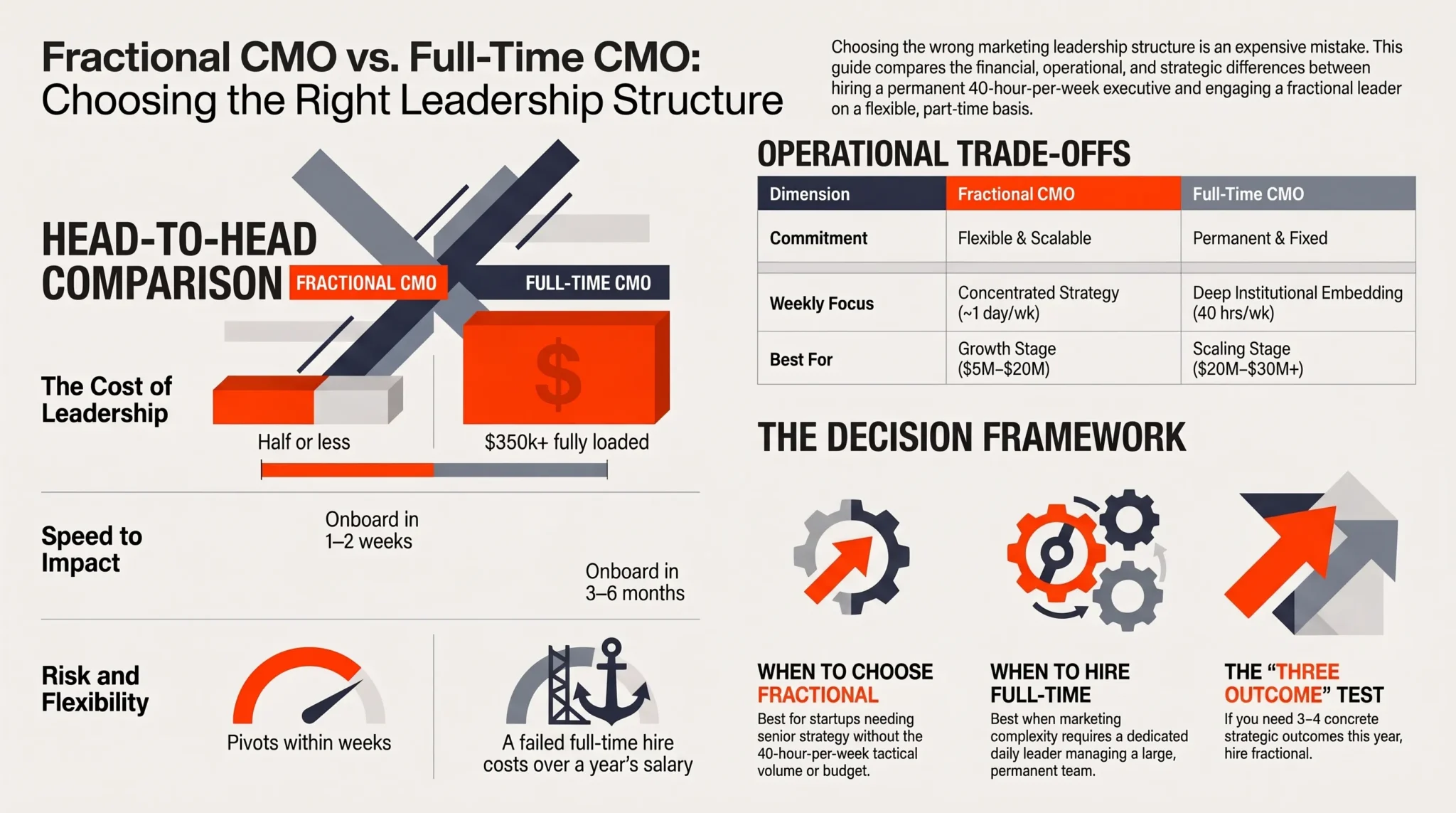
With fractional leadership, you pay exclusively for high-level judgment and strategic direction. You are not paying for physical time spent sitting in an office; you are buying executive pattern recognition that solves complex problems in a fraction of the time. This logic applies across all C-suite functions. Whether evaluating the cost of hiring a fractional CMO, assessing fractional CMO pricing, or calculating a fractional CMO hourly rate versus a fractional CTO retainer, fractional pricing decouples enterprise value from physical desk hours.

Round Two: Time to Hire, Flexibility, and Downside Risk
In the technology world, speed is often the difference between market dominance and total irrelevance. Conducting a search for a full-time CTO routinely takes between three and six months. Evaluating technical leadership is notoriously difficult for non-technical founders, making the interviewing process slow and tedious.
A fractional executive, by contrast, can be vetted and engaged in as little as one to two weeks, delivering measurable strategic impact within days of joining. If your platform is currently experiencing severe technical debt, if security compliance deadlines are looming, or if your previous technical lead suddenly departed, waiting six months for a full-time hire can inflict catastrophic damage on your business.
The difference in organizational commitment and downside risk is equally stark. A full-time executive is a permanent commitment. If your market conditions shift, if product strategy changes, or if cash runway tightens, unwinding a full-time C-suite contract is painfully expensive and culturally disruptive.
A fractional engagement is flexible by design. You can expand the scope, adjust the cadence, or end the contract cleanly without severance packages or legal friction. This inherent flexibility dramatically reduces downside risk. A failed full-time executive hire is one of the costliest mistakes a business can make. For a technical role, that cost compounds rapidly: every month spent without senior technical oversight leads to sub-optimal architectural decisions made by junior staff that will take years and hundreds of thousands of dollars to undo later.
Round Three: Institutional Depth and Long-Term Focus
This is the specific dimension where the full-time model genuinely shines and earns its premium price tag. A full-time CTO gives you total, undivided dedication. They spend forty hours a week inside your business, focusing on your vision and your challenges.
Over two or three years, a full-time CTO develops deep, irreplaceable institutional knowledge. They know the subtle quirks of your legacy codebase, the hidden personalities of your engineering team, and the historical trade-offs made during high-pressure product launches. They are present in every code review, every architectural debate, and every middle-of-the-night server incident.
A fractional CTO provides coordinated senior leadership on limited hours, balancing focus across a small portfolio of client companies. While fractional leaders excel at high-level strategy, team alignment, and vendor management, they cannot replicate the deep, day-to-day institutional context of a veteran full-time executive who has lived inside your codebase for years.
If your company is large and complex enough that technology requires a full-time leader in the building every day, managing a massive engineering organization, full-time is the correct choice. Never buy a part-time solution for a true full-time problem. However, you must be equally careful never to buy a full-time financial burden for a part-time strategic need.
The 6-Point Executive Comparison Matrix
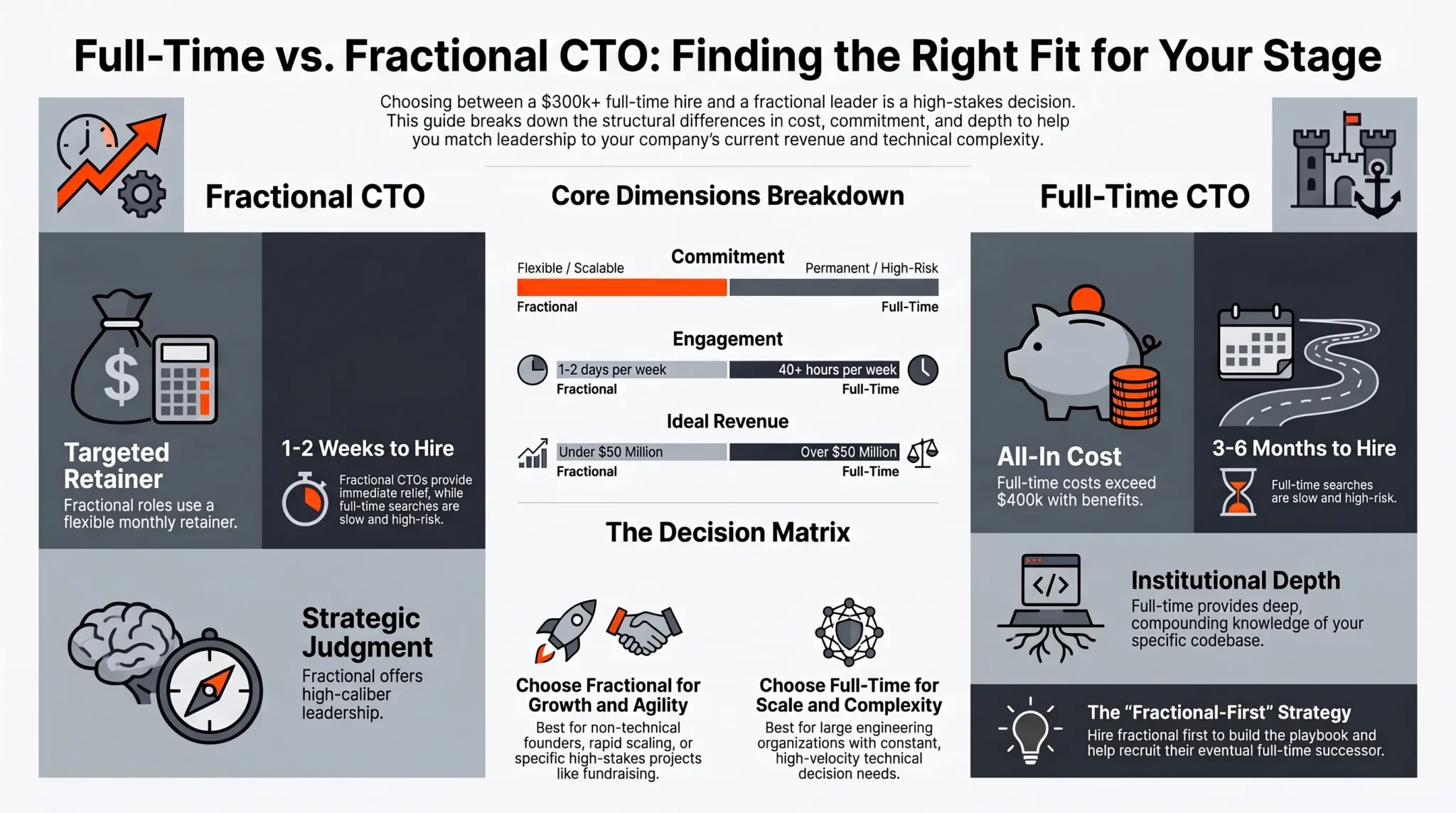
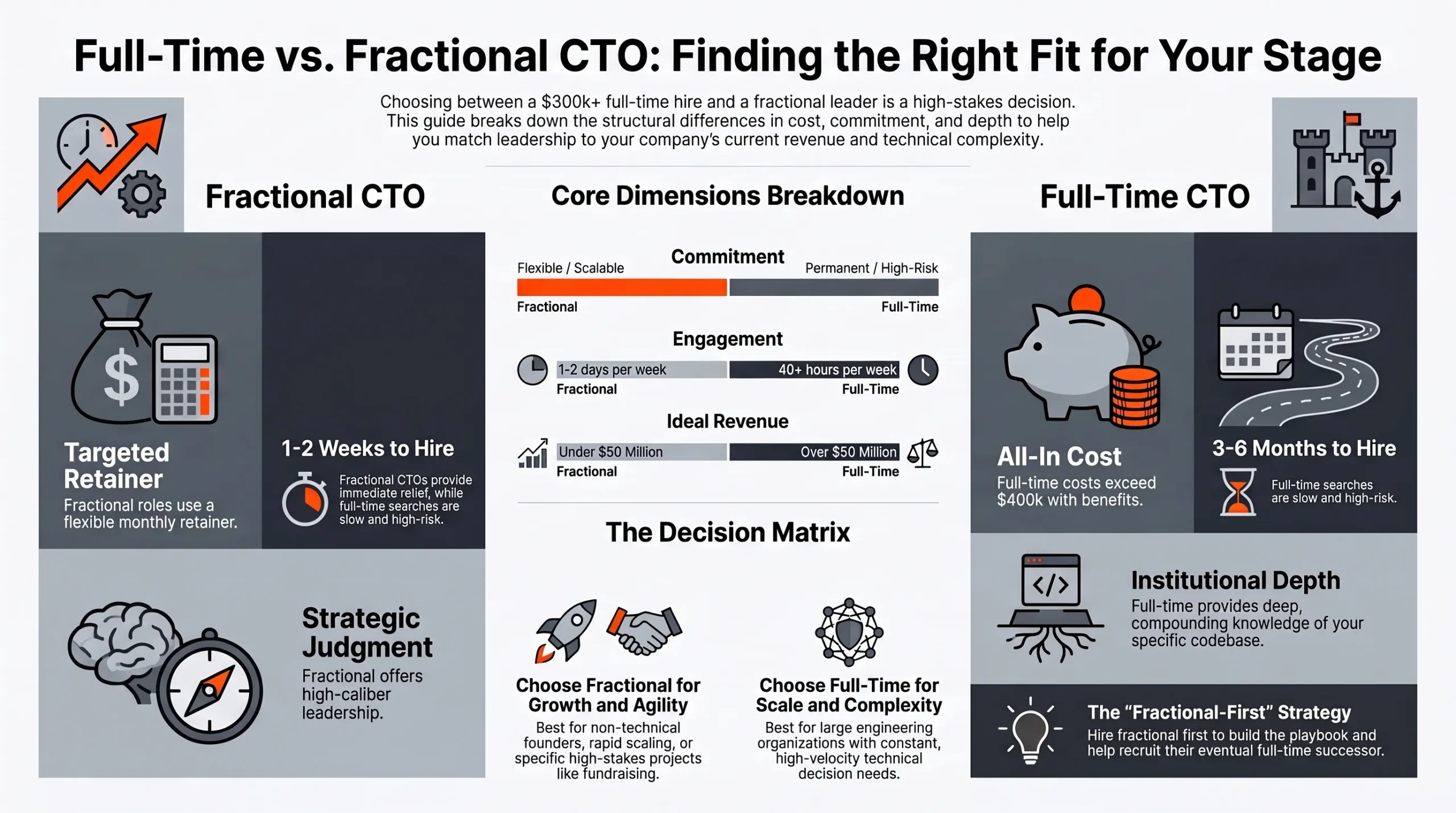
To help you evaluate these two leadership models side by side, the following table summarizes how full-time and fractional CTOs stack up across six essential business dimensions:
| Dimension | Full-Time CTO Model | Fractional CTO Model |
| Total Annual Cost | $400,000+ all-in (Salary, Equity, Benefits, Taxes) plus team overhead | Predictable monthly retainer ($5,000 to $15,000/mo) based on required cadence |
| Time to Hire | 3 to 6 months through complex executive search | 1 to 2 weeks for vetting, onboarding, and immediate impact |
| Commitment & Risk | High commitment; permanent W-2 contract; costly to unwind | Flexible monthly engagement; low risk; easily scaled up or down |
| Working Capacity | 40+ hours per week dedicated exclusively to your business | Concentrated senior executive focus 1 to 2 days per week |
| Institutional Depth | Deep, compounding knowledge of codebase, culture, and context | Focused strategic leadership, architecture oversight, and process alignment |
| Primary Value | Permanent daily operational management and team building | High-impact pattern recognition, technical roadmap, and executive direction |
Four Real-World Scenarios: Where Each Model Wins
Abstract comparisons are helpful, but practical decisions require concrete context. Here are four real-world scenarios that illustrate exactly when to hire a CTO fractional or full-time:
Scenario One: You are a non-technical founder building or scaling a product with no technical co-founder. This is the classic, textbook case for a fractional CTO. You need senior technical judgment to own product strategy, evaluate vendors, and oversee development, but you cannot justify a four-hundred-thousand-dollar payroll baseline. Fractional wins every single time.
Scenario Two: You have an active engineering team or an external agency, but no senior leader steering them. The developers are capable of writing code, but they lack strategic direction and architectural discipline. A fractional CTO steps in as the internal technical authority, establishing rigor and aligning engineering output with business objectives without full-time overhead. Fractional wins.
Scenario Three: You are scaling rapidly and your technology platform is straining under heavy load. The system architecture that worked smoothly for one hundred users is now buckling at five thousand. You need an expert architect to re-engineer your infrastructure immediately. A fractional CTO provides rapid emergency intervention, stabilizing your platform while helping you evaluate long-term technical needs. Fractional wins for speed and impact.
Scenario Four: You are past fifty million dollars in annual revenue with a massive engineering organization, complex legacy integrations, and high-velocity decision demands. Technology is your primary competitive moat. In this stage, you need a full-time Chief Technology Officer in the building every day, leading your org and building compounding institutional knowledge. Full-time wins hands down.
The Smart Founder Strategy: Start Fractional, Scale to Full-Time
One of the most effective strategies utilized by experienced founders is to hire a fractional executive first, even when their ultimate long-term goal is to employ a full-time leader.
Bringing in a fractional CTO allows you to audit your technology stack, fix immediate architectural bottlenecks, and establish clear engineering processes. The fractional leader builds the long-term technical roadmap and structures the engineering team. When your company eventually reaches the scale where a full-time hire is necessary, the fractional executive writes the exact job description, helps screen candidates, and hands over a fully operational technical playbook.
In many cases, the fractional leader even helps recruit their own full-time successor. This approach eliminates the risk of hiring a costly full-time executive into a chaotic environment. Very few companies ever regret starting with fractional leadership. Countless companies deeply regret hiring a full-time executive too soon.
The Bottom Line: Choose the Model That Matches Your Stage
Making the right executive choice comes down to assessing your current company stage, financial runway, and strategic decision volume with complete clarity. If you are past fifty million dollars in revenue with a massive engineering organization, invest in a full-time Chief Technology Officer. But if you need high-stakes technical leadership, architectural clarity, and team direction without an overwhelming financial overhead, stepping into the fractional leadership model is the smartest move you can make.
Stop overpaying for full-time executive capacity you do not yet need, and start building your technology foundation with agile, battle-tested fractional expertise.
Frequently Asked Questions for Founders and Executives
Question: How does the cost of hiring a fractional CTO compare to a full-time hire?
Answer: A full-time CTO requires an all-in financial commitment of $400,000 or more per year when accounting for base salary, bonuses, equity, benefits, employer taxes, and recruitment fees. A fractional CTO operates on a predictable monthly retainer, typically ranging between $5,000 and $15,000 per month depending on cadence and complexity. This delivers C-suite leadership at a fraction of full-time cost.
Question: How quickly can a fractional CTO start delivering strategic value?
Answer: While a full-time executive search typically takes 3 to 6 months, a fractional CTO can be vetted and onboarded in as little as 1 to 2 weeks. Because they bring pre-built frameworks and extensive pattern recognition, they often begin diagnosing architectural issues and aligning engineering teams within their first few days.
Question: Can a fractional CTO manage external development agencies and internal engineers?
Answer: Absolutely. One of the core responsibilities of a fractional CTO is serving as the authoritative technical interface between business leadership and technical execution teams. They manage external dev agencies, set quality standards for internal engineers, conduct code reviews, and ensure vendor deliverables align with corporate strategy.
Question: What does a fractional CMO do compared to a fractional CTO?
Answer: Understanding what does a fractional CMO do vs a fractional CTO comes down to business domains. Both function as embedded, part-time C-suite leaders holding outcome accountability. A fractional CMO owns customer acquisition, brand positioning, and go-to-market systems, whereas a fractional CTO owns software architecture, tech infrastructure, and product scalability. The total cost of hiring a fractional CMO and a fractional CTO combined is often less than a single full-time C-suite salary.
Question: Will institutional investors accept a fractional CTO during fundraising technical due diligence?
Answer: Yes, venture capital and private equity investors frequently prefer seeing a seasoned fractional CTO overseeing technology strategy rather than a junior lead developer attempting to answer executive-level questions. A veteran fractional leader provides investors with confidence that technology risks are actively managed.
Question: How many hours per week does a fractional CTO typically work with a company?Answer: Most fractional engagements are structured around outcomes and cadence rather than hourly tracking, typically translating to 8 to 16 hours per week (1 to 2 dedicated days). This provides sufficient bandwidth to lead strategic meetings, guide architecture, and mentor team members without paying for unneeded full-time hours.
Question: What happens when our company outgrows a fractional CTO?
Answer: A great fractional CTO will explicitly prepare your business for that transition. As your company scales past $50M in revenue or expands its engineering org significantly, the fractional CTO will help define the full-time role, participate in recruiting their successor, and execute a seamless handoff of the technology playbook.